










By Financial Markets Desk
Published October 14
Main Facts
The global cryptocurrency market suffered a sharp contraction on Wednesday, shedding nearly 0.7% of its total capitalization to settle at $2.8 trillion. The downturn was catalyzed by the release of a hotter-than-expected U.S. Consumer Price Index (CPI) report for September, which injected renewed anxiety into traditional financial and digital asset markets alike.
- Bitcoin (BTC) retreated 1.5% over the 24-hour trading window, slipping to $82,142 and testing crucial technical support thresholds.
- Altcoins Suffered Deeper Losses: Ethereum (ETH) dropped 2.8% to change hands at $2,440; Solana (SOL) fell 1.9%; and XRP slid 1.3%.
- Inflation Metrics Outpaced Estimates: Headline CPI rose 0.6% month-over-month, bringing the annual inflation rate to 3.7%—exceeding economists’ consensus forecasts of 3.6% and accelerating from August’s 3.8% (revised context). Core CPI, which excludes volatile food and energy components, printed at 2.6% annually, topping the 2.5% projection.
- Derivatives Wiped Out: The sudden drop triggered a wave of leveraged liquidations, totaling over $281 million across the crypto derivatives ecosystem within a 24-hour window. The vast majority of these liquidations hit long positions held by bullish traders.
Chronology: The Anatomy of a Market Correction
The sequence of events leading to Wednesday’s crypto market sell-off unfolded rapidly across global economic and digital asset exchanges:

- Early Morning (Pre-Release): Markets traded with cautious optimism. Bitcoin had spent the previous days consolidating within the Fibonacci "golden zone" around the low-$83,000s, recovering from earlier seasonal jitters. Traders maintained moderate leverage, anticipating a cooling inflation print that might prompt the Federal Reserve to pause its tightening cycle.
- 8:30 AM EST (The BLS Data Drop): The U.S. Bureau of Labor Statistics published the September CPI report. The headline figure of 3.7% immediately rattled interest rate markets. Within minutes, gasoline prices—which surged 9.1% in a single month due to prolonged crude oil pressures above $90 a barrel—were identified as the primary driver behind the surprise spike.
- 9:00 AM – 11:00 AM EST (Yields Surge & Equities React): Traditional financial markets reacted violently. The 2-year U.S. Treasury yield climbed 10 basis points to 4.9%, while the 10-year yield touched 5.3%, hovering near 24-year highs. Major stock indices slumped in tandem: the S&P 500 fell 0.6%, and the Nasdaq retreated 0.8%.
- Midday (The Crypto Liquidation Cascade): As macroeconomic pressure mounted and the U.S. dollar strengthened, digital asset prices broke below local intraday supports. Automated margin calls on major derivatives exchanges triggered a cascading series of liquidations. More than $281 million in positions were forcibly closed, with heavy concentrations occurring in a compressed four-hour window as long positions unwound.
- Late Afternoon: Bitcoin stabilized temporarily near $82,211, holding inside its daily technical support band, while analysts scrambled to reprice upcoming Federal Reserve policy actions.
Supporting Data and Market Metrics
The depth of Wednesday’s correction can be contextualized through a blend of macroeconomic indicators, derivatives data, and technical analysis metrics.
Macroeconomic Pressures
The resurgence of inflationary pressures is intrinsically tied to global commodity markets. Sustained crude oil trading above $90 per barrel over the preceding two months—exacerbated by geopolitical tensions involving the U.S. and Iran—has systematically increased shipping, manufacturing, and energy overhead. Consequently, core inflation continues to prove sticky, particularly in service sectors like rent and airfares, challenging the Federal Reserve’s journey back to its 2% target.
Fixed Income and Rate Probabilities
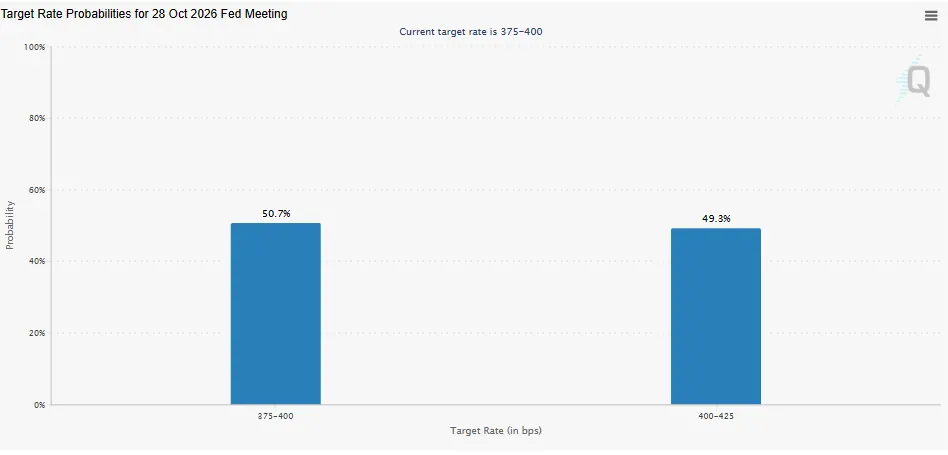
According to the CME FedWatch Tool, market pricing shifted dramatically following the CPI release. The implied probability of a Federal Reserve rate hike at the upcoming October 27–28 policy meeting surged from roughly 22% to between 44% and 49%. This recalibration reflects a growing consensus on Wall Street that the central bank may need to extend its benchmark rate hikes beyond the current 3.75%–4.00% target range established in September.
Derivatives and Leverage Dynamics
The crypto market’s structural reliance on leverage amplified the downward momentum. Coinglass data confirmed that over $281 million was wiped out in derivatives liquidations. Because retail and institutional traders frequently utilize high leverage to capture upside volatility in assets like Bitcoin and Ethereum, a sudden breach of technical support levels automatically converts standing buy orders into forced market sell orders, compounding the downward velocity.
Technical Outlook for Bitcoin
From a charting perspective, Bitcoin’s daily metrics present a nuanced battleground between bulls and bears:
- Trend Strength & Momentum: The 50-day moving average remains above the 200-day moving average, signaling that the broader macro uptrend is technically intact. The Average Directional Index (ADX) sits at 27.7—down slightly from 29.9 on Tuesday—indicating that while trend momentum is cooling, buyers retain a modest structural advantage. Meanwhile, the Relative Strength Index (RSI) dipped to 48.7, hovering just beneath the neutral 50 threshold.
- Volatility Contraction: The Squeeze Momentum Indicator has flashed red for eight consecutive sessions, signaling compressed volatility and foreshadowing an imminent explosive directional move. Its current reading of -0.76 leans slightly bearish.
- Key Levels to Watch: On the downside, a daily candlestick close below $81,603 would invalidate the Fibonacci golden zone, opening the door toward swing lows at $80,365 and the critical trend band near $80,284. A failure of these supports risks exposing deeper retracements down to $78,003. Conversely, bulls must reclaim $84,245 to build momentum toward upside resistance targets at $85,301, $86,644, and the monthly high of $87,422.
Official Responses and Stakeholder Commentary
While central bank officials maintain a data-dependent stance ahead of the late-October meeting, financial analysts and market makers have been vocal about the changing macro landscape.
- Fixed Income Strategists: Wall Street analysts note that the yield environment presents a generational hurdle for alternative asset classes. With 10-year Treasury yields pushing 5.3%—offering risk-free returns backed by the U.S. government—capital allocation models are shifting. "Investors are no longer incentivized to chase speculative risk when cash and short-duration government paper yield over 5% with zero counterparty risk," noted one macro strategist.
- Crypto Market Analysts: Digital asset commentators emphasize that Bitcoin’s correlation with macroeconomic liquidity remains exceptionally high. Despite long-term narratives positioning BTC as an inflation hedge, its short-to-medium-term price action continues to behave like a high-beta technology stock sensitive to real interest rates and liquidity contractions.
Implications for Investors and the Broader Economy
The intersection of sticky inflation, aggressive monetary tightening, and high-beta asset volatility carries several profound implications for the remainder of the fourth quarter:
- The Opportunity Cost of Capital: As risk-free yields climb, capital flows into the cryptocurrency ecosystem face stiffer competition. Institutional allocators are increasingly forced to weigh the asymmetric upside of digital assets against guaranteed double-digit yields available in traditional fixed-income instruments.
- Short-Term Volatility Warnings: Traders operating with high leverage remain acutely vulnerable to macroeconomic data surprises. With the Producer Price Index (PPI) scheduled for release on Thursday and the Federal Reserve rate decision looming on October 28, intraday volatility is expected to remain elevated.
- Decoupling vs. Correlation: Wednesday’s synchronized drop across Bitcoin, Ethereum, the S&P 500, and the Nasdaq underscores that crypto has not yet decoupled from broader macroeconomic cycles. Until global liquidity conditions ease or inflation prints consistently trend downward toward central bank targets, digital asset rallies will likely continue to face heavy macro headwinds.
Disclaimer: The views, information, and opinions expressed in this article are for informational purposes only and do not constitute financial, investment, or trading advice. Readers should conduct their own research and consult with a licensed financial advisor before making any investment decisions.