










In a landscape dominated by Silicon Valley titans and proprietary walled gardens, Beijing-based artificial intelligence lab Z.ai has sent shockwaves through the global tech ecosystem. On June 16, the company unveiled GLM-5.2, a massive 744-billion-parameter model that not only rivals the performance of Western industry leaders but does so using a technological pipeline entirely free from American silicon.
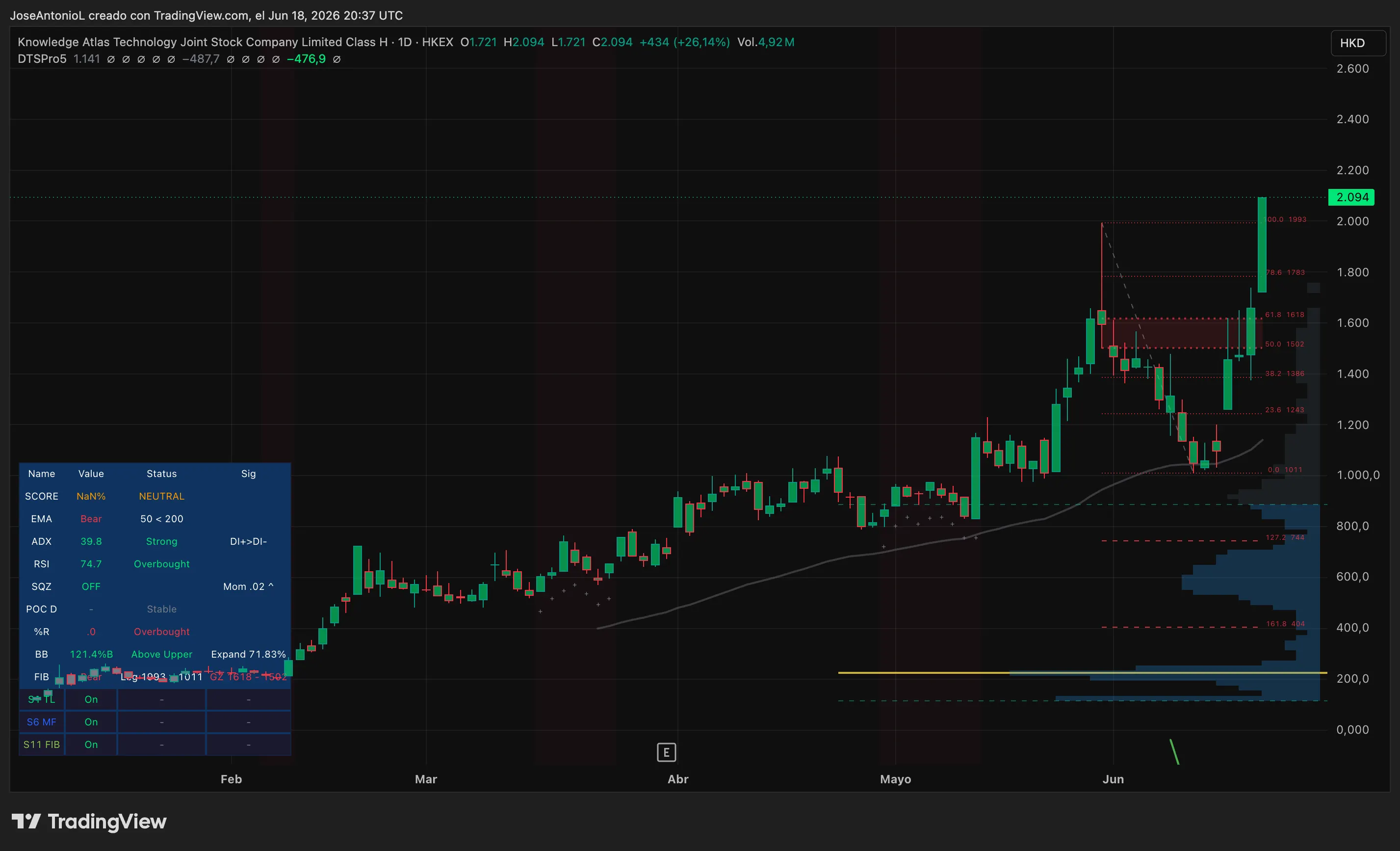
The launch marks a pivotal moment in the ongoing "AI Cold War," occurring at a time of heightened scrutiny regarding U.S. export controls and the accessibility of advanced compute resources. As Z.ai’s stock surges to record highs—a 90% rally over the past week—the industry is forced to confront a new reality: the "American-only" hegemony in frontier AI development is rapidly eroding.
Main Facts: A New Benchmark for Open-Source Intelligence
GLM-5.2 is a "Mixture-of-Experts" (MoE) model, a architecture that allows the system to route queries through specific, specialized neural pathways rather than activating its entire 744-billion-parameter weight set for every task. This design choice contributes to its remarkable efficiency.
Perhaps most striking is its infrastructure. While Western labs like Anthropic and OpenAI remain tethered to the latest Nvidia H100 and B200 clusters, Z.ai has leveraged Huawei’s Ascend Atlas server architecture. This hardware independence is not merely a logistical feat; it is a statement of strategic autonomy. With an MIT license, the model is fully open-source, ensuring that once the weights are downloaded, no government directive or corporate policy can revoke access.
The model boasts a native 1-million-token context window—a fivefold increase over its predecessor, GLM-5.1. This allows the model to ingest, analyze, and manipulate massive codebases or entire technical libraries in a single pass, effectively removing the need for the "chunking" strategies that have historically plagued long-form AI reasoning.
Chronology: From Entity List to Market Dominance
The trajectory of Z.ai has been defined by rapid, often defiant, acceleration:

- January 2025: The U.S. Department of Commerce adds Z.ai to the Entity List, citing national security concerns and restricting its access to advanced U.S.-manufactured semiconductors.
- Early 2026: Z.ai demonstrates its resilience by announcing it has successfully trained high-fidelity image generation models using exclusively domestic Chinese hardware.
- June 10, 2026: Regulatory pressure mounts as the U.S. moves to restrict Anthropic’s "Fable" model, citing safety and proliferation concerns. The resulting market volatility creates a vacuum in the high-performance AI sector.
- June 16, 2026: Z.ai officially releases GLM-5.2.
- June 18-20, 2026: Following a series of independent benchmarks, global developers flock to the model. Z.ai’s stock hits an all-time high, fueled by investor confidence in the lab’s ability to bypass Western supply chain constraints.
Supporting Data: By the Numbers
The performance metrics for GLM-5.2 are not just competitive; in specific domains, they are industry-leading.
The FrontierSWE Benchmark
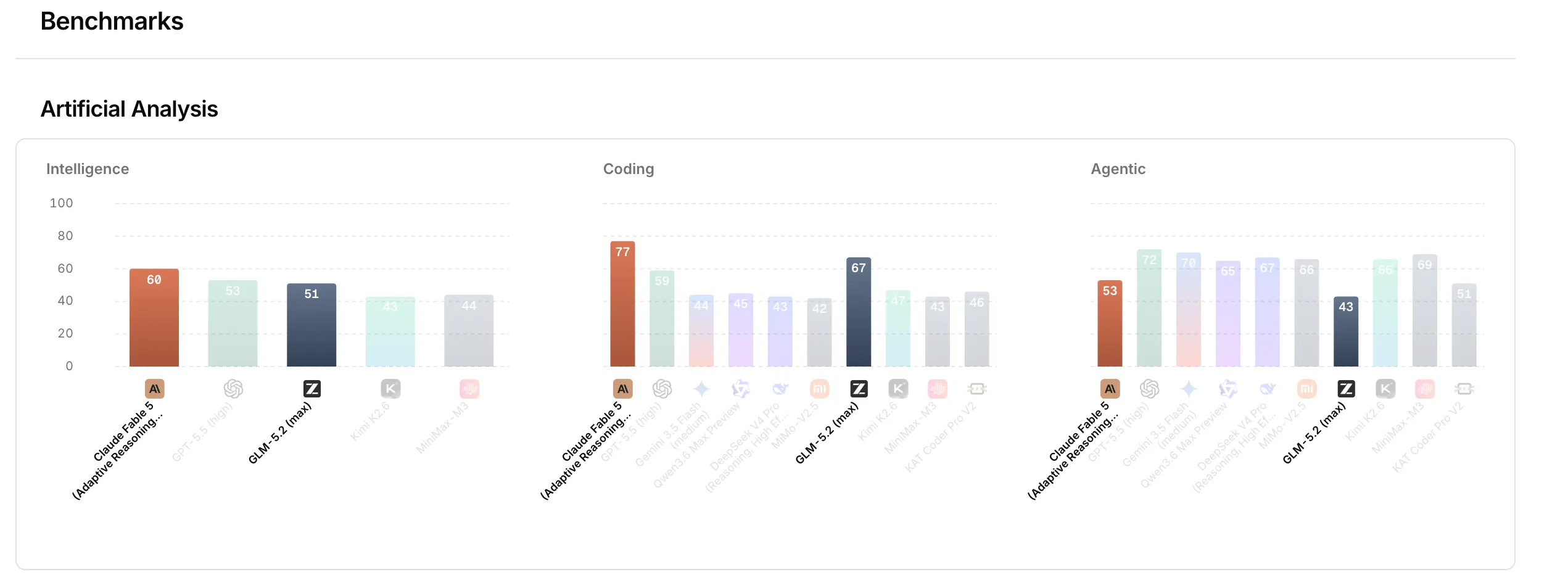
On the FrontierSWE benchmark, which evaluates the ability of an AI agent to perform open-ended, complex technical tasks—including system optimization and large-scale software engineering—GLM-5.2 achieved a dominance score of 74.4. For context, Claude Opus 4.8 currently sits at 75.1, while GPT-5.5 lags at 72.6.
SWE-bench Pro
In the more specialized arena of autonomous resolution of real-world GitHub issues, GLM-5.2 outperformed the competition, achieving a 62.1% pass rate, compared to 58.6% for GPT-5.5. This represents a significant leap from GLM-5.1, which scored 58.4%.
Economic Efficiency
The training costs provide the most compelling argument for Z.ai’s model. Emad Mostaque, founder of Stability AI, estimates that the total training cost for GLM-5.2 hovered around $25 million—a fraction of the billion-dollar price tags associated with Western frontier models. Approximately 80% of this cost was directed toward post-training, suggesting that with the right hardware-software co-optimization, the barriers to entry for training state-of-the-art models are falling faster than many analysts anticipated.
Official Responses and Developer Adoption
The developer community has responded with enthusiasm, particularly regarding the model’s accessibility. Unsloth AI has already released 2-bit GGUF quantizations, compressing the model from a massive 1.51TB footprint down to 238GB. While this still requires a high-end workstation—specifically one equipped with 256GB of unified memory or a high-VRAM GPU setup—it brings "frontier-class" intelligence into the realm of local, on-premise hardware.
"The shift is in the workflow," says one lead developer at a major open-source collective. "When you can run a 744B MoE model that handles a million tokens on your own hardware without needing to ping a U.S.-based API, you change the nature of data sovereignty."
Z.ai has not commented extensively on the geopolitical implications of their release, choosing instead to focus on the technical merits. Their official statement emphasizes the "democratization of agentic workflows," highlighting the model’s ability to handle multi-file refactors and long-range agentic pipelines as a "fundamental shift for the global software development community."
Implications: The End of the Compute Monopoly?
The success of GLM-5.2 carries profound implications for the global AI race:
1. The Myth of the Hardware Ceiling
For years, the consensus among Western analysts was that China would be unable to produce competitive frontier models without access to Nvidia’s flagship H-series chips. GLM-5.2 effectively dismantles this argument. By proving that the Ascend Atlas ecosystem is sufficient for top-tier training, Z.ai has signaled to other global players that they can build their own "sovereign AI" stacks.
2. The Price War
With API pricing set at $1.40 per million input tokens and $4.40 per million output, Z.ai is undercutting the dominant Western providers by a massive margin. Claude Opus 4.8, by comparison, charges $5 and $25 respectively. This price discrepancy will likely force Western labs to rethink their monetization strategies or risk losing the massive, price-sensitive developer market to international competitors.
3. The "Agentic" Shift
GLM-5.2’s performance in game state generation and complex coding tasks highlights a shift in what users want from AI. We are moving away from "chatbots" that provide static answers and toward "agents" that can manipulate environments, create diverse scenarios, and manage long-term projects. The fact that GLM-5.2 excels in "zero-shot" diversity—creating varied outcomes without needing extensive prompting—makes it a preferred tool for developers building autonomous systems.
4. A New Regulatory Dilemma
For Western regulators, the release of GLM-5.2 creates a "whack-a-mole" problem. If the U.S. bans specific tools or companies, but a highly capable, open-source, and hardware-independent model remains available, the effectiveness of export controls is severely diluted. The MIT-licensed nature of GLM-5.2 means that once the model is "in the wild," it cannot be pulled back.
Conclusion
GLM-5.2 is more than just a new model; it is a litmus test for the future of AI. It represents the first time that a non-Western lab has produced a model capable of standing toe-to-toe with the best of Silicon Valley while operating entirely outside the U.S. technical orbit.
As developers, researchers, and corporations weigh the benefits of this new, lower-cost, high-performance alternative, the "frontier" of AI is no longer a singular line drawn in California. It is now a global, fragmented, and fiercely competitive landscape where the barriers to entry are collapsing—and where the most powerful tools may soon come from places previously thought to be locked out of the race.
For now, the world is watching as GLM-5.2 is integrated into everything from coding assistants to experimental gaming, and one thing is clear: the era of the AI monopoly is officially over.