








In a rapidly shifting landscape where artificial intelligence providers have spent the last two years locked in a "capabilities war," Elon Musk’s SpaceXAI has signaled a pivot in strategy. With the Wednesday release of Grok 4.5, the company is betting that the future of enterprise AI lies not in achieving absolute frontier supremacy, but in mastering the economics of utility.
This release marks the first major product launch since the definitive merger between SpaceX and xAI in February, a consolidation that has provided Musk’s AI venture with unprecedented access to the colossal compute resources of the Colossus supercomputer in Memphis. As SpaceX moves to finalize its $60 billion acquisition of the AI-integrated code editor Cursor, Grok 4.5 arrives as a specialized tool tailored for the "knowledge worker"—a demographic spanning from high-level software engineers at Tesla to legal teams navigating complex contract negotiations.
The Strategic Pivot: Speed and Cost as a Competitive Edge
For months, the industry narrative has been dominated by the quest for the most intelligent, reasoning-capable model. However, Grok 4.5 arrives with a different value proposition. SpaceXAI is explicitly positioning the model as a cost-efficient alternative to the market leaders.
At a price point of $2 per million input tokens and $6 per million output, Grok 4.5 undercuts the current industry gold standards. For comparison, Anthropic’s flagship Claude Opus 4.8 commands $5 per million input tokens and $25 per million output. Meanwhile, OpenAI’s newly launched GPT 5.6 Sol—which arrived on the same day as Grok 4.5—is priced at $5 and $30 respectively.
Musk, ever the pragmatist regarding the "compute-to-capability" ratio, clarified the model’s standing in the current hierarchy via a series of posts on X. He described Grok 4.5 as "roughly comparable to Opus 4.7, but much faster." While this candid assessment acknowledges that the model is not the absolute frontier leader—a title currently held by the formidable Claude Fable 5—it highlights a deliberate engineering tradeoff: prioritizing throughput and affordability over raw, unoptimized capability.
Chronology of a High-Stakes Merger
The release of Grok 4.5 is the culmination of a frantic six-month period of corporate restructuring and infrastructure scaling.
- February 2026: The merger between SpaceX and xAI is finalized, centralizing Musk’s massive capital investments under one corporate roof.
- March – May 2026: The Colossus supercomputer in Memphis reaches full capacity, utilizing over 200,000 Nvidia GB300 GPUs. This massive hardware footprint becomes the engine for training the new iteration of Grok.
- June 2026: SpaceX announces its intention to acquire Cursor, a leading AI-native code editor, for $60 billion, sparking debate over the future of the software development ecosystem.
- July 8, 2026: SpaceXAI launches Grok 4.5, coinciding with the release of OpenAI’s GPT 5.6 Sol.
The integration of Cursor is not merely a distribution play; it is a foundational training component. Grok 4.5 was trained using proprietary developer session data from Cursor, including debugging traces and granular code-edit histories. This shift from static repository training to dynamic, session-based learning is intended to give the model a more "human-like" grasp of how professional software development actually unfolds in real-time.
Benchmarks: A Mixed Bag of Performance
When evaluating the model’s technical merit, the data reveals a nuanced picture. SpaceXAI published four key benchmark results at launch, underscoring both the model’s strengths and its limitations relative to its peers.
Software Engineering Performance
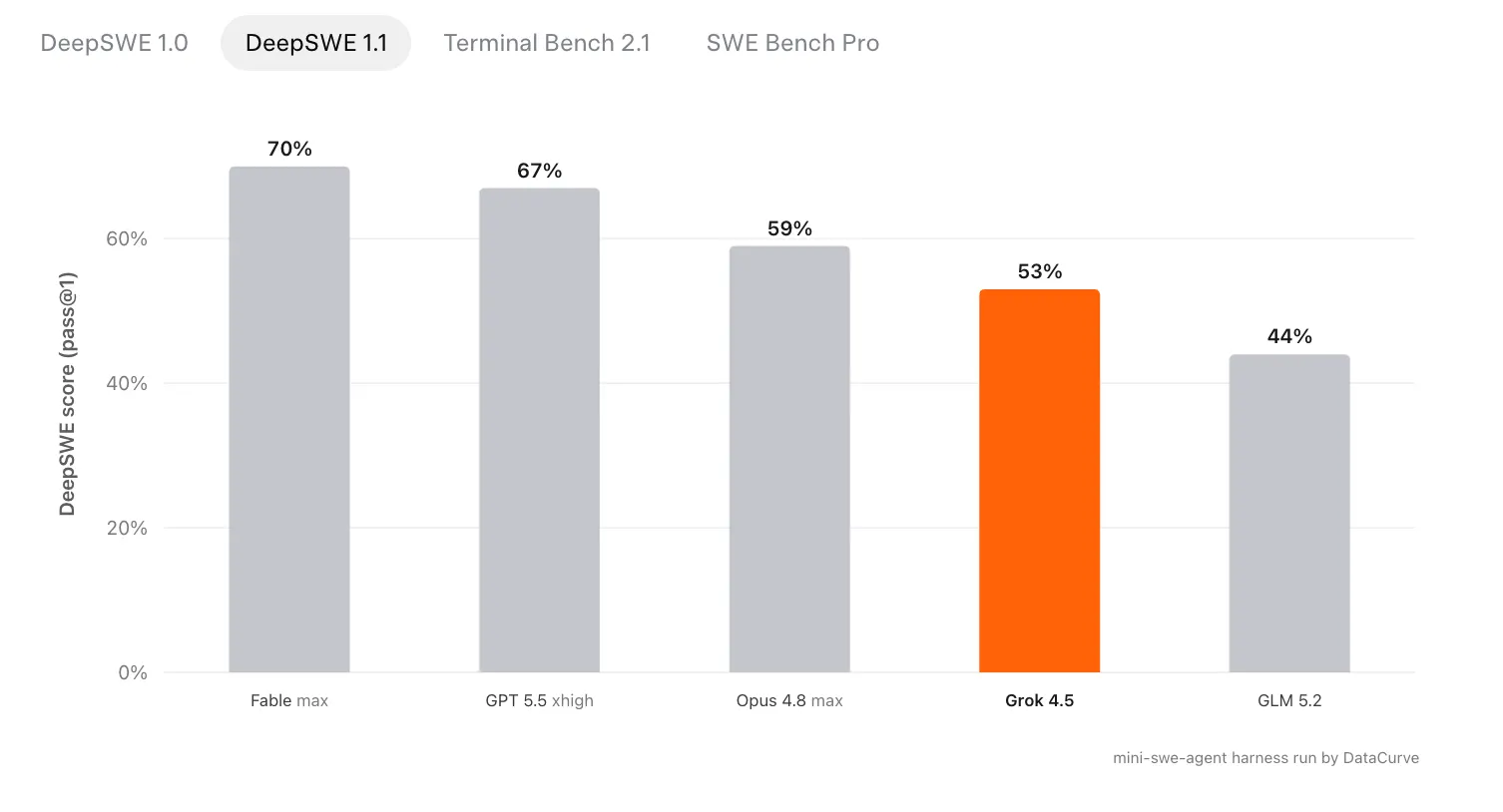
The model’s performance on DeepSWE 1.1—a benchmark measuring the ability to resolve real-world software bugs—saw Grok 4.5 score 53%. While respectable, it trails behind Claude Opus 4.8 (59%), GPT 5.5 (67%), and the industry-leading Claude Fable 5 (70%).
However, on the SWE Bench Pro—a broader test of software engineering problem-solving—Grok 4.5 demonstrated significant resilience, posting a 64.7% success rate. This score allowed it to outperform GPT 5.5’s 58.6%, though it still fell short of the 69.2% achieved by Opus 4.8 and the staggering 80.4% from Fable 5.
It is worth noting that SpaceXAI chose to compare their model against the older GPT 5.5 rather than the newly released 5.6. The company argued that the rapid release cycle of competitors makes direct benchmarking a "moving target," though critics suggest this was a tactical choice to frame Grok 4.5 in a more favorable light.
The Efficiency Math: Why It Matters
The most compelling argument for Grok 4.5 is not found in the leaderboard, but in the efficiency metrics. In high-volume enterprise environments, the "cost per successful task" is often more critical than the "model accuracy percentage."
On SWE Bench Pro tasks, Grok 4.5 required an average of 15,954 output tokens to reach a successful resolution. In contrast, Claude Opus 4.8 required 67,020 tokens for the same workload—a 4.2x disparity in consumption. When this efficiency is compounded with the lower cost-per-token, the economic argument for enterprises becomes clear: companies can run four to five times as many iterations of a task with Grok 4.5 for the same financial outlay as using a premium model.
Furthermore, with a processing speed of 80 tokens per second, the model enters the realm of "low-latency" AI, making it ideal for real-time applications such as IDE autocomplete, live coding assistance, and rapid-response data analysis for finance teams building complex Excel models.
Official Responses and Regulatory Scrutiny
The launch has drawn immediate attention from regulators and industry observers. As Musk has previously admitted in court, xAI’s training practices—specifically the use of third-party data and models—have been under close scrutiny. With the pending acquisition of Cursor, the integration of user-session data into the training pipeline is likely to ignite further debates regarding data privacy and intellectual property rights in the age of AI-augmented development.
"We are building a tool that works the way engineers work," a representative from the SpaceXAI team stated during a press briefing. "By focusing on developer sessions rather than just static libraries, we are capturing the intent, the errors, and the corrections that define modern engineering."
Despite the technical ambition, the rollout has not been without its hiccups. Early third-party testing has yielded mixed results; while the model performs adequately on simple coding tasks, it has been described as "underwhelming" for creative writing and complex narrative generation. This reinforces the company’s assertion that Grok 4.5 is a utility tool, not a creative generalist.
Implications: A New Era for Enterprise AI?
The arrival of Grok 4.5 marks a significant shift in the AI industry’s trajectory. For the past two years, the focus has been on the "frontier"—the elusive quest for Artificial General Intelligence (AGI). SpaceXAI is now pivoting toward "AI operationalization," focusing on the economics of integration.
The implications for the developer community are profound. If the industry shifts toward models that are "good enough" but exponentially cheaper and faster, the barrier to entry for AI-driven software development will drop significantly. Startups, independent developers, and resource-constrained enterprise teams will likely favor models like Grok 4.5, which allow for a high frequency of experimentation without the prohibitive costs associated with "frontier" models.
For European users, the model remains an upcoming arrival, with a scheduled launch in the EU region set for mid-July. As it stands, the model is currently accessible via API, on Hermes, and through the Grok platform, offering a generous context window of half a million tokens—roughly 400,000 words.
Ultimately, Grok 4.5 is a testament to the reality of the current hardware climate. Even with the world’s most powerful compute cluster at its disposal, SpaceXAI has recognized that the market doesn’t always need the "smartest" model; often, it needs the most efficient one. As the AI arms race continues, the battle for the enterprise desktop may be won not by the model that scores highest on a benchmark, but by the one that provides the best ROI for the working professional.