







Introduction: A Diplomatic Gesture or a Tactical Necessity?
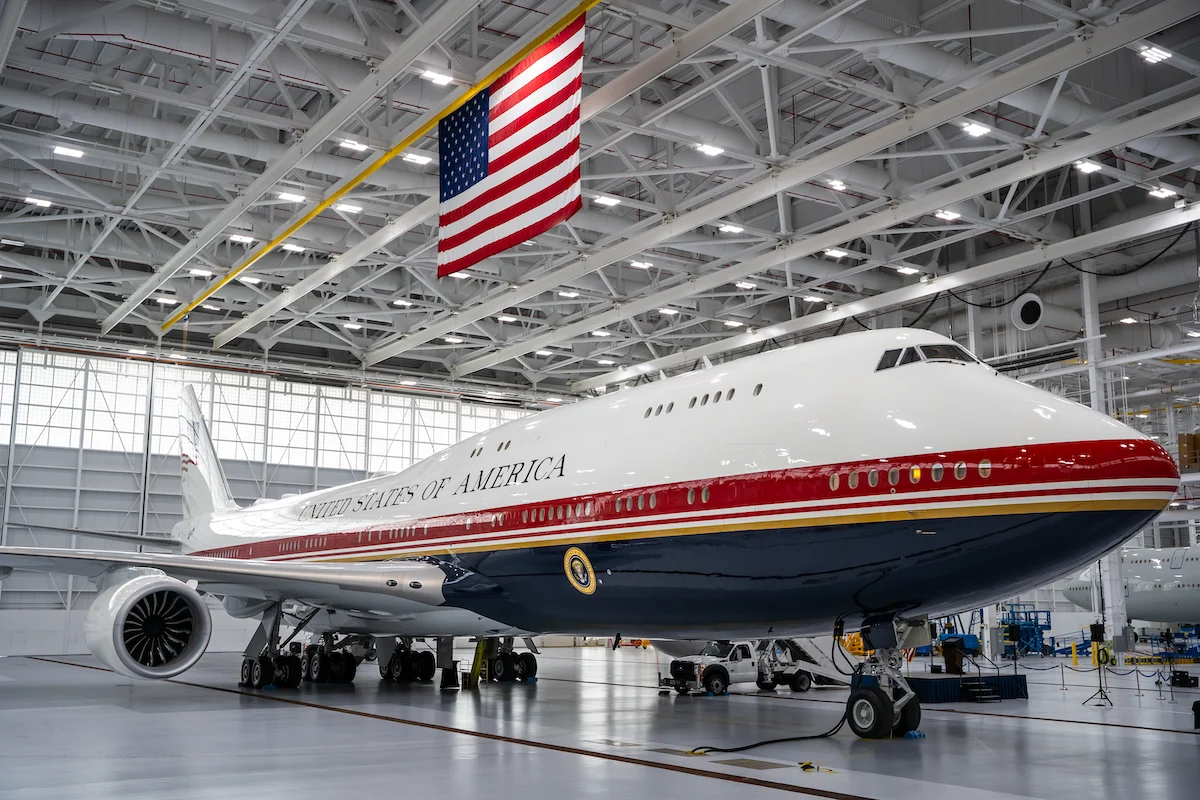
In a move that has drawn both praise from supporters and sharp skepticism from aviation experts, President Trump recently announced a split-itinerary for his return flight from a high-stakes NATO summit in Turkey. The President, who recently took delivery of a controversial, ultra-luxury Boeing aircraft gifted by the State of Qatar, stated he would be leaving the "new" Air Force One at Mildenhall Air Force Base in the United Kingdom.
The stated intent? To allow military personnel stationed in the UK a rare, firsthand opportunity to tour what the White House describes as the most sophisticated, luxurious, and "properly representative" aircraft in the world. However, as the President prepares to board the aging, battle-hardened VC-25—the traditional Air Force One—for the final leg of his journey back to Washington, observers are questioning whether this "selfless" act of morale-building is, in fact, a calculated response to glaring security vulnerabilities.
The Genesis of the "Flying Palace"
The aircraft in question, a Boeing 747-8 repurposed as a VIP transport, has been a lightning rod for controversy since its inception. Originally a gift from the Qatari government, the plane underwent a rapid, high-cost retrofit, reportedly exceeding $400 million in taxpayer funding to bring its interior up to presidential standards.
President Trump has frequently touted the plane as a "flying White House," characterized by an interior design that emphasizes opulence and comfort, which he claims is necessary to project American strength on the global stage. Unlike the official Boeing 747-8s currently being modified by the U.S. Air Force—a project that has been plagued by multi-year delays and massive cost overruns—the "Qatari jet" was rushed into service in under a year.
This truncated development timeline is the crux of the current debate. While the official Air Force One replacement program prioritizes the integration of hardened military-grade communication suites, anti-missile defense systems, and nuclear-survivability shielding, the "gifted" jet lacks the rigorous, multi-year testing cycle typically required for the President’s primary mode of transport.
Chronology of a Controversial Transition
To understand the current tension, one must look at the timeline of the President’s frustration with the standard Air Force One replacement program.
- 2023-2024: President Trump expresses public irritation regarding the delays and ballooning budgets associated with the official Air Force One program. He characterizes the existing fleet as "outdated" and "embarrassing."
- Early 2026: The arrival of the "Qatari gift" is announced. The aircraft is quickly rebranded and retrofitted to meet the President’s aesthetic requirements.
- Mid-2026: The aircraft enters service. The President begins using it for domestic and short-range international travel.
- July 2026 (The Turkey Summit): Tensions in the Middle East escalate as the ceasefire with Iran collapses. During this summit, the President announces that the "new" Air Force One will be diverted to the UK for a military tour, while he returns to the U.S. on the legacy aircraft.
Security Implications: Style vs. Substance
The heart of the concern lies in the distinction between a "luxury transport" and a "Head of State aircraft." The traditional Air Force One (the VC-25A) is essentially a flying fortress. It is designed to function as a command-and-control center during a national emergency, capable of mid-air refueling and equipped with sophisticated electronic warfare suites designed to jam enemy radar and neutralize incoming threats.
Independent aviation analysts and intelligence observers, such as Andrew Feinberg, have pointed out that the rushed "new" jet likely lacks these integrated self-defense capabilities. While the plane is perfectly suited for domestic hops between Washington and Mar-a-Lago, the operational risk profile shifts dramatically when the flight path traverses or approaches regions of active conflict—such as the airspace currently affected by the breakdown of the Iran ceasefire.
By opting to take the legacy aircraft from Turkey to the UK, the President is effectively choosing a platform with proven, robust defensive systems over a platform that, while visually spectacular, remains a "soft target" in a hostile theater of operation.

Official Rhetoric vs. Operational Reality
The White House has maintained a narrative of military appreciation. In his social media posts, President Trump framed the decision as a moral imperative:
"To honor our brave men and women of the Military, we are sending the brand new, and truly spectacular, Air Force One to Mildenhall Air Force Base… for old time’s sake, we’ll be taking the former Air Force One, from Turkey to Mildenhall."
However, the disconnect between this narrative and the technical realities of the aircraft is palpable. If the "new" Air Force One is indeed the pinnacle of American technology, as the administration claims, it should, in theory, be the safest option for the President. The fact that the President is distancing himself from the new jet precisely when flying out of a volatile region suggests that the "gift" is not considered safe enough for high-threat environments.
Economic and Strategic Consequences
The implications of this situation are twofold: financial and strategic.
Financially, the public is left wondering about the long-term utility of the $400 million spent on retrofitting the Qatari plane. If the aircraft is restricted to "safe" air corridors, it becomes a secondary asset rather than a primary tool of the executive branch. This raises questions about whether the funds could have been better directed toward accelerating the official, hardened Air Force One program, which is currently stalled.
Strategically, the reliance on the legacy VC-25 highlights the precarious state of the current presidential fleet. The legacy planes are aging rapidly, with maintenance costs rising every year. By relying on a hybrid fleet—one for luxury and one for security—the administration is essentially admitting that they have not yet achieved the capability to replace the original fleet with a modern, equally capable successor.
Conclusion: The Road Ahead
As the "flying palace" makes its rounds at military bases in the UK, it serves as a stark reminder of the tension between political branding and operational security. The aircraft is undoubtedly a marvel of comfort, but in the world of presidential security, substance must always outweigh style.
As the conflict with Iran continues to evolve, we can likely expect more "sacrificial" tours of the new plane. Every time the President needs to traverse a sensitive region, the limitations of the "Qatari gift" will become more apparent. For now, the administration seems content to play both sides of the coin: touting the luxury of the new jet while quietly relying on the proven, hardened security of the old one. Whether this strategy will hold up under the scrutiny of the American public and the demands of future geopolitical crises remains to be seen.
One thing is certain: the "Flying Palace" is a testament to a unique, and perhaps problematic, era in the history of the most famous aircraft in the world.