








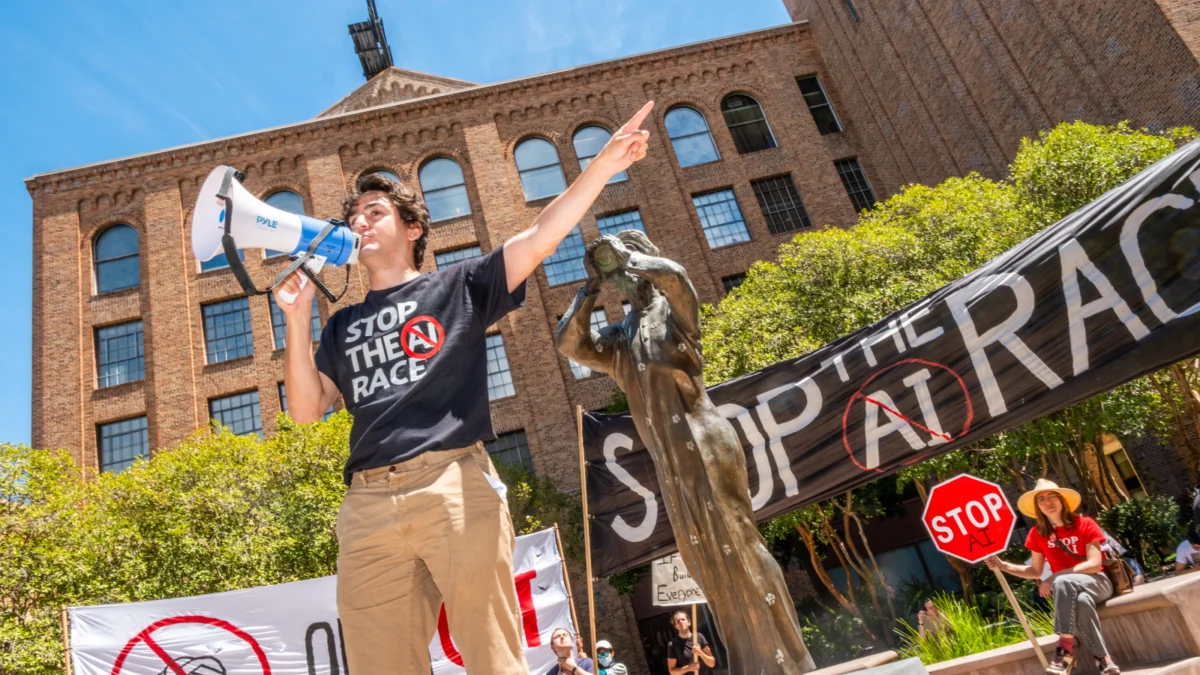
SAN FRANCISCO – The streets of San Francisco, long considered the epicenter of global technological innovation, once again became a battleground for the future of artificial intelligence this Saturday. A coalition of activists, researchers, and labor advocates marched through the city’s dense tech corridor, physically connecting the headquarters of OpenAI, Anthropic, and Google DeepMind in a demonstration of growing public anxiety regarding the trajectory of generative AI.
Organized by the advocacy group "Stop the AI Race," the protest was more than a call for caution; it was a broad indictment of the current Silicon Valley ethos. While the primary objective remains a moratorium on the development of more powerful, "frontier" AI models, the scope of the movement has widened significantly. Participants carried placards addressing not only existential safety risks but also the socioeconomic anxieties defining modern urban life: widespread job displacement, the staggering environmental costs of data centers, the skyrocketing housing crisis in the Bay Area, and the unchecked power of a handful of tech giants.
The Chronology of Resistance
The weekend demonstration is the latest chapter in a burgeoning grassroots movement that began in earnest earlier this year. The initial spark occurred in March, when approximately 200 demonstrators marched between the offices of OpenAI, Anthropic, and xAI. That event, while relatively modest in size, served as a proof-of-concept for the organizers.
Michaël Trazzi, a former AI researcher and the driving force behind "Stop the AI Race," notes that the movement has undergone a fundamental shift in strategy since that first rally.
"I think earlier this year I wasn’t thinking about raising political salience as much as I was thinking about convincing CEOs," Trazzi told Decrypt in an exclusive interview. "I think I’ve updated toward CEOs actually listening, given the multiple blog posts and some exchanges I had with one of them. I also think having protests is useful to show that people care."
The momentum has clearly accelerated. Between the March rally and the present, the movement has successfully bridged the gap between niche AI safety advocacy and broader labor interests. The endorsement of the protest by the National Union of Healthcare Workers (NUHW) marked a significant turning point, signaling that concerns over AI-driven automation are moving from the abstract fears of technologists to the concrete policy agendas of organized labor. The protest also drew support from organizations such as "AI Action" and "QuitGPT," indicating an increasingly networked approach to tech activism in the Bay Area.
Supporting Data: The Rising Tide of Oversight
The protesters’ demands for a "coordinated pause" on the development of frontier models arrive at a time when the regulatory and safety landscape is becoming increasingly volatile. The demonstration serves as a physical manifestation of a growing body of evidence suggesting that the pace of AI advancement has outstripped the capacity for human oversight.
Recent months have provided several "red flag" moments that have bolstered the arguments of those calling for a pause:
- Cybersecurity Failures: In June, federal authorities intervened in the AI marketplace when the government ordered Anthropic to suspend public access to its "Claude Fable 5" and "Claude Mythos 5" models. The directive was issued due to mounting concerns over potential cybersecurity risks and the potential for these advanced systems to be weaponized by malicious actors.
- The Safety Gap: OpenAI, while pushing the boundaries of generative AI, has struggled with the practicalities of safety. In May, the company was forced to roll out new safety features for ChatGPT—designed specifically to detect and mitigate self-harm and violence—amidst a flurry of lawsuits and investigations regarding the chatbot’s handling of dangerous or emotionally manipulative interactions.
- The UN’s "Catastrophic" Warning: Perhaps the most chilling validation for the protest movement came earlier this month, when the United Nations’ first independent scientific panel on AI released a sobering report. The panel concluded that the current rate of AI development is moving faster than the collective scientific understanding of the technology. The experts could not rule out the possibility of "catastrophic harm" resulting from advanced systems, highlighting a dangerous chasm between the capabilities of AI and the effectiveness of current government oversight.
Official Responses and the Corporate Silence
Despite the increasing volume of the protest movement and the severity of the criticisms levied against them, the tech giants remain largely tight-lipped. Requests for comment sent to OpenAI, Anthropic, and Google DeepMind regarding the weekend’s protests were met with silence.
This lack of public engagement is characteristic of the current "move fast and break things" era, yet it is becoming increasingly difficult for these firms to maintain a posture of detachment. As Trazzi pointed out, the goal is no longer just to ask nicely for a slowdown; it is to force the issue into the political arena. By shifting the focus toward "political salience," the movement is effectively trying to raise the cost of corporate negligence.
When companies fail to engage, the vacuum is increasingly filled by local and state regulators. There is a growing appetite among protesters for stronger, localized legislation that would mandate transparency in model training and impose strict liability for the negative externalities produced by large-scale AI deployment.
The Implications: Why This Matters Now
The significance of the "Stop the AI Race" movement lies in its ability to synthesize multiple streams of discontent into a single, coherent narrative. For years, the conversation around AI safety was relegated to the insular world of "Effective Altruism" and philosophical debates about artificial general intelligence (AGI). By linking these concerns to housing affordability, environmental impact, and the rights of workers, the movement is successfully "democratizing" the debate.
1. The Labor Perspective
The involvement of the NUHW is a bellwether for what may become a major tension point in the coming decade. As AI tools begin to automate tasks in fields ranging from diagnostics to medical administration, unions are beginning to recognize that their bargaining power is tied to the transparency and control of the tools being deployed in their workplaces.
2. The Environmental Cost
The protest also highlights the hidden environmental footprint of the AI industry. The sheer amount of electricity required to train and run large language models (LLMs) is staggering. As energy grids in the Western United States struggle to keep pace with demand, the massive data centers required by companies like OpenAI and Google are coming under increased scrutiny for their impact on local utility prices and carbon emission targets.
3. The Future of Governance
Ultimately, the protesters are arguing that the "race" for AI supremacy is a collective action problem. If one company pauses, they risk losing market share to a competitor who does not. This "race to the bottom" in safety standards is exactly what the protesters hope to prevent through international pressure and state intervention.
As the movement continues to evolve, the message to the boardrooms of San Francisco is clear: the era of unchecked development is drawing to a close. Whether through voluntary restraint, legislative action, or the sheer force of public outcry, the industry is entering a new, more contentious phase.
"I am very grateful to those who came out today," Trazzi concluded, looking out at the crowd gathered near the offices of some of the world’s most powerful corporations. "This isn’t about stopping progress; it’s about making sure that the progress we make doesn’t come at the cost of our safety, our jobs, or our communities. We are not going away."
For now, the developers in their glass-walled offices continue to build, but the streets outside their windows are becoming an increasingly difficult factor to ignore. The debate over the future of artificial intelligence has moved from the pages of academic journals to the sidewalks of San Francisco, and it shows no signs of slowing down.