









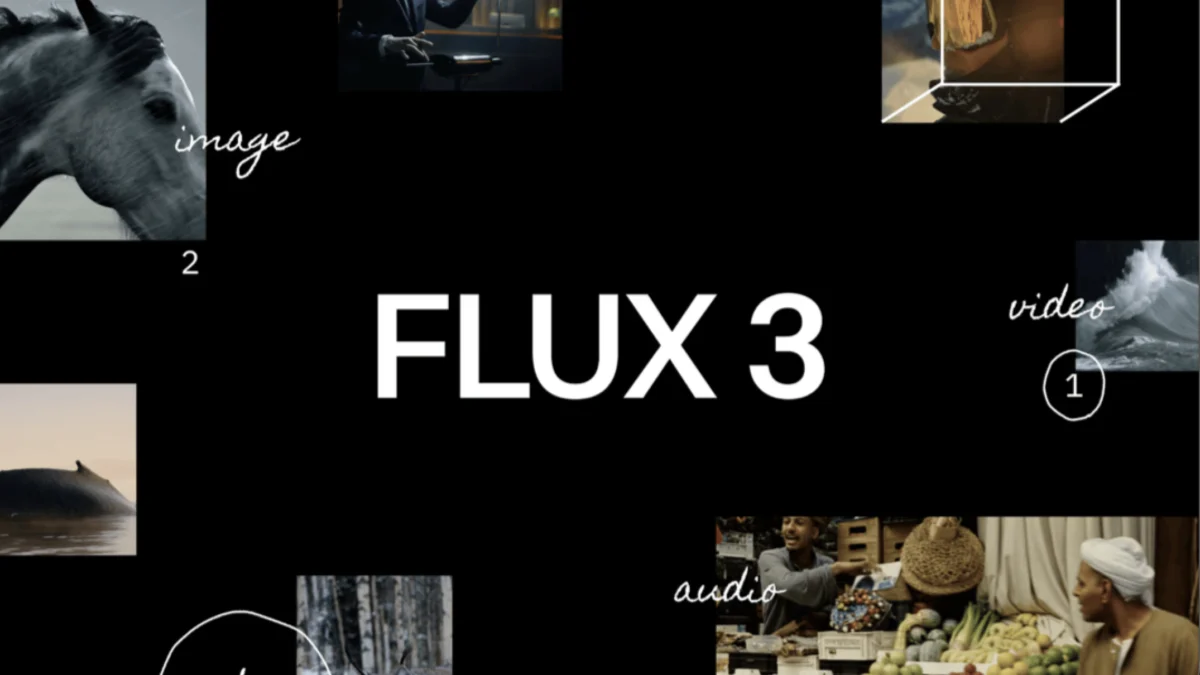
Black Forest Labs (BFL), the German AI powerhouse that redefined the landscape of generative imagery, officially ushered in a new era this Thursday with the unveiling of FLUX 3. Marking a pivotal shift in the company’s trajectory, FLUX 3 represents the firm’s inaugural foray into video generation. However, this is not merely a "text-to-video" tool; it is a fundamental architectural leap. By training a single model on a unified corpus of images, video, and audio, Black Forest Labs has achieved true multimodality, moving away from the industry standard of "bolting on" separate tools to achieve complex results.
The launch of FLUX 3 is more than a product update; it is a statement of intent from a team that has consistently disrupted the status quo. With this release, BFL is signaling that the future of artificial intelligence lies not just in the creation of pixels, but in the understanding of the physical world—a philosophy that extends beyond the digital canvas and directly into the realm of robotics.
The Technical Evolution: From Pixels to Physics
At the heart of FLUX 3 lies a sophisticated, unified architecture. While competitors often rely on disparate models—one for visual generation, another for audio synthesis, and a third for motion consistency—BFL has synthesized these inputs into one cohesive system.
The video generation capabilities are the immediate headline. FLUX 3 is capable of rendering high-fidelity clips of up to 20 seconds, featuring audio that is generated natively alongside the visuals. This ensures that dialogue, ambient noise, and complex sound effects are not just added in post-production, but are inherently synced to the action occurring on screen.
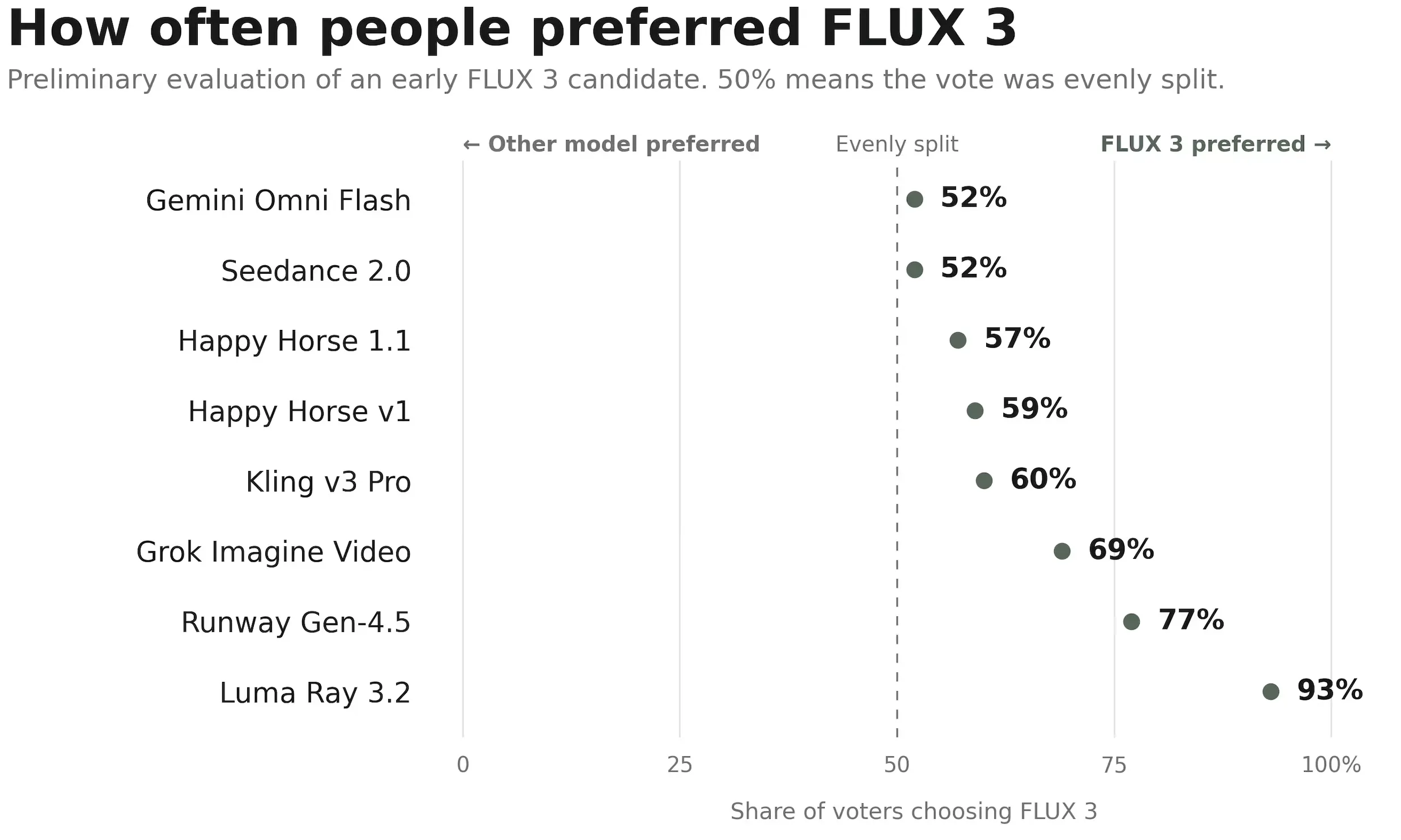
According to preliminary internal evaluations, the performance is striking. In head-to-head human preference tests, FLUX 3 outperformed Runway Gen-4.5 in 77% of comparisons and dominated Luma Ray 3.2 with a 93% win rate. When pitted against industry heavyweights like Gemini Omni and Seedance, FLUX 3 secured a victory in 52% of assessments. While these metrics rely on human subjective preference rather than a fixed, objective rubric, they underscore a clear trend: BFL’s latest iteration has vaulted to the top of the competitive leaderboard.
A Chronology of Disruption: The Rise of Black Forest Labs
To understand the magnitude of the FLUX 3 release, one must look at the rapid ascent of Black Forest Labs. Founded in August 2024 by a cadre of veteran researchers—many of whom were instrumental in the development of the original Stable Diffusion models at Stability AI—the company was born out of a desire to reclaim the high ground of generative art.
- Late 2024: BFL launches the original FLUX line, which immediately garnered critical acclaim for its photorealism and prompt adherence, effectively overshadowing both MidJourney and the then-underwhelming Stable Diffusion 3.
- October 2024: The release of FLUX 1.1 Pro solidified BFL’s dominance, topping the Artificial Analysis image arena. While the community clamored for more, the company pivoted to a closed-source, professional-grade model.
- November 2025: BFL released FLUX.2. Despite the anticipation, the model struggled to gain the same cultural cachet as its predecessor. Simultaneously, the open-source community shifted its attention elsewhere, specifically to Alibaba’s Z-Image Turbo, which offered high-quality generation on consumer-grade hardware.
- July 2026: The unveiling of FLUX 3 marks the company’s definitive comeback. By returning to their roots of groundbreaking innovation, BFL has once again shifted the conversation away from incremental improvements and toward fundamental shifts in AI architecture.
Beyond Content: The "FLUX-mimic" Breakthrough
Perhaps the most profound aspect of the FLUX 3 launch is not the video generation, but the "hidden" capability that drives it: an internal understanding of the physical world.
"A model that only learns images can only generate images," said co-founder and CEO Robin Rombach. The company’s core thesis is that by forcing a model to predict the motion, weight, and timing inherent in video, the AI necessarily learns the physics of reality. To demonstrate this, BFL introduced FLUX-mimic, a project developed in collaboration with Zurich-based robotics firm, mimic.
FLUX-mimic utilizes the video-prediction engine of FLUX 3 and integrates a lightweight "decoder"—a specialized component that translates the model’s latent understanding of movement into instructions for physical hardware. This is currently being tested by automotive giant Audi for complex manufacturing tasks, such as fitting flexible door seals—a notoriously difficult task for traditional, rigid automation systems.
Official Responses and Industry Implications
The collaboration between BFL and Audi serves as a litmus test for the viability of generative models in industrial settings. Christoph Schneider, representing Audi, noted that the integration of these models has allowed their robotics to "solve complex soft-body manipulation work" that previously required human intervention or complex, brittle programming.
The response time of the system is equally impressive. BFL reports that the full processing loop—from perception to action—occurs in approximately 101 milliseconds. This latency is roughly equivalent to human visual reflexes, a benchmark that is essential for real-time interaction in factory settings or unpredictable environments.
However, the commercial release strategy has sparked debate. Currently, the video and action capabilities are restricted to early access via APIs and select enterprise partners. The image generation component is slated for a staggered release "in the coming weeks," and the open-weight "Dev" version—the only iteration intended for local, unrestricted use—is not scheduled until later in 2026. This reflects a shift in BFL’s strategy, mirroring the industry-wide trend of prioritizing enterprise stability and safety before broad open-source distribution.
Implications: The Future of Embodied AI
The implications of FLUX 3 extend far beyond the creative arts. We are witnessing the birth of a new category of "World Models." By treating the world as a video to be predicted, AI developers are creating systems that possess an intuitive grasp of causality.
If FLUX 3 can simulate a cloth folding or a door seal being applied with human-like precision, it implies that the model has successfully internalized the physical constraints of our environment. This has massive downstream effects for:
- Manufacturing: As demonstrated by Audi, the ability to automate "soft-body" tasks will fundamentally change assembly lines, moving from hard-coded robots to adaptive agents.
- Simulation and Training: High-fidelity video generation combined with physical understanding allows for the creation of near-perfect synthetic training environments for autonomous vehicles and humanoid robots.
- Creative Media: The ability to generate synced, high-quality audio and video will further commoditize video production, lowering the barrier to entry for filmmakers and content creators while simultaneously raising the standard for "AI-generated" content.
As the industry digests the announcement of FLUX 3, the focus will undoubtedly shift toward the pending open-weight release. For the community that championed the original FLUX, the wait for the 2026 local version will be a defining period. If BFL can maintain its lead in the "AI arena" while successfully executing its vision for industrial robotics, it will not just be the king of AI art—it will be the architect of the physical AI revolution.
In the final analysis, Black Forest Labs has succeeded where many others have faltered: they have successfully pivoted from being a generator of aesthetic illusions to a creator of functional, world-aware intelligence. Whether FLUX 3 will hold its title against the next wave of competition remains to be seen, but one thing is certain: the era of static, text-to-image models is drawing to a close, and the era of active, world-predicting AI has begun.