








For decades, the traditional gas tax has served as the financial backbone of American infrastructure, acting as a direct user fee intended to charge motorists precisely for the privilege of driving on government-maintained roads. However, a complex web of state excise taxes, local levies, and aggressive new environmental regulations has drastically altered the cost of filling up a tank.
Compounded by broader economic pressures, supply chain disruptions driven by geopolitical conflict, the rise of electric vehicles, and persistent inflation, the traditional per-gallon gas tax model is showing profound cracks. As lawmakers from coast to coast grapple with declining transportation revenues, the entire philosophy of how the United States funds its roads is undergoing a monumental transformation.
Main Facts: The Anatomy of the Modern Fuel Tax Burden
The financial burden drivers face at the pump is rarely a single, uniform charge. Instead, it is an aggregation of federal excise taxes, state-level per-gallon excises, wholesale gross receipts taxes, and localized county or municipal fees.
At its core, a gas tax is designed to function as a user fee rather than a broad-based tax. This structure attributes the costs of government services—namely highway construction and maintenance—directly to those who benefit from them, sparing non-drivers from footing the bill through general income or sales taxes.
However, the application of these fees varies wildly across the country. States utilize different mechanisms to collect fuel revenue, ranging from flat per-gallon excise taxes to variable rates tied to the wholesale price of fuel. Furthermore, an increasing number of states are layering environmental policies—such as cap-and-trade systems, carbon pricing, and clean fuel standards—onto motor fuels. While these programs are engineered to alter consumer behavior and lower carbon emissions rather than fund asphalt and bridges, their economic impact is inevitably passed down to motorists at the pump, significantly widening the disparity in fuel costs between states.
Chronology: Recent Policy Shifts and Regulatory Implementation
The regulatory landscape governing American motor fuels has accelerated rapidly over the last several years, introducing new costs and structural changes:
- July 1, 2025: California officially implements a more stringent amendment to its Low Carbon Fuel Standard (LCFS), intensifying regulatory pressure on fuel suppliers and driving up projected compliance costs.
- April 2026: New Mexico formally begins the implementation of its Clean Transportation Fuel Program, initiating a framework designed to phase in carbon-crediting mechanisms that will inevitably affect retail fuel prices.
- Mid-2026: Ongoing geopolitical conflicts involving Iran continue to restrict global petroleum supply, elevating crude oil prices and translating into higher baseline fuel costs for American consumers. At the same time, regional cap-and-invest auctions, such as those linked under Washington’s Climate Commitment Act, demonstrate shifting carbon credit costs that directly influence state fuel markets.
- Current Outlook (2026): Lawmakers nationwide continue to weigh temporary "gas tax holidays" to combat high prices at the pump, even as transportation economists warn against the long-term structural damage such gimmicks inflict on highway trust funds. Concurrently, states rapidly expand alternative fee structures—such as special registration fees for electric vehicles (EVs) and pilot programs for Vehicle Miles Traveled (VMT) taxes—to offset eroding fuel tax revenues.
Supporting Data: State-by-State Disparities and Market Realities
The total tax burden on gasoline—inclusive of state excises, local additions, and environmental compliance costs—creates a striking geographic divide across the United States.
Highest Gas Tax States
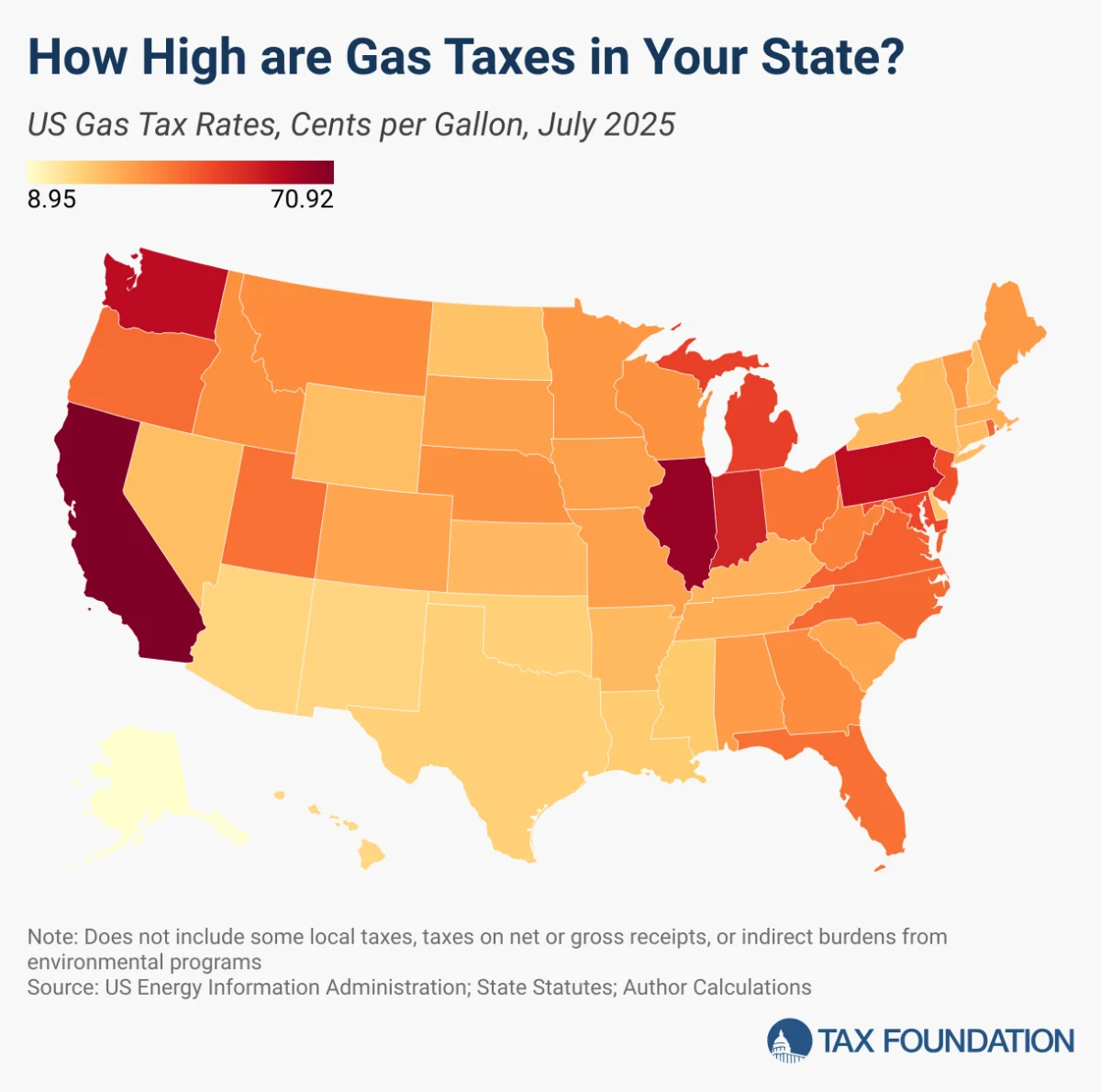
According to baseline tax data, California levies the highest direct tax on gasoline in the nation at 73.6 cents per gallon (cpg). When factoring in the state’s aggressive environmental programs—such as the cap-and-trade system and the Low Carbon Fuel Standard—the total direct and regulatory burden on a gallon of California gasoline climbs to an estimated $1.156 per gallon.
- Illinois follows closely behind with a state gas tax burden of 70.4 cpg.
- Indiana ranks third, levying 63.1 cpg through a structure that adjusts dynamically based on the average wholesale price of fuel (ad valorem taxation).
Lowest Gas Tax States
Conversely, drivers in other regions enjoy significantly lower baseline tax rates:
- Alaska maintains the lowest gas tax in the country at 8.95 cpg.
- Hawaii registers the second lowest at 18.5 cpg at the state level, though local county additions can alter this picture dramatically.
- New Mexico rounds out the lowest three at 18.9 cpg (prior to the full integration of its newer clean fuel mandates).
The Impact of Local Additions
While many states preempt local governments from levying independent fuel taxes, others permit municipal or county charges that drastically compound the motorist’s burden.
- In Hawaii, local county taxes outpace the state excise, adding up to an extra 24 cpg for drivers in Maui.
- In Nevada, Regional Transportation Commission Fuel Revenue Indexing leads to massive localized surcharges: drivers in Clark County face total local-level impacts of 39.8 cpg, while those in Washoe County face an astonishing 67.8 cpg—surpassing the state-level tax rates of all but the highest-taxed states in the union.
Environmental Program Projections vs. Realities
Quantifying the exact marginal impact of environmental policies on per-gallon prices remains a contentious exercise. State environmental agencies frequently project modest price impacts, whereas independent economic analyses often warn of much higher consumer costs.
- In Washington, the Department of Ecology estimates that the Clean Fuel Standard adds roughly 7.2 cpg, while the cap-and-invest program adds between 5.16 and 15.5 cpg.
- In Oregon, the Department of Environmental Quality estimated that its Clean Fuels Program increased gas prices by approximately 9.35 cpg, with more aggressive programs like the Climate Protection Program facing intense legal scrutiny and public debate over their long-term economic toll.
Official Responses and Stakeholder Perspectives
The convergence of high global oil prices, state environmental mandates, and crumbling infrastructure funding has sparked fierce debate among policymakers, regulatory bodies, and economic analysts.
State revenue departments and environmental protection agencies often defend regulatory frameworks by emphasizing their long-term ecological necessities. Proponents of programs like California’s LCFS or Washington’s Climate Commitment Act argue that market-based mechanisms are essential for curbing greenhouse gas emissions and meeting aggressive state climate targets. They maintain that putting a price on carbon internalizes the environmental costs of fossil fuel consumption, steering capital toward cleaner technologies.
However, transportation economists and taxpayer advocacy groups offer a starkly different perspective. Critics argue that layering expensive environmental compliance mandates onto motor fuels disproportionately harms working-class commuters who rely on gasoline-powered vehicles for daily transit and have no immediate means to purchase a zero-emission alternative.
Furthermore, fiscal watchdogs have raised strong objections to the political impulse for "gas tax holidays." When global supply shocks drive prices past $4 a gallon, lawmakers frequently rush to suspend state gas taxes to provide immediate relief. Economists consistently push back against these temporary halts, pointing out that tax holidays fail to address the root causes of supply constraints, artificially stimulate demand precisely when fuel is scarce, and starve highway trust funds of the revenue required to maintain safe bridges and roads. Because the physical cost of road maintenance remains constant, suspending the gas tax merely forces governments to shift financial burdens onto less appropriate, broad-based revenue streams like general sales or income taxes.
Implications: The Future of Road Funding and the Rise of VMT Taxes
The traditional per-gallon excise tax is facing an existential crisis. Its viability as a user fee is deteriorating rapidly due to three converging macroeconomic trends:
- Surging Fuel Efficiency: Modern internal combustion engines consume far fewer gallons of fuel per mile driven than older fleets, directly depressing revenue yields per vehicle.
- The Rise of Electric Vehicles (EVs): EVs utilize the nation’s highways and local roads extensively but pay little to nothing into traditional gas tax funds, creating a structural free-rider problem.
- Inflationary Pressures: Because most state gas taxes are levied as flat per-gallon rates rather than percentage-based fees, inflation relentlessly erodes the purchasing power of collected revenues over time.
To adapt to this shifting paradigm, most states have already begun implementing special annual registration fees for electric vehicles, attempting to capture a baseline contribution for road wear from non-gasoline vehicles. Yet, because these flat EV fees often fail to capture actual road usage—an EV driven 20,000 miles a year inflicts far more wear on asphalt than one driven 5,000 miles—policymakers are looking toward more sophisticated solutions.
The ultimate horizon in American transportation finance is the Vehicle Miles Traveled (VMT) tax. By replacing the per-gallon gas tax entirely with a system that charges motorists based on the exact number of miles they drive, states can re-establish a true user-fee structure. Proponents argue that a well-calibrated VMT tax neutralizes the disparities between fuel-efficient, gas-guzzling, and electric vehicles, ensuring that road maintenance costs are borne equitably by those who actually utilize the infrastructure. As the limitations of the gas tax become increasingly untenable, the transition toward mileage-based user fees may well define the next era of American mobility.