








Main Facts
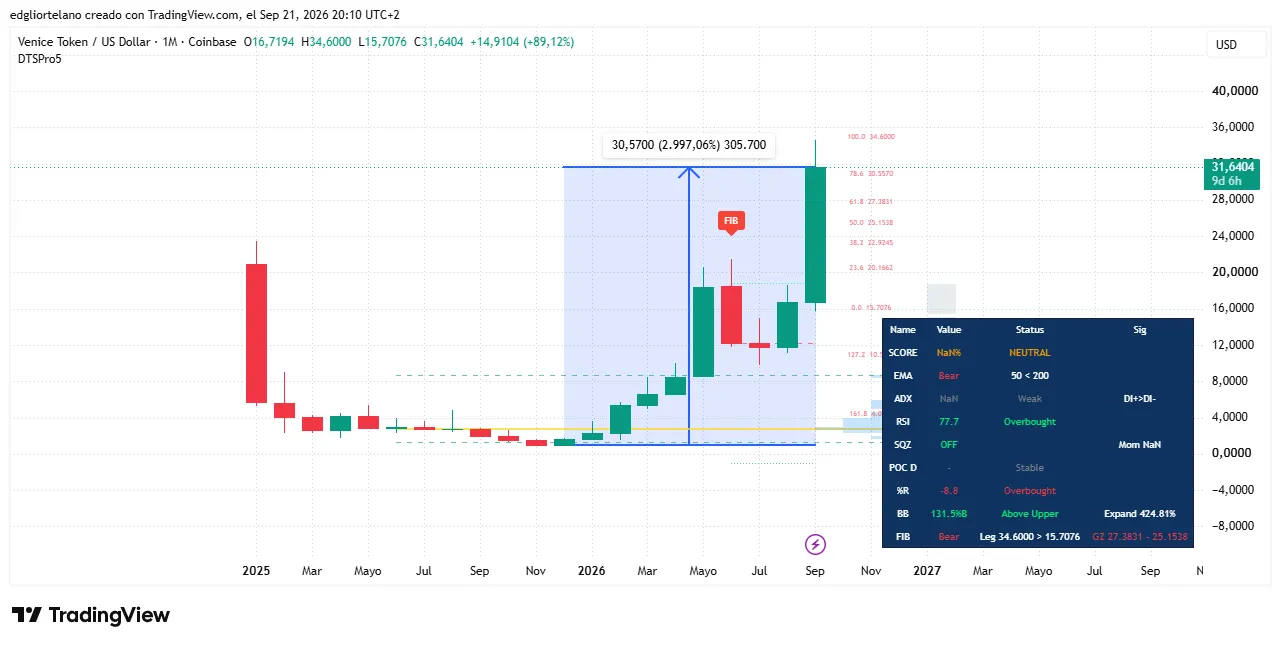
The native utility token of the privacy-centric artificial intelligence ecosystem Venice AI—trading under the ticker VVV—reached a landmark all-time high of $34.51 on Sunday. The milestone underscores a blistering rally that has seen the token climb roughly 17% over a 24-hour window and an astounding 3,000% since hitting a cycle low of $0.92 in December.
With its market capitalization hovering near $1.6 billion, VVV has firmly established itself as the third-largest AI-focused cryptocurrency in the digital asset market, trailing only industry heavyweights Near and Tao.
Unlike traditional cryptocurrencies designed for general transactions or speculative trading, VVV serves as a functional digital access key for Venice AI. Founded by prominent early Bitcoin and crypto entrepreneur Erik Voorhees—best known for launching ShapeShift—Venice AI operates as a zero-log chatbot and image generation platform. Instead of imposing standard per-prompt subscription billing models popularized by mainstream entities like OpenAI’s ChatGPT, Venice leverages decentralized financial (DeFi) architecture. Users can stake VVV tokens in smart contracts to claim a daily share of the platform’s computational inference.
Furthermore, the platform utilizes a secondary token mechanism known as DIEM. By locking staked VVV, the protocol mints DIEM, granting holders a perpetual, dollar-equivalent API credit daily. Venice also channels a portion of its corporate revenue into open-market buybacks, systematically burning VVV tokens to reduce circulating supply over time. Despite these technical innovations, market analysts point out a critical structural risk: blockchain analytics from Basescan reveal that the top 100 VVV wallets control approximately 98% of the token’s total supply, leaving the asset vulnerable to concentrated price volatility driven by a handful of large holders.

Chronology of the Venice AI Phenomenon
To understand the meteoric rise of Venice AI and its native asset, it is necessary to examine the trajectory of the platform and broader market catalysts throughout 2024 and 2025:
- 2024: Erik Voorhees officially launches Venice AI, introducing a decentralized, censorship-resistant, and privacy-first alternative to centralized generative AI tools.
- December 2024: VVV hits its cyclical bear market bottom at $0.92, establishing a deep foundational support level before a major market reversal.
- July 2025: Venice AI secures a major vote of confidence from institutional markets by closing a $65 million Series A funding round led by crypto-native venture firm Dragonfly. The round values the privacy-focused startup at $1 billion, marking its first influx of external capital since inception.
- August 2025: Business metrics accelerate rapidly as Venice AI reports an annualized revenue run rate scaling past $100 million, a substantial leap from the $70 million run rate recorded just one month prior.
- Early September 2025: A public dispute erupts between an NYU mathematician and OpenAI concerning credit for a fluid-dynamics research proof. While neither party alleges direct chat log misuse, the public fallout triggers widespread debate across platforms like X (formerly Twitter) and Hacker News. Users increasingly question whether centralized AI providers archive sensitive enterprise prompts to train future models or aid competitors.
- Mid-September 2025: Capitalizing on the privacy anxiety sparked by the OpenAI dispute, VVV experiences a massive 34% single-day price surge. Speculative inflows combine with organic protocol utility to drive the asset higher.
- September 1, 2025: In line with pre-planned tokenomics adjustments, Venice AI reduces its annual token issuance rate from its launch figure of 14 million VVV down to 2.5 million VVV.
- Sunday, September 21, 2025: VVV breaks through previous resistance levels to register a fresh all-time high of $34.51, cementing its status as a top-tier AI crypto asset.
- October 1, 2025 (Upcoming): Venice AI is scheduled to execute its next automated supply squeeze, cutting annual token emissions further from 2.5 million to 2 million VVV.
Supporting Data and Tokenomics
The valuation of Venice AI and its VVV token is underpinned by unique financial engineering that blends decentralized finance mechanics with traditional software-as-a-service (SaaS) revenue models.
Financial and Market Metrics
- Token Price All-Time High: $34.51 (achieved Sunday).
- Price Growth from Bottom: ~3,000% increase since the December low of $0.92.
- 24-Hour Momentum: Up approximately 17%.
- Market Capitalization: ~$1.6 billion.
- Sector Ranking: 3rd largest AI cryptocurrency (behind Near and Tao).
- Annualized Revenue Run Rate: $100 million (reported in August, up from $70 million in July).
- Series A Valuation: $1 billion (July 2025 funding round led by Dragonfly).
Supply Dynamics and Deflationary Controls
Venice AI’s tokenomics are engineered to combat inflation through a dual-pronged approach: programmatic issuance reductions and revenue-backed token burns.
- Issuance Cuts: At launch, Venice introduced an emission schedule of 14 million VVV per year. This has been systematically curtailed. On September 1, emissions dropped to 2.5 million VVV annually, with a subsequent reduction to 2 million VVV slated for October 1.
- Revenue Burns: A designated portion of platform fiat and crypto revenue is deployed to purchase VVV directly from open-market liquidity pools, permanently removing those tokens from circulation.
- The Whales’ Share: On-chain data retrieved via Basescan indicates that the top 100 VVV wallets control nearly 98% of the total circulating supply. This high degree of concentration represents a double-edged sword: while it signals strong accumulation by early backers and insiders, it also presents liquidity and manipulation risks for retail market participants.
Official Responses and Industry Perspectives
Erik Voorhees and the Venice AI development team have consistently positioned the platform not merely as a chatbot, but as a ideological and infrastructural counterweight to the prevailing Big Tech surveillance model.
In public commentary surrounding the platform’s vision, Voorhees has emphasized that the modern knowledge economy suffers from an invisible tax: the forfeiture of intellectual property. Mainstream AI chatbots routinely retain user prompts, conversation histories, and generated media—often utilizing this proprietary data to train subsequent frontier models or screen queries against corporate content filters. Venice AI explicitly rejects this paradigm by implementing a strict zero-log architecture. The platform does not require user accounts, preserves absolute anonymity, and avoids the heavy-handed content filtering seen on rival services.
Addressing the broader industry climate, Venice representatives have highlighted that the platform does not attempt to reinvent the wheel by training costly, proprietary foundational models from scratch. Instead, Venice acts as a secure, decentralized routing layer that leverages advanced open-source models such as Meta’s Llama and DeepSeek. While these open-source systems traditionally lag behind the absolute frontier benchmarks set by closed-source models from OpenAI and Google in standardized academic evaluations, Venice argues that absolute data privacy and censorship resistance far outweigh marginal gains in raw model reasoning capabilities for a rapidly growing segment of developers and professionals.
Market commentators and decentralized finance analysts have praised the DIEM staking mechanism as a novel intersection of utility and value accrual. By forcing users to lock up VVV to secure daily API credits, the protocol successfully removes circulating supply while tying token demand directly to the active utilization of artificial intelligence infrastructure rather than hollow speculative hype.
Implications for the AI and Crypto Sectors
The explosive growth of Venice AI and the VVV token carries significant implications for both the artificial intelligence industry and the digital asset economy.
1. The Normalization of Privacy-First AI
The public friction experienced by centralized AI giants regarding intellectual property ownership and data harvesting has created a profound trust deficit among researchers, legal professionals, developers, and corporate innovators. Venice AI’s rapid ascent—highlighted by a $100 million revenue run rate and a $1 billion valuation—proves that a lucrative, viable market exists for sovereign, confidential AI tools. If centralized providers continue to assert ownership rights over user prompts, alternative infrastructure providers like Venice are well-positioned to capture substantial market share.
2. The Maturation of Utility Tokens
For years, the crypto industry faced intense regulatory and public criticism for launching utility tokens that lacked functional application within their respective ecosystems. Venice AI demonstrates a blueprint for bridging decentralized finance with real-world software utility. By substituting traditional subscription tiers with smart-contract staking, token burns, and API credit minting (DIEM), Venice aligns user incentives directly with the long-term health and usage volume of the underlying platform.
3. Centralization and Market Risks
Despite its impressive financial performance, Venice AI’s token distribution model serves as a cautionary tale for prospective retail investors. With 98% of the VVV supply locked within the top 100 wallets, the token price remains exceptionally sensitive to the trading decisions of a minute fraction of holders. Furthermore, because Venice relies entirely on underlying open-source models developed by third parties, its long-term competitive moat relies less on proprietary algorithmic breakthroughs and more entirely on the strength of its privacy guarantees, user interface, and cryptographic tokenomics.
As the October 1 token issuance reduction approaches, all eyes will remain on the charts to see whether Venice AI can sustain its parabolic trajectory while navigating the delicate balance between decentralization, privacy, and market stability.