








Main Facts: The Rise of a Gen Z Real Estate Mogul
Lawrence "Landlord Larry" Guerguis expected his life to follow a predictable script: major in finance, move to Wall Street, work grueling 80-hour weeks, and chase a traditional corporate career for the next 40 years. Today, however, that trajectory is a distant memory.
At just 23 years old, Guerguis owns and operates a portfolio of 40 residential rental properties generating thousands of dollars in monthly cash flow. Operating primarily out of Cleveland, Ohio, and St. Louis, Missouri, the young entrepreneur achieved this rapid accumulation of wealth in just over three years—starting while he was still a full-time undergraduate student in Southern California with no traditional W-2 income.
Guerguis’s success hinges on a calculated real estate strategy: focusing on affordable Midwestern housing, leveraging Debt-Service Coverage Ratio (DSCR) loans to bypass traditional banking hurdles, and utilizing Section 8 housing vouchers to guarantee consistent, government-backed rental income. His journey has not only transformed his own financial future but also turned him into a viral social media educator known as "Landlord Larry" on Instagram and TikTok, where he demystifies real estate investing for a younger generation.
Chronology: A Timeline of Rapid Wealth Accumulation
The Accidental Encounter (Fall 2021)
The pivot point of Guerguis’s life occurred during the first semester of his junior year at San Diego State University. While out at a local bar and a subsequent pizza parlor with friends, Guerguis struck up a conversation with a visibly exhausted man sitting alone.
When Guerguis asked if everything was alright, the man replied bitterly, "Don’t talk to me. I only get two weeks out of the year off." The man revealed he was an investment banker working on Wall Street.
During an hour-and-a-half conversation, the banker asked Guerguis a defining question: "Do you love money?" When Guerguis answered honestly that he liked money but did not "love" it enough to sacrifice his entire life and freedom, the banker delivered a blunt verdict: forget about finance, and find an alternative path. That night planted the seed for Guerguis to explore real estate.
The First Leap: Selling the Car for Capital (2022)
Determined to enter the housing market before graduation, Guerguis faced a major roadblock: as a college student in Southern California, he had no W-2 income, no savings, and zero budget to buy local property.
Refusing to accept defeat, Guerguis sold his car for $16,000, opting instead to drive an aging 2008 family vehicle. With his cash down payment secured, he used online real estate platforms to search for markets where home prices hovered under $70,000. He identified Peoria, Illinois, as an affordable entry point.
Through a local handyman he found on Facebook—relying entirely on a digital "thumbs-up"—Guerguis purchased a duplex for $65,000, putting down roughly $15,300. Because he lacked traditional income, he secured a DSCR loan (Debt-Service Coverage Ratio), which evaluates the property’s income rather than the borrower’s personal paycheck.
Proving the Concept and Hitting Overload (2022–2023)
Guerguis’s first venture yielded immediate results. He rented the Peoria duplex to a Section 8 tenant whose voucher covered 100% of the rent. With a monthly mortgage payment of roughly $480 and $1,400 coming in monthly, the positive cash flow provided immediate proof of concept.
Energized, Guerguis rushed to his academic advisor to restructure his final semesters. To graduate on time while pursuing real estate, he doubled up on his course load, taking 18 credits in a single semester, alongside summer and winter classes, culminating in a grueling 23-credit final stretch. Simultaneously, he built an online network via Discord, eventually pitching a crypto investor on a Canva-designed deck, securing additional private capital to fuel his next moves.
Expanding to Cleveland and Scaling to 40 Units (2024–Present)
Immediately after graduation in mid-2024, Guerguis packed his bags and relocated to Cleveland, Ohio. Immersing himself in the local market, he toured dozens of properties, vetted local contractors, and refined his operational framework.
Operating in duos, Guerguis bought six properties in his first six months in Cleveland. By partnering with private investors and strategically acquiring undervalued single-family homes and duplexes—often raising below-market rents through the local housing authority—he rapidly expanded his footprint. Today, his portfolio stands at 40 single-family and multifamily units across Ohio and Missouri.
Supporting Data: The Economics of Midwest Section 8 Investing
Guerguis’s portfolio relies heavily on specific economic metrics that make low-cost Midwestern markets attractive to bootstrapping investors:
- Low Acquisition Costs: Initial property purchase prices in his target markets frequently range between $65,000 and $90,000, compared to median home prices well exceeding $800,000 in his native Southern California.
- Accessible Down Payments: Cash-to-close amounts for his early acquisitions typically ranged from $15,000 to $20,000 per property.
- Cash Flow Margins: With mortgage payments averaging $500 to $700 per month and Section 8 voucher rent allowances ranging from $1,200 to $1,800, properties routinely generate hundreds of dollars in net positive cash flow per door.
- Government-Backed Security: Utilizing the Section 8 housing voucher program largely eliminates default risk, providing steady, reliable monthly payments directly from government housing authorities.
Official Perspectives: Advice from the Front Lines of Next-Gen Real Estate
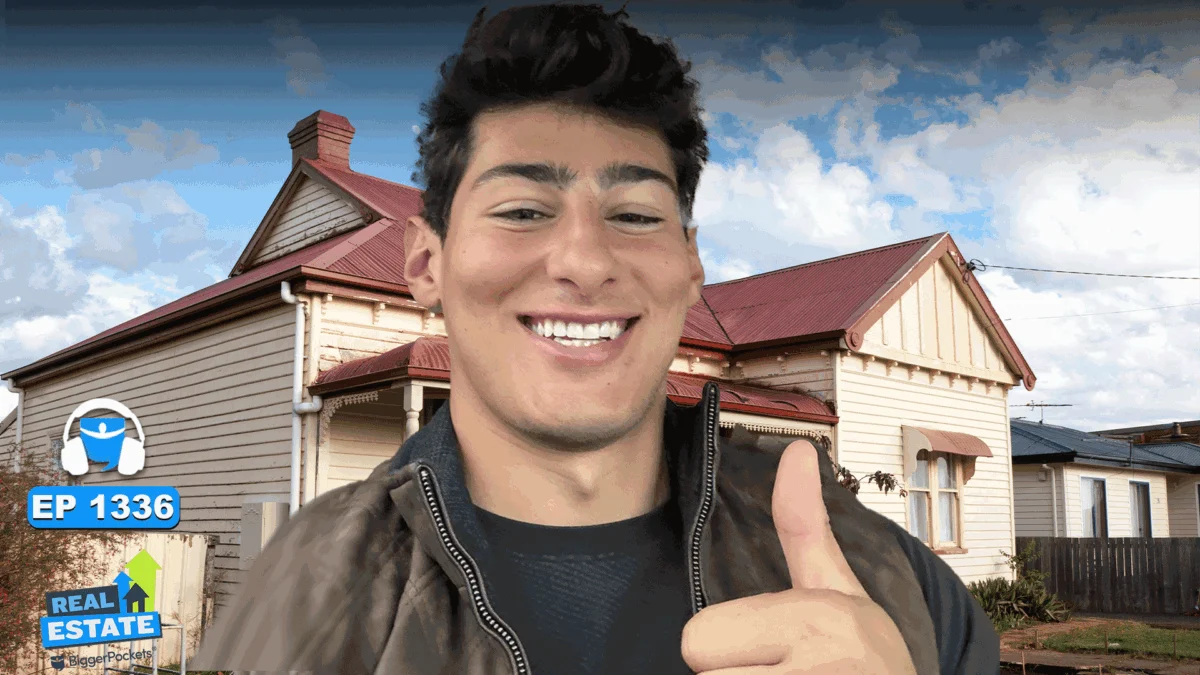
Appearing on industry platforms like the BiggerPockets Podcast alongside co-host Henry Washington, Guerguis has spoken candidly about the psychological and strategic hurdles of building a portfolio at a young age.
Reflecting on his early days of penny-pinching over minor negotiation points, Guerguis noted:
"My biggest regret in my first year… was that I was penny-pinching. I had lost deals because I was a thousand, $2,000 away from what the seller wanted. And in reality, what is that? On a small deal, that’s $5 a month different. I wish I bought every deal sooner."
On the necessity of education over recklessness, Guerguis emphasizes that while his aggressive entry worked out, newcomers must treat real estate as a serious profession:
"Do yourself a favor and educate yourself. Do your homework. School is boring, but so is real estate. The back end of it is all numbers… Real estate is a high-ticket career. If you’re going to invest, you’re going to spend money—a ton of it. Invest in some education of some sort."
Implications: The Shift Toward Gen Z Wealth Building
Lawrence Guerguis’s transition from a hypothetical Wall Street careerist to an independent real estate portfolio manager highlights several broader shifts in modern wealth accumulation:
- The Democratization of Capital: Through digital communities, Discord channels, and social media platforms, younger investors are increasingly able to connect with private capital sources outside traditional banking institutions, bypassing standard W-2 employment requirements.
- Geographic Arbitrage: High-cost coastal residents are increasingly looking to Midwestern and Southern rust-belt markets to achieve financial independence through high-yield, low-cost rental properties.
- The Rise of Digital Educators: By documenting his day-to-day operations under the moniker "Landlord Larry," Guerguis represents a growing wave of transparent, social-media-native entrepreneurs who use short-form video content to build personal brands, attract private lenders, and mentor the next generation of investors.
As Guerguis continues to scale his operations past the 40-property milestone, his trajectory serves as a case study in calculated risk-taking, proving that financial freedom is accessible long before retirement age for those willing to master the numbers and execute under pressure.