







In the modern digital workplace, the "app fatigue" phenomenon—where employees spend more time toggling between software tabs than actually executing tasks—has become a silent killer of productivity. Slack, the ubiquitous communication platform, is aiming to dismantle this barrier with a major overhaul of its signature virtual assistant, Slackbot. By embedding advanced artificial intelligence that learns organizational nuances, Slack is shifting the paradigm from a reactive messaging tool to a proactive, context-aware operational partner.
For small business owners and lean teams, these advancements represent more than just a software update; they signify a fundamental change in how work is organized, retrieved, and automated.
The Core Transformation: From Command-Line to Context-Awareness
At the heart of the latest Slackbot evolution is the concept of "contextual memory." Traditionally, bots have been static; they execute a command, provide a result, and forget the interaction the moment the chat window closes. The new Slackbot breaks this cycle by learning the specific workflows, preferences, and dynamics of individual teams.
By retaining user context, the AI eliminates the "onboarding tax"—the repetitive process of explaining to a bot how a specific task should be formatted or which department handles which query. Over time, the system becomes a bespoke assistant, tailored specifically to the unique operational heartbeat of a business. This is particularly advantageous for small businesses that lack the resources for dedicated IT support or extensive internal training programs.
Chronology of the Shift: The Path to Intelligent Collaboration
The journey toward this AI-centric model has been methodical. Slack’s strategy has transitioned through three distinct phases:
- The Communication Phase: Slack began as a simple, real-time messaging tool designed to replace internal email threads.
- The Integration Phase: Recognizing that teams live in various apps (Google Workspace, Atlassian, CRM platforms), Slack expanded its API capabilities to bring notifications into one place.
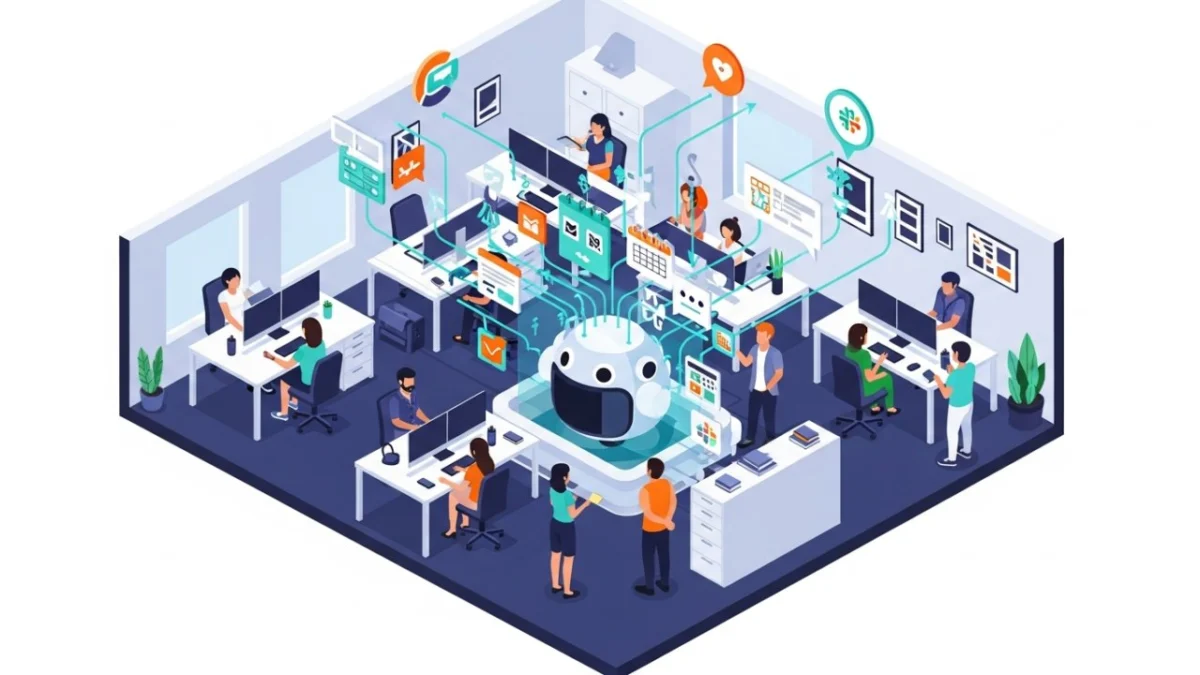
- The Intelligence Phase (Current): Slack is now moving beyond mere notifications. By leveraging AI, the platform is now acting as a central nervous system that interprets, visualizes, and executes tasks across the entire digital stack.
This evolution mirrors the broader trajectory of the SaaS industry, where the focus has shifted from "aggregation" (getting everything in one place) to "synthesis" (making sense of everything in one place).
Supporting Data: Quantifying the Productivity Gain
The efficacy of these tools is not merely theoretical. Salesforce’s Raveesh Raina, a sales engineer, provided a compelling case study on the impact of specialized AI-driven workflows. By developing a custom skill for Slackbot that automates activity logging immediately following customer calls, Raina was able to reclaim forty-three minutes per week for his colleagues.
While forty-three minutes might seem modest in isolation, the ripple effect is substantial. When scaled across a team of ten, this equates to over seven hours of reclaimed productivity every week—nearly a full workday—that can be redirected toward high-value client interactions or strategic planning. As Raina aptly noted, "That’s what it looks like when one person’s best process becomes everyone’s capability."
Official Responses and Strategic Vision
Slack’s leadership emphasizes that the ultimate goal is to remove "friction" from the workday. The philosophy is that the most effective tool is the one that stays out of the way. By integrating voice actions, Slackbot allows for a more natural, human-centric interaction.
Consider the common scenario: a project manager walks out of a high-stakes meeting with their hands full of coffee and a laptop bag. Previously, capturing the resulting action items would require finding a desk, opening a project management tool, and manually typing updates. With the new voice functionality, the manager can dictate instructions to Slackbot while walking to their car. The AI understands the context, routes the data to the correct document, and alerts the relevant team members.
This capability is supported by deep integrations with industry giants like Google, Atlassian, and DocuSign. By bridging the gap between communication and execution, Slack is positioning itself as the "operating system" for the modern, agile small business.
Visual Intelligence: Native Charts and Data Democracy
One of the most significant pain points for small business owners is the time-consuming process of exporting raw data from CRM or project management tools into spreadsheets for visualization. Slackbot’s new "Native Charts" feature solves this by generating visual representations of data directly within the chat interface.
This democratization of data is vital. When a team can see a trend in sales performance or task completion rates without leaving their conversation, the speed of decision-making increases exponentially. It removes the need for "meeting-about-the-meeting" sessions where team members present data that could have been reviewed asynchronously.
Implications for Small Business Culture
While the technical capabilities are impressive, the implications for company culture are perhaps more profound.
1. Fostering Cohesion in Hybrid Environments
Remote and hybrid work can often lead to a sense of isolation or a loss of institutional knowledge. Because the new Slackbot retains organizational context, it serves as a digital repository of "how we do things here." New hires can interact with the bot to understand past decisions or team preferences, which accelerates the onboarding process and ensures that team culture remains consistent regardless of physical location.
2. The Hurdle of Implementation
However, business owners must remain realistic. Technology is only as effective as the team’s willingness to adopt it. There is an inevitable adjustment period. Teams accustomed to traditional workflows may initially resist the transition. To mitigate this, leadership should consider:
- Gradual Integration: Rolling out one AI feature at a time rather than an entire suite.
- Consistency Protocols: Establishing team-wide standards for how to prompt the bot to ensure the "memory" function remains accurate and useful.
- Continuous Feedback Loops: Allowing team members to flag when the AI’s assumptions are incorrect, which helps "train" the system to be more accurate over time.
3. Maintaining the Human Element
There is a common fear that AI will replace human interaction. Slack’s approach suggests the opposite: by automating the "low-level" coordination tasks, Slackbot frees up human employees to focus on the "high-level" interpersonal work—creativity, empathy, and strategic thinking—that AI cannot replicate.
The Competitive Landscape
For small businesses, the competitive landscape is increasingly brutal. Efficiency is no longer just a "nice-to-have"; it is a survival mechanism. By consolidating the digital stack into a single conversational interface, Slack is offering small businesses the same operational muscle typically reserved for large enterprises with massive IT departments.
As the boundaries between "talking about work" and "doing the work" continue to dissolve, the businesses that succeed will be those that effectively leverage these intelligent tools to create a seamless flow of information. The transition to an AI-powered Slackbot is not just an update to a messaging app; it is a strategic investment in organizational agility.
Conclusion: Preparing for the Future of Work
The integration of AI into workplace communication is not merely an incremental change; it is a fundamental shift in how organizations function. By transforming Slackbot into an intelligent, memory-enabled, and voice-responsive entity, Slack has provided a roadmap for how small businesses can scale without losing their agility.
The path forward for business owners involves a commitment to both the technology and the process. As teams begin to experiment with these new features, the focus should remain on the goal: reducing the noise of daily operations to make room for the signal of growth. For those willing to embrace this shift, the result is a more cohesive, efficient, and empowered workforce, ready to compete in an increasingly complex digital economy.
For further technical details on how to implement these specific features within your organization, you can explore the official Slack blog post.