







In a profound irony that has sent shockwaves through the national security establishment, the U.S. Cybersecurity & Infrastructure Security Agency (CISA)—the very entity tasked with shielding the nation’s critical infrastructure from digital adversaries—has itself fallen victim to a significant security lapse.
A CISA contractor, wielding administrative access to the agency’s development environment, inadvertently exposed a vast repository of internal secrets, including plaintext AWS GovCloud keys, on a public GitHub account. The incident, first brought to light by KrebsOnSecurity, has prompted a swift and aggressive response from Capitol Hill, where lawmakers are questioning the agency’s internal security posture, its management of third-party contractors, and its ability to safeguard sensitive federal networks at a time of heightened geopolitical tension.
The Breach: A "Scratchpad" of Agency Secrets
The exposure centered on a public GitHub repository titled “Private-CISA,” established in November 2025. According to forensic analysis, the repository served as an unofficial synchronization tool for a CISA contractor who used the public platform to mirror files from their professional workstation.
The repository was far from a collection of benign code. It functioned as an indiscriminate data dump, containing plaintext credentials for dozens of internal CISA systems, browser password exports, and highly sensitive AWS GovCloud tokens. Most alarming to security experts was the revelation that the contractor had actively bypassed GitHub’s native security features, specifically disabling the platform’s built-in “secret scanning” protections that would have otherwise flagged and blocked the commit of sensitive credentials.
The files exposed were comprehensive in scope, including sensitive documents such as AWS-Workspace-Bookmarks-April-6-2026.html, AWS-Workspace-Firefox-Passwords.csv, and Important AWS Tokens.txt. This data effectively provided an open-access roadmap to the agency’s digital infrastructure.
Chronology of the Exposure and Discovery
The timeline of the incident reflects a prolonged period of vulnerability:
- November 2025: The "Private-CISA" repository is created on GitHub. It begins to be used as a personal synchronization mechanism for work-related data.
- Late April 2026: The repository is updated with some of its most critical and sensitive credentials, including high-level access tokens for agency cloud resources.
- May 18, 2026: KrebsOnSecurity publishes the initial report detailing the existence of the repository, forcing the agency to acknowledge the breach.
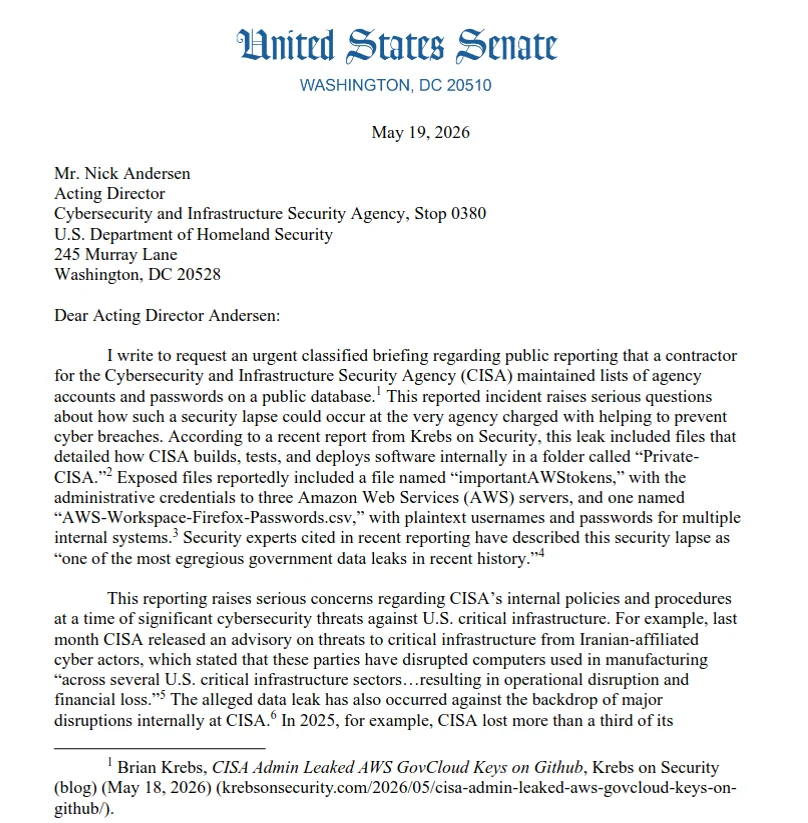
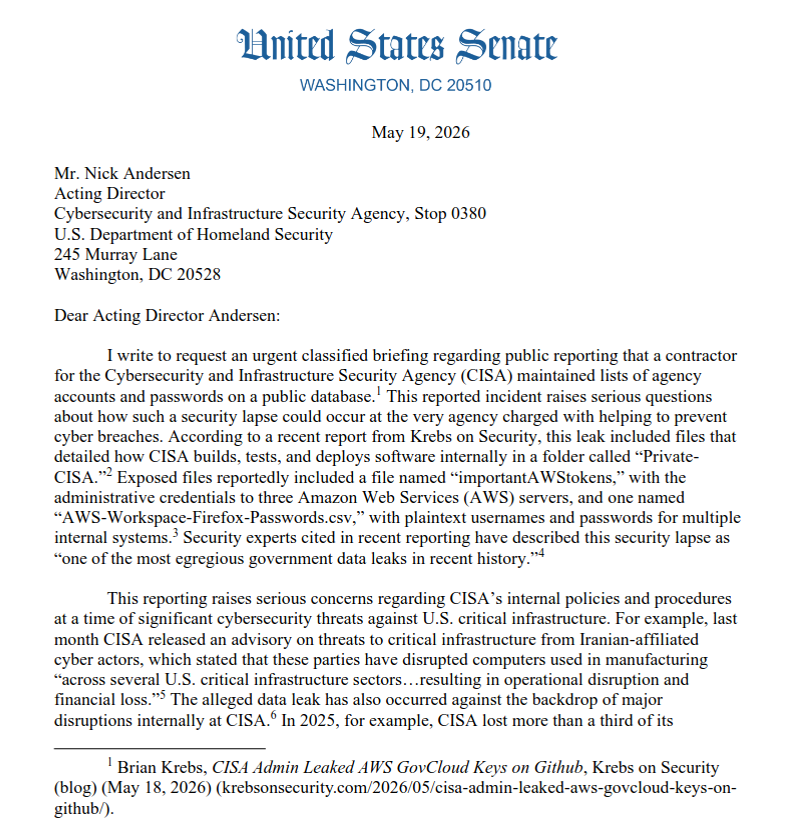
- May 19, 2026: Sen. Maggie Hassan (D-NH) and Rep. Bennie Thompson (D-MS) issue formal letters to CISA’s acting director demanding accountability and detailed explanations of the agency’s security failures.
- May 20, 2026: Dylan Ayrey, founder of Truffle Security, identifies that a critical RSA private key—granting full access to CISA’s GitHub enterprise organization—remains active despite the initial report. Following notification, CISA finally revokes the key.
Technical Implications: The "TruffleHog" Findings
The severity of the breach was underscored by Dylan Ayrey, creator of the open-source security tool TruffleHog. Ayrey’s investigation revealed that, even days after the initial exposure was reported, CISA had failed to rotate a critical RSA private key.

This specific key was particularly dangerous; it provided administrative access to a GitHub app owned by the CISA enterprise account. An attacker in possession of this key could have performed a wide array of malicious actions, including reading source code from every repository in the CISA-IT organization, hijacking CI/CD (Continuous Integration and Continuous Delivery) pipelines by registering rogue runners, and modifying security settings such as branch protection rules.
"CI/CD pipelines are the crown jewels of software development," says one independent security consultant familiar with the incident. "If an adversary compromises a CI/CD pipeline, they aren’t just stealing data—they are injecting malicious code directly into the agency’s software supply chain. The potential for a long-term, stealthy ‘backdoor’ operation is immense."
Congressional Outcry and Institutional Fragility
The breach has arrived at a precarious moment for CISA. The agency is currently navigating a period of internal volatility following a massive reduction in its workforce. Reports indicate that the agency has lost more than a third of its personnel, including a significant portion of its senior leadership, due to a wave of forced retirements, buyouts, and resignations initiated under the current administration.
Sen. Maggie Hassan, in her May 19 letter to Acting Director Nick Andersen, did not mince words. "This reporting raises serious concerns regarding CISA’s internal policies and procedures at a time of significant cybersecurity threats against U.S. critical infrastructure," she wrote. Her letter included a dozen pointed questions, ranging from the duration of the exposure to whether the agency has verified if any state-sponsored actors accessed the public repository.
Rep. Bennie Thompson, alongside Rep. Delia Ramirez, framed the incident as a failure of culture and oversight. "We are concerned that this incident reflects a diminished security culture and/or an inability for CISA to adequately manage its contract support," the representatives wrote. They explicitly noted that the information contained in the "Private-CISA" repository provided a "roadmap" for adversaries such as Russia, China, and Iran to gain persistent access to federal networks.
The Human Factor and the Limits of Policy
While CISA continues to work with vendors to rotate compromised credentials, the incident has reignited a debate regarding the efficacy of technical controls in an era of remote, contract-based labor.
Security experts like James Wilson and Adam Boileau of the Risky Business podcast have argued that while organizations can mandate top-down policies for managed devices, the "human factor" remains an intractable problem. "This is a human problem where you’ve hired a contractor to do this work and they have decided of their own volition to use GitHub to synchronize content from a work machine to a home machine," Boileau noted.
The incident highlights a critical vulnerability in the "Bring Your Own Device" (BYOD) and modern development culture: even the most robust enterprise security infrastructure can be bypassed by an employee or contractor who, for the sake of convenience, moves sensitive data to an insecure, personal environment.
Official Response and Future Outlook
CISA’s official response has been measured, though critics argue it lacks the transparency required given the agency’s mission. In a brief statement, the agency maintained that "there is no indication that any sensitive data was compromised as a result of the incident."
However, security researchers remain skeptical. Because GitHub publishes a public "firehose" of activity—a real-time stream of all commits and changes—cybercriminals and state-sponsored intelligence units often monitor these feeds specifically to harvest leaked API keys and SSH credentials. As Dylan Ayrey pointed out, "Anyone monitoring GitHub events could be sitting on this information."
The agency claims it is "actively responding and coordinating with the appropriate parties and vendors to ensure any identified leaked credentials are rotated and rendered invalid."
For the time being, the "Private-CISA" repository is offline, but the damage to the agency’s credibility remains. As CISA works to audit its entire credential portfolio, the incident stands as a stark warning to the federal government: the most sophisticated cybersecurity defenses in the world are only as strong as the human beings tasked with operating them. For the nation’s primary cybersecurity agency, the upcoming congressional hearings will likely be a grueling test of its remaining institutional integrity.