








The Cybersecurity and Infrastructure Security Agency (CISA)—the very entity tasked with safeguarding the United States’ critical digital infrastructure—is currently embroiled in a high-stakes security crisis. Following a report by KrebsOnSecurity, it has been revealed that a CISA contractor inadvertently exposed highly sensitive administrative credentials, including AWS GovCloud access keys, on a public GitHub repository. This massive security lapse has triggered a formal inquiry from Congress, with lawmakers questioning how such a breach could occur within the agency’s own ranks.
The incident, which involves the exposure of plaintext credentials to dozens of internal systems, has left the agency scrambling to contain the damage, invalidate compromised keys, and manage a growing public relations and national security disaster.
The Nature of the Exposure: "Private-CISA"
The breach centers on a public GitHub profile titled "Private-CISA." Investigations into the repository indicate that a contractor with administrative access to CISA’s code development platform intentionally created the public repository to store agency files. Security researchers who analyzed the commit logs discovered that the contractor had explicitly bypassed GitHub’s built-in "secret scanning" protections, which are designed to prevent the accidental publication of API keys, tokens, and passwords.
The repository functioned as a digital "scratchpad," a synchronization mechanism used by the contractor to move data between work and personal environments. The files left exposed included sensitive documents such as Important AWS Tokens.txt, kube-config.txt, and browser-stored password exports. Experts have noted that the repository exhibits patterns consistent with a lack of adherence to basic cybersecurity hygiene, rather than any malicious intent to expose the agency. However, the result is the same: the keys to the kingdom were left in plain view on the public internet.
Chronology of the Crisis
- November 2025: Initial creation of the "Private-CISA" repository, according to forensic analysis of the commit history.
- Late April 2026: The repository is populated with some of its most sensitive, high-value credentials, including active AWS GovCloud keys.
- May 18, 2026: KrebsOnSecurity publishes an exposé detailing the existence of the repository and the scope of the leaked credentials.
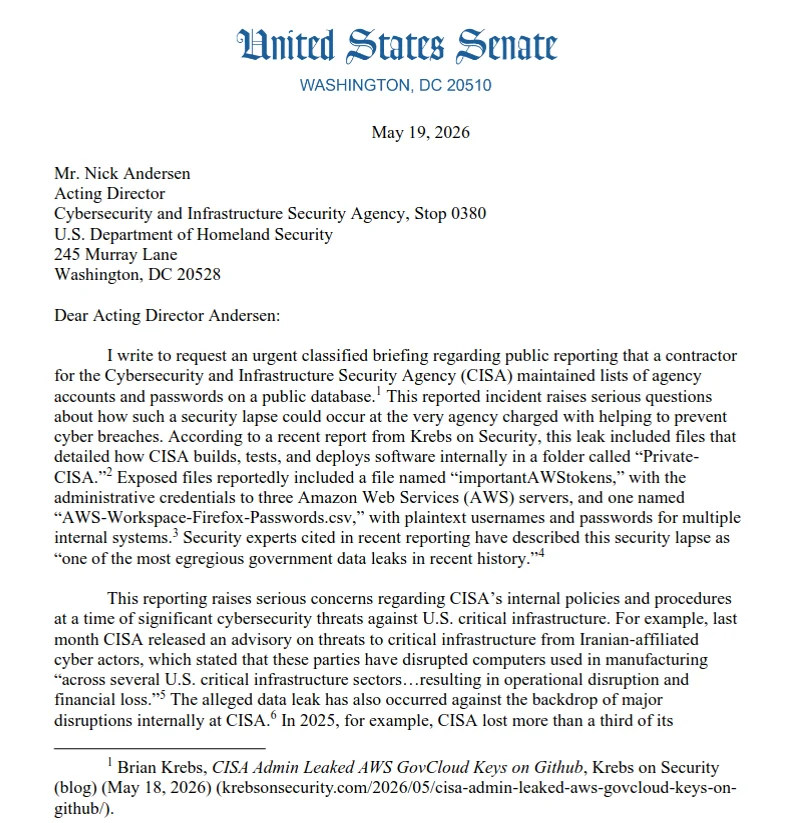
- May 19, 2026: Sen. Maggie Hassan (D-NH) and Rep. Bennie Thompson (D-MS) issue formal letters to CISA Acting Director Nick Andersen, demanding an immediate accounting of the breach.
- May 20, 2026: Security firm Truffle Security, led by Dylan Ayrey, notifies CISA that they have identified a highly dangerous, unrevoked RSA private key within the repo. This key provided full administrative access to the CISA-IT GitHub organization.
- Post-May 20, 2026: CISA begins the process of invalidating the specific RSA key identified by Truffle Security, though work continues to rotate other, less critical credentials.
Technical Implications: The Keys to the CI/CD Pipeline
The severity of this breach cannot be overstated. Among the exposed items was an RSA private key that allowed for total control over CISA’s enterprise GitHub account. Dylan Ayrey, creator of the open-source secret-discovery tool TruffleHog, provided a grim assessment of the risks posed by this specific credential.
"An attacker with this key could read source code from every repository in the CISA-IT organization, including private repositories," Ayrey explained. Beyond simple data theft, an adversary could have registered "rogue self-hosted runners" to hijack CI/CD (Continuous Integration/Continuous Delivery) pipelines. By compromising the CI/CD process, an attacker could inject malicious code directly into the agency’s software builds, effectively turning CISA’s own automated systems into a vector for a supply-chain attack.
Furthermore, the ability to modify branch protection rules and webhooks meant that an attacker could have maintained persistent, invisible access to the agency’s internal development infrastructure. While CISA has confirmed that they have since invalidated this specific key, the delay—lasting more than a week after the initial notification—has left experts concerned about what other entities may have scraped the repository while it was live.
The Human Element and Institutional Fragility
Industry analysts and security experts point to a deeper, more systemic problem within CISA. The breach occurred against a backdrop of significant institutional instability. Following the departure of over a third of its workforce—a mass exodus caused by forced retirements, buyouts, and resignations during the current administration—the agency is suffering from a depleted security culture.
Sen. Hassan’s letter explicitly references this instability, noting that the incident is symptomatic of a broader failure in internal policy enforcement. Rep. Bennie Thompson and Rep. Delia Ramirez echoed these sentiments, suggesting that the leak reflects "an inability for CISA to adequately manage its contract support."
The dilemma, as noted by James Wilson and Adam Boileau of the Risky Business podcast, is that technical controls have clear limits. "This is a human problem," Boileau noted. When a contractor decides to synchronize their professional work with a personal machine using a public cloud repository, they are operating outside the agency’s visibility. "I don’t know what technical controls you could put in place given that this is being done presumably outside of anything CISA managed or even had visibility on."
Official Responses and Accountability
CISA’s official stance has been one of damage control. In a brief written statement, the agency asserted that "there is no indication that any sensitive data was compromised as a result of the incident." This claim, however, is met with skepticism by the cybersecurity community. Because GitHub publishes a public "firehose" of activity, it is widely accepted that cybercriminal actors and state-sponsored intelligence services monitor these feeds specifically to harvest credentials.
Regarding the ongoing cleanup, CISA stated: "CISA is actively responding and coordinating with the appropriate parties and vendors to ensure any identified leaked credentials are rotated and rendered invalid and will continue to take appropriate steps to protect the security of our systems."
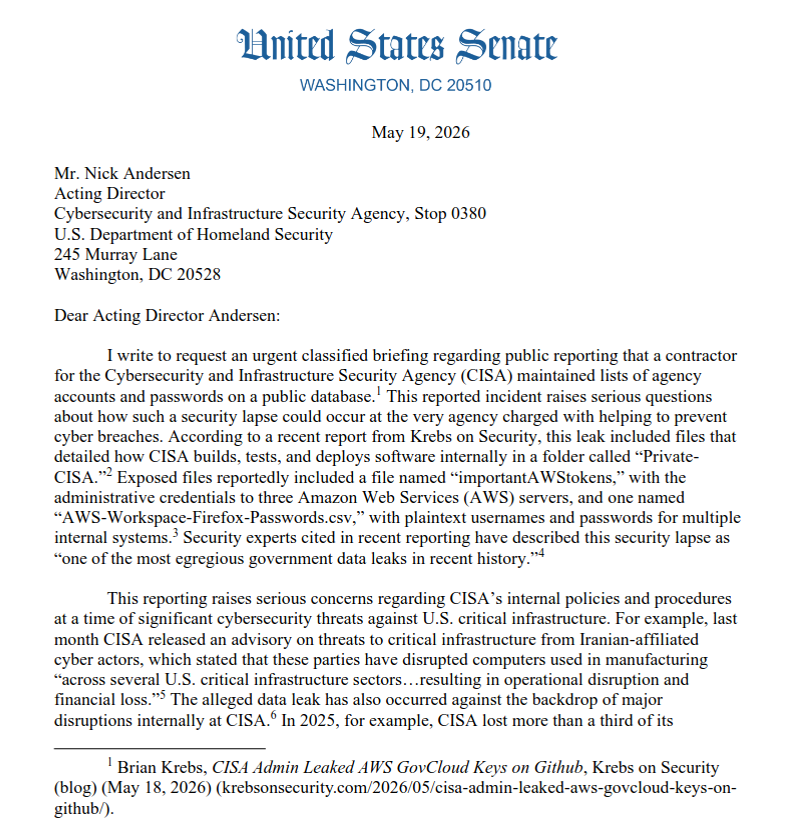
However, Congress is not satisfied with broad assurances. Sen. Hassan has demanded answers to twelve specific questions, including:
- The exact timeline of when CISA discovered the repository.
- An audit of the contractor’s access privileges.
- An assessment of whether any foreign intelligence services accessed the leaked data.
- Why the agency’s own internal monitoring failed to detect the exfiltration of these keys to a public domain.
Implications for Federal Cybersecurity
This breach serves as a jarring wake-up call for federal agencies relying on third-party contractors. The reliance on external vendors for critical development work, combined with the "shadow IT" practices of individual contractors, creates a massive, unmanaged attack surface.
If CISA—the agency that issues the directives for how other federal organizations should protect their infrastructure—cannot secure its own credentials, the question remains: what does this imply for the security of the nation’s critical infrastructure? The incident has effectively handed a "roadmap" to potential adversaries, including Russia, China, and Iran, who are actively looking for entry points into the federal government’s digital backbone.
As CISA continues to scrub its credentials and answer to a frustrated Congress, the incident stands as a cautionary tale regarding the limits of organizational policy in the face of human error. The "Private-CISA" leak is not just a technical oversight; it is a manifestation of an agency in transition, struggling to maintain its mandate while fighting the internal erosion of its own expertise and security oversight. Whether this event leads to meaningful reform or merely further regulation remains to be seen, but for now, the agency remains under intense scrutiny.