








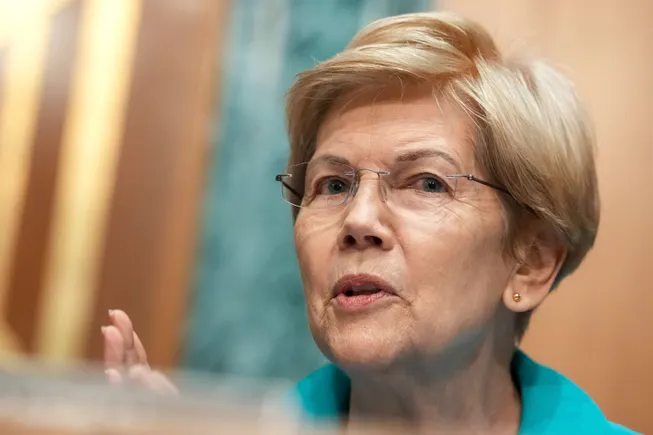
In a move that underscores the intensifying scrutiny over the relationship between federal regulators and the financial industry, Senator Elizabeth Warren (D-MA) has launched a formal inquiry into the circumstances surrounding the Consumer Financial Protection Bureau’s (CFPB) abrupt dismissal of a major lawsuit against Capital One. At the heart of the investigation is Brian Johnson, a high-ranking Capital One executive and former CFPB official who has recently been nominated by President Donald Trump to lead the very agency that was once prosecuting his current employer.
The inquiry, detailed in a letter sent Monday to Capital One CEO Richard Fairbank, seeks to uncover whether Johnson played a role in the "inexplicable" decision to drop a lawsuit alleging that Capital One deprived its customers of more than $2 billion in interest. As the Senate prepares for Johnson’s confirmation hearings, Warren’s demand for transparency sets the stage for a contentious battle over regulatory integrity, corporate influence, and the "revolving door" of Washington politics.
Main Facts: The Intersection of Corporate Compliance and Federal Oversight
The controversy centers on a sequence of events that began in early 2025, just days before the transition of power at the White House. On January 14, 2025, the CFPB filed a lawsuit against Capital One, alleging a years-long scheme to "cheat" millions of savers out of billions of dollars in interest payments. However, within a month—and following the installment of new leadership at the bureau—the agency took the rare step of dropping the lawsuit entirely.
Senator Warren’s investigation focuses on Brian Johnson, who currently serves as Vice President and U.S. Card Compliance Officer at Capital One. Johnson’s career path is a quintessential example of the "revolving door":
- Public Sector: Served as Deputy Director of the CFPB during the first Trump administration.
- Private Sector: Joined Capital One in November 2024 to oversee compliance.
- Nomination: Tapped by President Trump in mid-2025 to return to the CFPB as its Director.
Warren is demanding that Capital One provide all correspondence between Johnson and the CFPB, particularly any communications related to the termination of the lawsuit. The Senator is also seeking internal records detailing any advice Johnson provided to Capital One regarding the CFPB’s enforcement actions. The core of the concern is whether a sitting executive at a major bank used his prior connections or his prospective return to power to influence a federal enforcement action in favor of his employer.
Chronology: A Decade of Disparity and Regulatory Whiplash
To understand the gravity of Warren’s inquiry, one must look at the decade-long timeline of Capital One’s savings products and the subsequent legal fallout.
2012: The ING Direct Acquisition
The roots of the dispute date back to 2012, when Capital One acquired ING Direct USA. As part of the acquisition, Capital One inherited the "Orange Savings Account," a popular high-yield product. These accounts were rebranded as "360 Savings" accounts. For years, these customers believed they were holding a premier, high-interest product.
2019–2024: The "Two-Tier" Strategy
According to the CFPB’s original complaint, Capital One began a strategic pivot in 2019. While the bank continued to market its "360" brand as offering "nation-leading" rates, it effectively froze the interest rates on the legacy 360 Savings accounts. Simultaneously, it launched a new product: the "360 Performance Savings" account.
While the names were nearly identical, the interest rates were not. The bank allegedly failed to notify legacy customers that they were being left behind in a lower-tier product, even as the 360 Performance Savings account offered rates up to 14 times higher than the original 360 Savings account.
January 2025: The CFPB Sues
In the waning days of the Biden administration, the CFPB filed suit, seeking $2 billion in restitution. The agency alleged that Capital One had "worked to keep customers in the dark" by forbidding employees from proactively mentioning the higher-yielding account to legacy customers and removing references to the old product from its website to prevent comparisons.
February 2025: The Lawsuit is Dropped
Following the inauguration of President Trump and a change in the CFPB’s acting leadership, the bureau filed a motion to dismiss the case. The dismissal was granted "without prejudice," but no detailed public explanation was provided for why the agency abandoned a case involving $2 billion in alleged consumer harm.
May 2025: The New York Attorney General Steps In
Seeing the federal government retreat, New York Attorney General Letitia James filed a similar lawsuit against Capital One, utilizing state consumer protection laws.
June 2025: Settlement and the Discover Merger
Faced with the New York lawsuit and the looming closure of its massive acquisition of Discover Financial Services, Capital One opted to settle. The bank agreed to pay $425 million in restitution to affected customers. The settlement was seen by many analysts as an effort to clear the regulatory path for the Discover merger, which required approval from multiple federal agencies.
Supporting Data: The Cost of "Keeping Customers in the Dark"
The financial data underlying the CFPB’s initial complaint and the subsequent New York settlement highlight the scale of the alleged misconduct.
The Interest Gap:
At the height of the interest rate hikes by the Federal Reserve in 2023 and 2024, the disparity between the two accounts became cavernous. While the "360 Performance Savings" account offered rates north of 4.00% APY, many "360 Savings" holders were still earning as little as 0.30% APY. For a customer with $50,000 in savings, this disparity represented a loss of nearly $1,850 in interest annually.
The $2 Billion Allegation:
The CFPB’s $2 billion figure was calculated based on the cumulative difference in interest paid to millions of account holders over a five-year period. The agency argued that Capital One’s "bait-and-switch" was not merely a marketing failure but a systemic effort to reduce the bank’s interest expense at the expense of loyal customers.
The $425 Million Settlement:
While significantly lower than the $2 billion originally sought by the CFPB, the $425 million settlement reached with the New York Attorney General represents one of the largest state-level settlements for a savings-related dispute in recent history. It provides a baseline for the "harm" that even the bank eventually acknowledged—or at least agreed to pay to resolve.
Official Responses: Warren’s Warning and Capital One’s Silence
Senator Warren’s letter to CEO Richard Fairbank is pointed and carries significant weight as she is a senior member of the Senate Banking Committee, which oversees CFPB nominations.
"Mr. Johnson’s role at Capital One, given the CFPB’s inexplicable and seemingly ill-considered decision to drop a major enforcement action against the bank, raises significant concerns related to his nomination," Warren wrote. She further characterized the situation as a "second pass through the revolving door," suggesting that Johnson’s loyalties may be divided between the public interest and the corporate interests of his most recent employer.
Warren’s specific demands include:
- A full list of all meetings, calls, or digital communications between Brian Johnson and any CFPB official between November 2024 and the present.
- Internal documents showing whether Johnson advised Capital One on its strategy regarding the 360 Savings litigation.
- Clarification on whether Johnson was involved in the "two-tier" savings structure or the decision to "obscure" the newer product from existing customers.
As of Tuesday, Capital One has not issued a formal rebuttal to Warren’s letter. Historically, the bank has defended its savings products, maintaining that customers have the "flexibility" to choose their accounts and that interest rates are subject to change based on market conditions. Regarding the settlement, a spokesperson previously stated that the bank was "pleased to put this matter behind us" as it focuses on its strategic growth.
The White House has also stood by Johnson’s nomination, describing him as a "principled leader with deep institutional knowledge" of the CFPB who is uniquely qualified to reform the agency.
Implications: Regulatory Integrity and the Confirmation Battle
The outcome of this inquiry has far-reaching implications for the financial sector and the future of consumer protection in the United States.
1. The Future of the CFPB
If Brian Johnson is confirmed as Director, his first task will be overseeing an agency that he recently worked "against" as a compliance officer. Warren’s inquiry is a preemptive strike aimed at forcing Johnson into a series of recusals. If Johnson is forced to recuse himself from all matters involving Capital One—one of the nation’s largest credit card issuers—his effectiveness as Director could be significantly hampered.
2. The "Revolving Door" Precedent
The investigation highlights a perennial issue in Washington: the movement of high-level officials between regulatory bodies and the industries they regulate. While proponents argue this brings "real-world expertise" to government, critics like Warren argue it leads to "regulatory capture," where agencies become too sympathetic to the companies they are supposed to police.
3. Impact on the Discover Merger
Capital One’s acquisition of Discover remains under intense scrutiny. The $425 million settlement cleared one hurdle, but Warren’s inquiry creates a new "headline risk." If the Senate investigation reveals that Capital One executives improperly influenced the CFPB to drop a $2 billion lawsuit, it could provide ammunition for those looking to block the merger on the grounds of "managerial fitness" and "corporate character."
4. Consumer Confidence
For the millions of Americans who hold accounts with Capital One, the dispute raises fundamental questions about transparency. The "two-tier" savings structure is not unique to Capital One; many banks offer "legacy" and "promotional" accounts. However, the legal focus on whether a bank has an affirmative duty to inform customers of better internal options could change how the entire banking industry markets its products.
As the July 7 deadline for Capital One’s response approaches, the financial industry will be watching closely. Senator Warren has made it clear that the confirmation of the next CFPB Director will not proceed without a thorough accounting of the "inexplicable" disappearance of a $2 billion consumer fraud case. For Capital One, the cost of "putting the matter behind them" may have just gone up.