









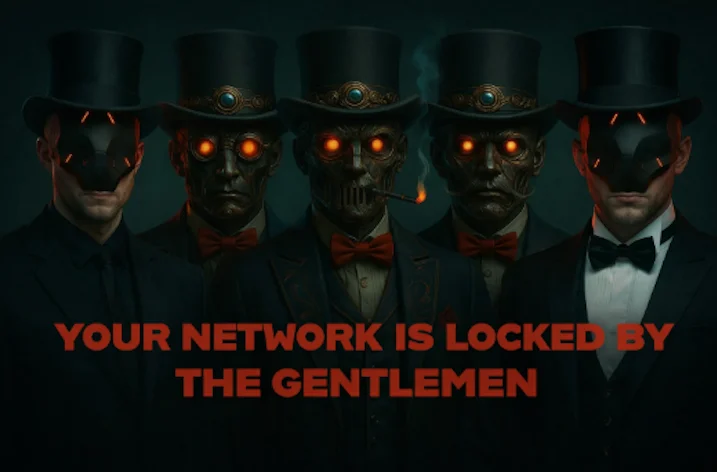
In the high-stakes arena of global cybercrime, few entities have ascended the ladder of infamy as rapidly as "The Gentlemen." Emerging from the shadows in mid-2025, this ransomware-as-a-service (RaaS) syndicate has rapidly carved out a position as the second most active ransomware group by victim count. According to recent intelligence from Check Point Software, the group has claimed at least 332 victims since its inception, with a staggering 240 incidents recorded in 2026 alone.
While many ransomware groups operate through opaque, decentralized hierarchies, The Gentlemen have distinguished themselves through an aggressive—and highly lucrative—business model. By offering affiliates an unprecedented 90 percent cut of all ransoms, they have effectively cannibalized the talent pools of competing groups. However, this pursuit of dominance has come at a cost: the digital breadcrumbs left behind by their primary administrator have led security researchers directly to a real-world identity in the heart of Russia.
The Anatomy of an Emergent Threat
The Gentlemen operate on a classic RaaS model, but with a predatory financial incentive structure that has disrupted the cybercriminal ecosystem. Industry standards typically dictate an 80/20 split between the affiliate (the individual who gains access to a victim’s network) and the group’s core developers. By tilting the scales to a 90/10 split, The Gentlemen have incentivized experienced operators to abandon their previous programs, resulting in a rapid expansion of their operational capabilities.
Technical analysis reveals a group that favors speed and efficiency over complex, long-term persistence. Their preferred entry point into corporate networks involves exploiting vulnerabilities in internet-facing devices, specifically VPNs and firewalls. Once inside, the group’s automated tools move with clinical precision, often encrypting entire enterprise networks within hours of the initial breach.
A Chronology of Digital Footprints
The investigation into the administrator—a figure known across the dark web by the monikers "Zeta88" and "Hastalamuerte"—is a masterclass in open-source intelligence (OSINT). Security firms including Intel 471, Flashpoint, and Constella Intelligence have painstakingly reconstructed the evolution of this individual from a novice forum user to a major crime syndicate architect.
The Formative Years (2019–2021)
The persona "Hastalamuerte" first appeared on the cybercrime scene between 2019 and 2020. During this period, the user was far from the sophisticated threat actor they are today. Archival records from the hacker training channel @pntst reveal a user struggling with basic penetration testing tools, asking rudimentary questions, and participating in entry-level tutorials. It was a period of trial and error, where the individual was building the technical foundation that would later power The Gentlemen.
The Escalation (2022–2025)
By 2022, the transition to the "Zeta88" persona began. Registering on forums like Breached, this individual began to shed the mask of the learner, instead adopting the role of a facilitator. The registration of these accounts from IP addresses in Izhevsk, Russia, established a geographical anchor point.
The digital trail solidified through the use of consistent identifiers. The email address [email protected] became a linchpin. Beyond the obvious white supremacist symbolism in the suffix, the address linked to Apple accounts, GitHub profiles under the alias "SantaMuerte," and a specific Telegram ID: 30907522.
The Breach of Backend Infrastructure (2026)
In early 2026, a significant breach of The Gentlemen’s backend infrastructure provided the final pieces of the puzzle. Researchers found that the administrator’s account was responsible for assembling the locker, managing the RaaS panel, and distributing the 10 percent commission—the "administrator’s cut." This definitively linked the technical operations of the malware to the persona of Hastalamuerte/Zeta88.
The Unmasking: Alexander Andreevich Yapaev
The most damning evidence emerged when security researchers cross-referenced the Telegram ID associated with the ransomware group with leaked databases from Russian government entities. The ID 30907522 was found to be linked to the Russian phone number +79127650004.
Records associated with this phone number point to one individual: Alexander Andreevich Yapaev, a 36-year-old resident of Izhevsk. Further investigation revealed that Yapaev utilized the username "4apai18" on the Russian social media platform Pikabu—a phonetic play on the name "Chapaev"—and used the email address [email protected].
The final confirmation came from a LinkedIn profile under the name Alexander Yapaev, which lists him as the head of B2B marketing for Uralenergo Udmurtia, one of Russia’s largest suppliers of electrical and lighting products. The use of the same bu4vs prefix across both his professional LinkedIn account and his illicit cybercrime activities provides a rare, high-confidence link between a corporate professional and the mastermind of an international ransomware syndicate.
Implications of Operational Security Failures
The discovery of Alexander Yapaev raises a recurring question in the cybersecurity community: Why do skilled, and presumably intelligent, cybercriminals leave such obvious trails?
The answer is rarely a single factor. Many criminals begin their illicit careers in their youth, driven by curiosity and a lack of foresight. By the time they have evolved into high-level threats, their early digital identities—often linked to real-world phone numbers and personal email addresses—are already deeply embedded in the infrastructure they use to conduct their crimes.
Furthermore, the environment in Russia provides a degree of "controlled impunity." So long as hackers refrain from targeting domestic infrastructure and maintain a low profile that avoids international diplomatic incidents, they are often left untouched by local law enforcement. This creates a false sense of security, leading criminals to neglect the rigorous operational security (OPSEC) that would be required if they lived in jurisdictions where international extradition was a constant threat.
The Role of Artificial Intelligence
The recent report from the threat research group PRODAFT adds a modern dimension to the group’s operations. PRODAFT confirms that the administrator (Zeta88/Hastalamuerte) has integrated AI into the core of The Gentlemen’s operations.
Beyond simply using AI for automated code generation, the group is leveraging large language models to streamline post-exploitation activities and maintain their ransomware toolsets. This indicates a shift in the RaaS model: the "administrator" is no longer just a manager of people, but a curator of automated, AI-driven workflows that allow a small core team to scale their impact across hundreds of global organizations.
Official Responses and Future Outlook
As of the date of this report, Alexander Yapaev has not responded to multiple requests for comment regarding his alleged double life. His employers at Uralenergo Udmurtia have similarly remained silent regarding the accusations levied against their B2B marketing lead.
The rise of The Gentlemen serves as a stark reminder of the current state of ransomware. The industry is no longer characterized by singular, isolated hackers, but by professionalized, business-like entities that operate with the efficiency of legitimate corporations. They recruit, they outsource, and they utilize cutting-edge AI—all while masquerading behind the mundane veneers of corporate life.
For organizations, the message is clear: the threat is not just a piece of malware, but a sophisticated administrative apparatus. Protecting against such groups requires more than just defensive patches; it requires an understanding of the business models that drive these syndicates to innovate at such a terrifying speed. As law enforcement agencies continue to gather intelligence, the "Gentlemen" may find that their professional success in the marketing world is being eclipsed by their permanent, and highly public, record in the halls of cybercrime history.