







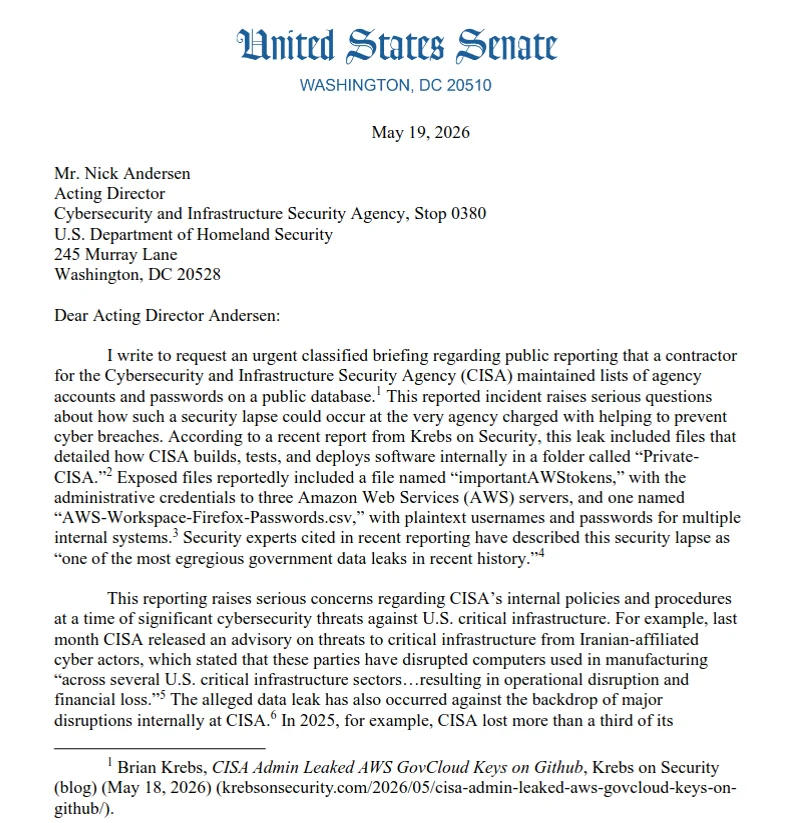
In a profound irony for the agency tasked with defending the nation’s digital infrastructure, the U.S. Cybersecurity & Infrastructure Security Agency (CISA) is currently embroiled in a high-stakes crisis. Lawmakers in both the House and Senate have launched formal inquiries into the agency following reports that a CISA contractor inadvertently—and perhaps negligently—exposed a massive cache of internal credentials, including highly sensitive AWS GovCloud keys, on a public GitHub repository.
The incident, first brought to light by KrebsOnSecurity, has sparked outrage on Capitol Hill, raising fundamental questions about the agency’s internal security culture, its oversight of third-party contractors, and its ability to protect its own digital perimeter. As CISA works to mitigate the fallout, the cybersecurity community remains on high alert, fearing that state-sponsored actors and cybercriminals may have already weaponized the leaked data.
The Breach: A "Private" Repository Exposed to the World
The breach centers on a public GitHub profile titled "Private-CISA," created by a contractor with administrative privileges on the agency’s development platform. Security researchers discovered that the repository contained plaintext credentials to dozens of internal CISA systems, acting as a veritable "master key" to the agency’s technical infrastructure.
Evidence gathered from the repository’s commit logs suggests that the contractor intentionally disabled GitHub’s native security features—tools specifically designed to scan for and block the publication of sensitive secrets, such as API keys and SSH credentials. Forensic analysis by security experts indicates that the repository was not a professional project, but rather a "scratchpad" used by the contractor to synchronize work between different environments.
By treating a public platform as a personal storage bin for high-level government credentials, the contractor effectively bypassed every security protocol intended to keep CISA’s "crown jewels" private.
A Chronology of the Exposure
- November 2025: Initial creation of the "Private-CISA" repository on GitHub.
- Late April 2026: The repository is updated with its most sensitive and critical credentials, including various AWS GovCloud access tokens.
- May 18, 2026: KrebsOnSecurity breaks the news of the leak, identifying the scope of the exposure.
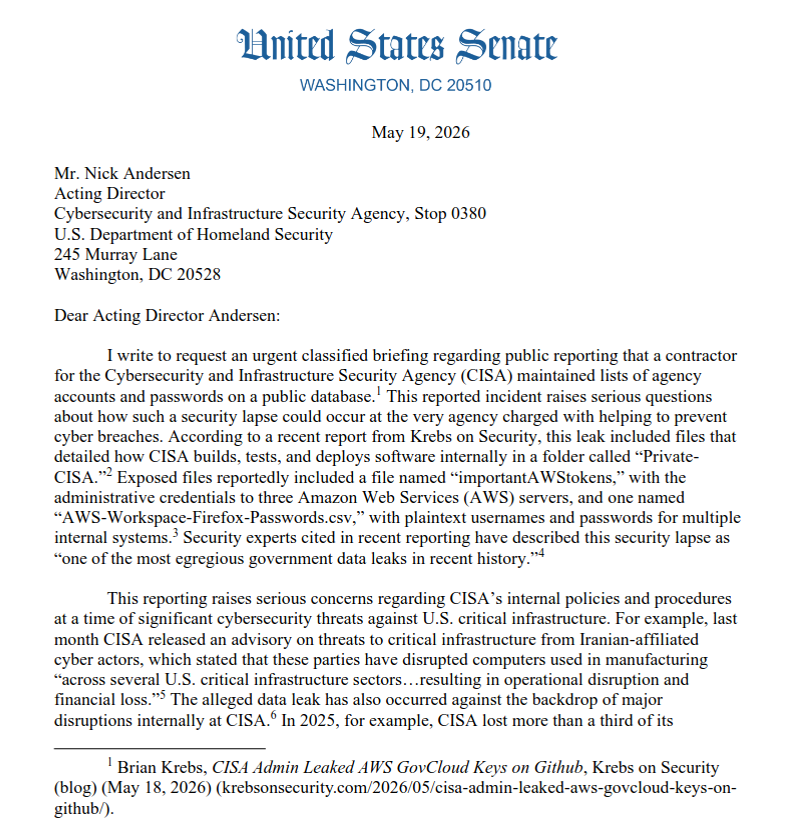
- May 19, 2026: Sen. Maggie Hassan (D-NH) sends a formal letter of inquiry to CISA Acting Director Nick Andersen. Simultaneously, Rep. Bennie Thompson (D-MS) and Rep. Delia Ramirez (D-Ill) demand answers regarding the agency’s security culture.
- May 20, 2026: Security firm Truffle Security identifies that critical RSA private keys remained active even after the initial discovery, granting potential access to the agency’s entire IT organization on GitHub. CISA begins the arduous process of revocation following external notification.
The Technical Fallout: What Was at Risk?
The severity of the leak cannot be overstated. Among the exposed data were credentials tied to the "CISA-IT" GitHub organization. Dylan Ayrey, creator of the open-source security tool TruffleHog, provided a sobering assessment of the danger.
"An attacker with this key could read source code from every repository in the CISA-IT organization, including private repositories," Ayrey explained. "They could register rogue self-hosted runners to hijack CI/CD pipelines, access repository secrets, and modify admin settings, including branch protection rules and webhooks."
In the world of software development, the CI/CD (Continuous Integration/Continuous Delivery) pipeline is the lifeblood of an agency. If an adversary gains control over these pipelines, they can inject malicious code directly into the agency’s software deployments. This allows for persistent, invisible access to systems that are trusted by default.
Despite CISA’s claims that there is "no indication that any sensitive data was compromised," industry experts remain skeptical. GitHub publishes a "firehose" of data—a real-time feed of public activity. Because this feed is accessible to anyone, including foreign intelligence services, the window of time between the initial commit and the discovery of the leak was likely sufficient for sophisticated threat actors to scrape and archive the credentials.
Congressional Outcry: A Crisis of Confidence
The incident has triggered a fierce response from lawmakers who view the breach as a symptom of a larger, systemic failure. Sen. Maggie Hassan’s letter to Acting Director Nick Andersen is particularly scathing, demanding a full accounting of the incident and a detailed explanation of why standard security guardrails failed.
"This reporting raises serious concerns regarding CISA’s internal policies and procedures at a time of significant cybersecurity threats against U.S. critical infrastructure," Hassan wrote.
Rep. Bennie Thompson and Rep. Delia Ramirez took the critique further, linking the incident to the current instability within the agency. CISA has recently undergone significant personnel turnover, losing over a third of its workforce and much of its senior leadership due to forced retirements and resignations under the current administration.
"We are concerned that this incident reflects a diminished security culture," the representatives wrote. They highlighted the danger of the leak in the context of global geopolitical tensions, noting that adversaries like Russia, China, and Iran are constantly monitoring for exactly this type of oversight to gain a foothold in federal networks.
Official Responses and Remediation
CISA’s official responses have been brief and measured, emphasizing ongoing remediation efforts. A spokesperson for the agency stated, "CISA is actively responding and coordinating with the appropriate parties and vendors to ensure any identified leaked credentials are rotated and rendered invalid and will continue to take appropriate steps to protect the security of our systems."
However, critics argue that the agency’s speed in responding to the incident has been inadequate. Days after the initial notification, researchers were still finding active, unrevoked keys in the wild. The struggle to rotate these credentials suggests that the agency’s inventory of its own digital assets—particularly those used by contractors—is incomplete or poorly managed.
Implications: The "Human Problem" in Cybersecurity
The CISA breach highlights a sobering reality: even the most robust technical security policies can be defeated by a single human error. James Wilson, editor for the Risky Business security podcast, noted that while organizations can implement top-down technical controls to prevent the use of public repositories for corporate work, they cannot easily monitor the personal devices and habits of contractors.
Adam Boileau, a security expert, argued that this is fundamentally a "human problem." When a contractor decides to synchronize work files to a home machine via a personal GitHub account, they are operating outside the agency’s visibility. This forces a conversation about the "Trust but Verify" model in federal contracting. Should contractors be allowed to maintain administrative access to sensitive platforms from unmanaged environments?
Lessons Learned and Future Outlook
As the dust settles, the CISA incident serves as a wake-up call for the entire federal government. It underscores three critical imperatives for modern cybersecurity:
- Strict Credential Management: The reliance on static, long-lived credentials must end. Agencies should shift toward ephemeral credentials and hardware-backed authentication that cannot be easily copied or pasted into a text file.
- Contractor Oversight: Agencies must enforce stricter controls on the environments from which contractors access sensitive government systems. If a contractor is handling critical code, their environment should be as secure and monitored as that of an internal employee.
- Active Monitoring of "Public Shadows": Organizations must proactively monitor platforms like GitHub for their own leaked data. Relying on outside security firms to identify breaches after the fact is a reactive posture that leaves the door open for adversaries.
The "Private-CISA" incident will likely result in a tightening of federal procurement and security standards. For now, however, the agency faces the uncomfortable task of rebuilding its reputation as the gold standard for cybersecurity, all while demonstrating that it can protect its own house from the very threats it warns others about.