









Main Facts
A decade has passed since House Speaker Paul Ryan and Ways and Means Committee Chairman Kevin Brady unveiled the "Better Way" tax reform blueprint—a sweeping legislative framework that laid the intellectual and structural groundwork for the Tax Cuts and Jobs Act (TCJA) of 2017. As the most comprehensive overhaul of the United States tax code in over three decades, the TCJA fundamentally restructured corporate and individual taxation, altering the economic and political landscape of the nation.
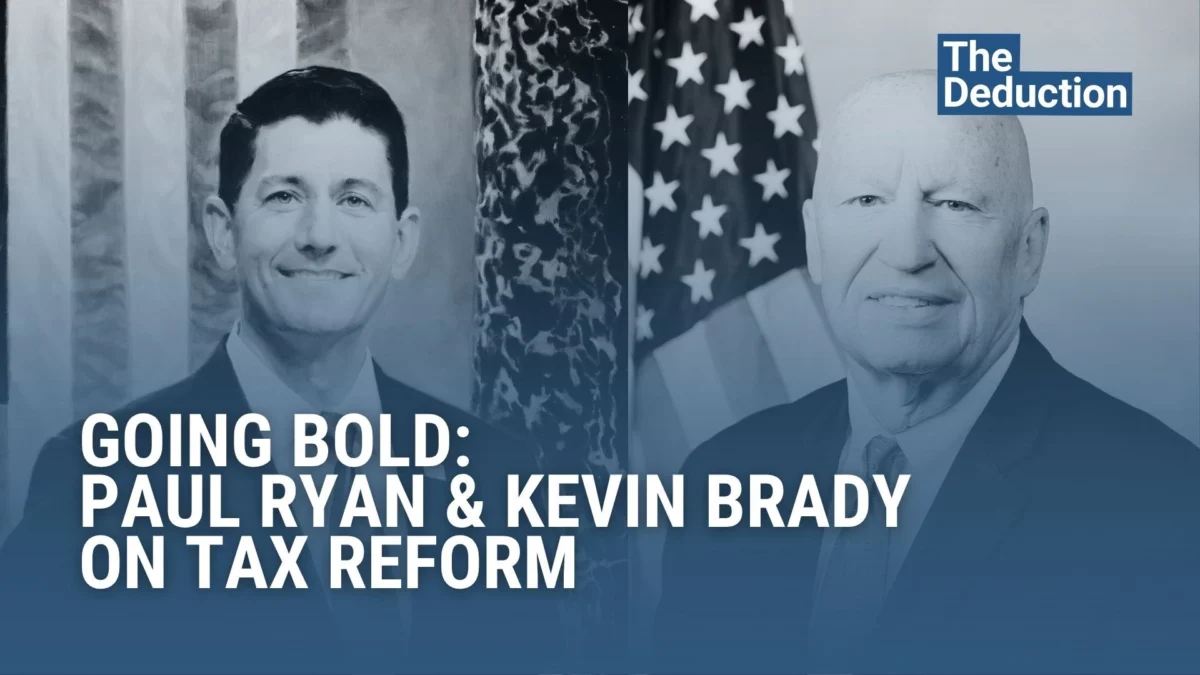
Today, as policymakers face a mounting national debt, looming insolvency timelines for key entitlement programs like Social Security, and an evolving global trade environment shaped by sweeping tariffs, the debate over the future of U.S. fiscal policy has returned to the forefront. To mark the tenth anniversary of the "Better Way" rollout, hosts Erica York and Kyle Hulehan dedicated a special episode of the podcast The Deduction to interviewing the original architects of the plan. Ryan and Brady reflected on the behind-the-scenes negotiations, the calculated political risks they took, the provisions that ultimately failed to make the final cut—such as the contentious border adjustment tax—and what a decade of hindsight reveals about the economic trajectory of the United States.
Chronology: From Concept to Law and Beyond
Understanding the magnitude of the 2017 tax overhaul requires tracing the decade-long evolution of conservative tax policy, from the initial frustrations with a stagnant tax code to the legislative battles of the Trump administration.
The Wilderness Years and the Genesis of "Better Way" (2010–2016)
Following the 2008 financial crisis and the subsequent sluggish economic recovery, Republican lawmakers in the House of Representatives recognized the urgent need for a cohesive economic narrative. The U.S. corporate tax rate, standing at 35 percent, was the highest in the industrialized world, incentivizing domestic companies to invert, hoard profits overseas, or invest abroad.
Under the leadership of Paul Ryan, who assumed the speakership in late 2015, and Kevin Brady, who took the helm of the powerful House Ways and Means Committee, House Republicans embarked on an ambitious policy project. Rather than reacting piecemeal to White House proposals, the congressional leadership decided to craft an unapologetic, comprehensive policy agenda. Released in 2016, the "Better Way" blueprint proposed slashing the corporate tax rate, transitioning the U.S. to a territorial tax system, consolidating individual tax brackets, and simplifying the tax filing process for millions of Americans.
The Legislative Sprint of 2017
The electoral victory of Donald Trump in November 2016 created a unified Republican government, turning the "Better Way" blueprint from an opposition roadmap into a governing agenda. Throughout 2017, Brady and Ryan worked in close coordination with the Trump administration and Senate leaders, chief among them Senate Finance Committee Chairman Orrin Hatch.
Despite operating under tight procedural constraints—specifically the use of budget reconciliation to bypass a potential Senate filibuster—lawmakers moved at a historic pace. The legislative process involved intense lobbying from interest groups, grueling negotiations over state and local tax (SALT) deductions, and eleventh-hour compromises to secure the necessary votes. On December 22, 2017, President Trump signed the Tax Cuts and Jobs Act into law, fulfilling the core promises of the "Better Way" framework.
Post-Enactment and the 2025/2026 Expiration Horizon
In the years following its passage, the TCJA became a central pillar of the pre-pandemic economic expansion, characterized by historically low unemployment rates and rising real wages. However, to comply with Senate budget rules under reconciliation, many of the individual tax provisions—including lower individual income tax rates, the doubled standard deduction, and the expanded Child Tax Credit—were written to expire at the end of 2025.
As a result, the current fiscal debate centers heavily on the looming expiration of these provisions, transforming tax policy into one of the most critical battlegrounds in modern American politics.
Supporting Data: Economic Impact and Fiscal Realities
A decade after the initial drafting of the "Better Way" plan and seven years post-TCJA, economists and policy analysts continue to debate the empirical data surrounding the legislation’s impact on growth, investment, and federal revenues.
Corporate Tax Restructuring and Investment
The most enduring feature of the TCJA was the permanent reduction of the federal corporate income tax rate from 35 percent to 21 percent. Proponents argued this change was vital to restore American competitiveness. According to data from the Bureau of Economic Analysis and the Tax Foundation, the immediate aftermath of the tax cuts saw a significant repatriation of foreign-held corporate earnings and an uptick in domestic capital expenditures.
By aligning the U.S. corporate rate closer to the Organization for Economic Co-operation and Development (OECD) average, the legislation successfully curbed corporate inversions—a trend where American firms relocated their legal headquarters overseas to lower their tax burdens.
Individual Provisions and the Labor Market
On the individual side, the TCJA lowered marginal tax rates across most brackets, nearly doubled the standard deduction, and expanded the Child Tax Credit to $2,000 per child. These changes simplified tax compliance for millions of households, removing the need for many lower- and middle-income taxpayers to itemize deductions.
Economic analyses of the post-2017 labor market noted strong wage growth, particularly for lower-income workers, alongside historically low unemployment rates among minority groups prior to the COVID-19 pandemic. However, critics point out that the distribution of tax savings skewed numerically higher for upper-income earners, whose aggregate tax liabilities dropped significantly in dollar terms.
The Fiscal Cost and the National Debt
The primary criticism levied against the "Better Way" framework and the resulting TCJA centers on their impact on the federal budget deficit and the national debt. Dynamic scoring models utilized by the Joint Committee on Taxation (JCT) and independent think tanks projected that the tax cuts would spur economic growth, generating dynamic revenue feedback that would offset a portion of the static cost.
Nevertheless, the legislation resulted in a substantial net reduction in federal tax receipts. Combined with subsequent bipartisan and partisan spending packages—including emergency relief during the COVID-19 pandemic—the national debt has climbed past $34 trillion. This fiscal reality has complicated current debates, as lawmakers weigh the economic benefits of extending the expiring 2017 provisions against the inflationary and fiscal risks of adding trillions more to the deficit.
Official Responses and Reflections: Insights from The Deduction
On the anniversary episode of The Deduction, hosts Erica York and Kyle Hulehan engaged Paul Ryan and Kevin Brady in a candid retrospective, exploring the political calculus that shaped the legislation and the lessons learned from policy misfires.
The Politics of Boldness
Reflecting on the creation of the "Better Way" agenda, Paul Ryan emphasized that structural reform requires political courage and a willingness to confront entrenched interests. Ryan noted that policymakers often fall into the trap of incrementalism, tweaking the edges of a broken tax code rather than addressing its foundational flaws. By releasing a comprehensive blueprint, leadership forced both internal party unity and external opposition to engage with a serious, market-oriented alternative.
The Border Adjustment Tax That Wasn’t
One of the most revealing segments of the podcast discussion focused on the provisions that did not survive the legislative gauntlet. Chief among them was the proposed Border Adjustment Tax (BAT)—a cornerstone of the original "Better Way" framework designed to tax imports while exempting exports, effectively leveling the playing field for domestic manufacturers.
Kevin Brady detailed the intense political pushback the BAT faced from multinational retailers, importers, and foreign trade partners, who warned it would raise consumer prices and disrupt global supply chains. Ultimately, the proposal was abandoned due to insurmountable opposition within the business community and the Senate. Both Ryan and Brady acknowledged the BAT as a classic example of a theoretically elegant economic concept colliding with harsh political and commercial realities.
Looking to the Future of Tax Reform
With the expiration date of the TCJA individual provisions fast approaching, both architects stressed that the next Congress and White House face an unprecedented fiscal challenge. Beyond simply debating whether to extend the 2017 cuts, policymakers must grapple with structural entitlement reform, demographic shifts, and the economic fallout of modern protectionist trade policies, including broad-based tariffs.
Implications: The Next Era of Fiscal Policy
As the United States stands at the threshold of a new legislative era, the lessons of the "Better Way" blueprint and the TCJA offer critical guidance for future economic policymakers.
The 2025/2026 Fiscal Cliff
The immediate implication of the 2017 tax cuts is the impending expiration of its individual provisions. If Congress takes no action, American taxpayers will face the largest tax increase in modern history, as rates revert to pre-2017 levels and the standard deduction is halved. Navigating this fiscal cliff will require immense political dexterity, particularly in a closely divided Congress where majorities are razor-thin. Lawmakers will have to decide whether to offset the trillions in extension costs through spending cuts, base-broadening measures, or accept higher deficits.
The Intersection of Taxes and Trade
While the 2017 reform championed a globalized, market-oriented corporate tax structure, the political consensus on trade has shifted dramatically over the past decade. Modern economic policy increasingly relies on tariffs, industrial policy, and protectionist measures to resupply domestic manufacturing and counter geopolitical rivals. Future tax reforms will have to operate within this new paradigm, balancing the desire for competitive corporate rates against the inflationary pressures of import taxes and supply chain localization.
Entitlement Reform and Long-Term Sustainability
Perhaps the most sobering implication highlighted by the decade anniversary of the "Better Way" is the unsustainable trajectory of the federal budget. With Social Security and Medicare racing toward insolvency within the next decade, tax policy can no longer be evaluated in a vacuum. Any serious long-term reform must reconcile the revenue-generating side of the ledger with mandatory entitlement spending.
As Erica York and Kyle Hulehan concluded in their special anniversary discussion, the legacy of the "Better Way" tax plan is not merely a set of statutes codified in 2017, but a benchmark for how policymakers approach structural change. Whether the next generation of leaders can summon the same ambition to tackle the fiscal crises of today and tomorrow remains the defining question for the future of the American economy.