








As traditional cigarette consumption continues a decades-long, public-health-driven decline, state budgets face an impending fiscal reckoning. For generations, tobacco excise taxes served as a reliable, highly lucrative stream of revenue for local governments. But as smokers successfully stub out traditional cigarettes in favor of non-combustible alternatives, states are experiencing a profound revenue crater.
Enter oral nicotine pouches—discreet, smoke-free alternatives that deliver nicotine without the dangerous chemicals and toxic combustion associated with traditional cigarettes. These alternative nicotine products (ANPs) have rapidly exploded in popularity, successfully drawing millions of consumers away from smoking. However, as states scramble to integrate these innovative products into their existing tax codes to plug budget gaps, a dangerous policy mismatch is taking shape.
Across the nation, state legislatures are applying blunt, punitive tax regimes to products that offer immense public health benefits. By miscategorizing smoke-free pouches alongside traditional tobacco, policymakers risk undermining harm reduction, fueling cross-border smuggling rings, and disincentivizing smokers from making life-saving transitions.
Main Facts: The Rise of Nicotine Pouches and the State Tax Scramble
Oral nicotine pouches—marketed under popular brands like ZYN, On!, and Velo—consist of plant-based fibers, flavorings, and pharmaceutical-grade nicotine that is either extracted from tobacco plants or synthetically manufactured. Unlike traditional chewing tobacco, snuff, or cigars, most modern oral pouches do not contain leaf tobacco at all. Crucially, because they involve no combustion, they lack the tar and dozens of known carcinogens found in cigarette smoke. While nicotine is addictive, public health experts widely agree that it is not the primary driver of tobacco-related mortality; the smoke and toxic chemicals are.
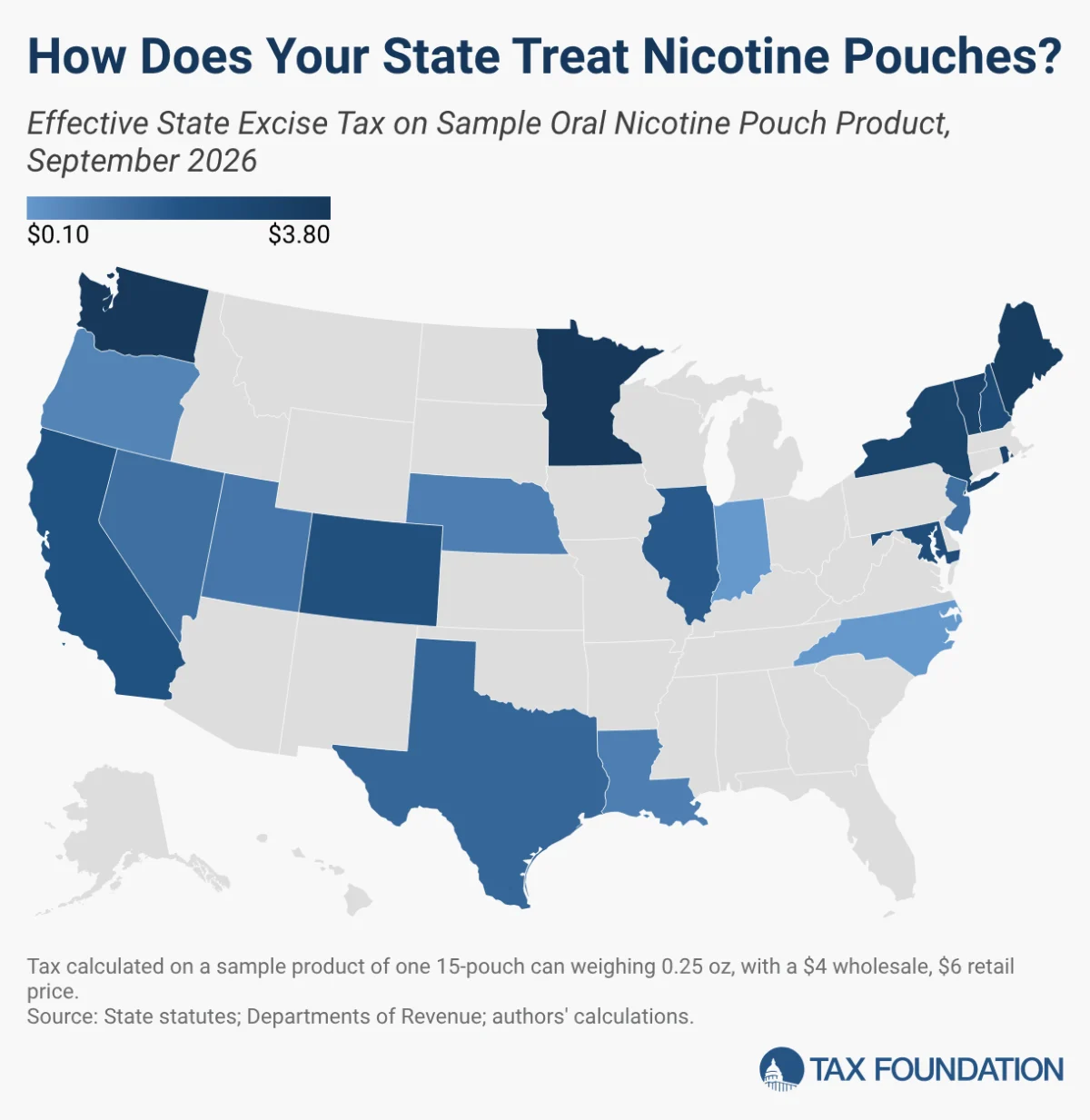
Despite these distinct chemical profiles, states are moving aggressively to tax them. As of September 2026, 20 states and the District of Columbia have formally incorporated oral nicotine pouches into their state tax frameworks.
Rather than developing tailored, evidence-based policies, the vast majority of these jurisdictions have committed a fundamental administrative error: they have lumped nicotine pouches into their broad, pre-existing tax categories for "Other Tobacco Products" (OTP). This umbrella category traditionally encompasses cigars, pipe tobacco, loose-leaf chewing tobacco, and moist snuff—products that are significantly more hazardous and structurally different than tobacco-free or synthetic oral pouches.
Consequently, consumers and retailers face an erratic patchwork of tax rates that vary wildly from state to state, creating severe market distortions and regulatory chaos.
Chronology: The Evolution of Smoke-Free Regulations and Legislative Action
The trajectory of alternative nicotine product regulation has evolved rapidly over the past decade, shifting from a period of unregulated market expansion to aggressive legislative catch-up:
- Mid-2010s: Early-generation alternative nicotine products, primarily open-system vapor products and e-cigarettes, enter the mainstream market, catching state tax authorities flat-footed.
- Late 2010s to 2020: Modern oral nicotine pouches emerge as a dominant market force, offering a clean, spit-free alternative that appeals heavily to adult smokers attempting to quit combustible cigarettes.
- 2021–2023: As cigarette excise tax receipts accelerate their decline, state budget offices begin identifying alternative nicotine products as a viable, untapped revenue base to offset structural deficits.
- 2024–2025: A wave of state legislatures introduces disparate bills to fold nicotine pouches into OTP classifications or draft standalone excise taxes, resulting in a fractured regulatory landscape across the United States.
- September 2026: Data reveals that 20 states and Washington, D.C., now explicitly tax oral nicotine pouches, with tax burdens stretching from fractions of a cent per pouch to exorbitant ad valorem wholesale rates exceeding 90 percent.
- January 2027 (Upcoming): Jurisdictions like Iowa are scheduled to implement new targeted frameworks, such as Iowa’s newly established $0.05-per-can tax set to take effect under SF 2480, signaling a potential shift toward more rational, ad quantum tax designs.
Supporting Data: A Wildly Disparate Tax Landscape
Because fewer than half of U.S. states currently tax nicotine pouches specifically, the existing spectrum of tax treatments is remarkably wide. To evaluate and compare the tax burden across state lines, analysts typically look at a standardized sample product: one can containing 15 pouches, sold at a wholesale price of $4.00 and a retail price of $6.00.
The disparity between high-tax states and low-tax states is staggering, easily rivaling—and often exceeding—the jurisdictional tax gaps historically seen with combustible cigarettes.
The Highest-Tax Jurisdictions
- Minnesota and Washington: Tied for the most punitive tax regimes in the nation. Both states levy a steep 95 percent wholesale tax, resulting in an effective tax burden of $3.80 on the sample can of pouches.
- Maine: Employs a weight-based tax structure with a strict one-ounce minimum, driving the tax on the sample product to $3.54.
- Rhode Island: Levies an 80 percent wholesale tax, translating to $3.20 per sample can.
- Vermont: Utilizes a weight-based tax with a 1.2-ounce minimum, placing the effective tax at $3.08.
The Lowest-Tax Jurisdictions
- North Carolina: Maintains the most consumer-friendly and harm-reduction-aligned tax policy, charging a mere $0.005 per pouch—equal to just $0.10 per standard can of 20.
- Indiana: Imposes a $0.50-per-ounce tax with no minimum weight requirement, resulting in an effective tax of $0.13 on the sample product.
- Oregon: Levies a flat $0.65 per standard can.
- Louisiana and Nebraska: Both assess a 20 percent wholesale tax, capturing $0.80 from the sample product.
| State / Jurisdiction | Tax Mechanism | Effective Tax on Sample Can (15 pouches / $4 wholesale / $6 retail) |
|---|---|---|
| Minnesota | 95% Wholesale Tax | $3.80 |
| Washington | 95% Wholesale Tax | $3.80 |
| Maine | Weight-Based (1 oz. minimum) | $3.54 |
| Rhode Island | 80% Wholesale Tax | $3.20 |
| Vermont | Weight-Based (1.2 oz. minimum) | $3.08 |
| Louisiana | 20% Wholesale Tax | $0.80 |
| Nebraska | 20% Wholesale Tax | $0.80 |
| Oregon | Flat Tax per Standard Can | $0.65 |
| Indiana | $0.50 per ounce (no minimum) | $0.13 |
| North Carolina | $0.005 per pouch | $0.10 ($0.13 for a 25-pouch equivalent) |
Official Responses and Economic Insights: The Harm Reduction Imperative
Public health advocates, economists, and tax policy organizations have increasingly criticized state legislatures for prioritizing short-term budget fixes over long-term public health outcomes.
The Tax Foundation and other economic research institutions have established a comprehensive policy framework for evaluating alternative tobacco product taxation, anchored in the principle of harm reduction. Harm reduction is a pragmatic public health strategy that focuses on minimizing the adverse consequences of behavior rather than demanding total, immediate abstinence—which is often unrealistic for addicted consumers.
According to tax analysts, excise taxes should be directly tied to the public health harms they seek to mitigate. Because oral nicotine pouches are empirically proven to be drastically less harmful than combustible cigarettes, applying equivalent or near-equivalent tax rates defies economic logic and undermines public health goals.
"A better tax policy would be to tax oral pouches with their own specific rate," note tax policy researchers. "An ad quantum tax levied per can or per ounce is a better tax base than an ad valorem tax based on price. States that embrace harm reduction can generate the necessary revenues while enabling growth and health benefits from innovative products."
By reducing excise taxes on safer alternatives relative to deadly cigarettes, governments create a crucial price differential. This financial incentive encourages stubborn smokers to make the switch to smoke-free options. Conversely, excessive taxation closes that price gap, trapping consumers in deadly cigarette habits and depriving society of massive long-term healthcare savings.
Implications: Smuggling, Market Distortions, and the Path Forward
The extreme variance in state tax codes carries severe unintended consequences that reach far beyond local treasury ledgers.
Cross-Border Smuggling and Arbitrage
Just as exorbitant cigarette taxes have historically fueled massive illicit smuggling networks and cross-border arbitrage (such as purchasing cheap cigarettes in neighboring states or tribal lands), nicotine pouch taxation is triggering identical behavioral responses.
For instance, consumers living in high-tax Washington state can save approximately $3.15 in taxes on a single can of pouches simply by crossing the border into Oregon. Alternatively, Washington residents can avoid state excise taxes entirely by shopping across the northern border in Idaho. These massive financial incentives inevitably spur informal gray markets, illicit enterprises, and cross-border shopping sprees that rob high-tax states of their projected revenues.
The Case for Principled Tax Design
As smoking rates continue their secular decline, cash-strapped state governments will undoubtedly continue eyeing alternative nicotine products to fill the growing void in their budgets. However, how they choose to tax these products will determine whether they foster public health or inadvertently protect the cigarette industry.
States that have yet to incorporate nicotine pouches into their tax schemes face a clear choice. Ideally, leaving alternative nicotine products untaxed maximizes the price differential that encourages smokers to transition away from combustible tobacco, yielding maximum public health dividends.
However, if fiscal pressures make taxation politically unavoidable, states must abandon the lazy practice of lumping pouches into "Other Tobacco Products" categories. Lawmakers must design principled, ad quantum excise taxes that are strictly proportional to the actual, relative harms of the product. By establishing moderate, predictable tax rates, states can successfully capture sustainable revenues, protect legal retail markets from illicit competitors, and—most importantly—empower millions of smokers to embrace a dramatically safer future.