









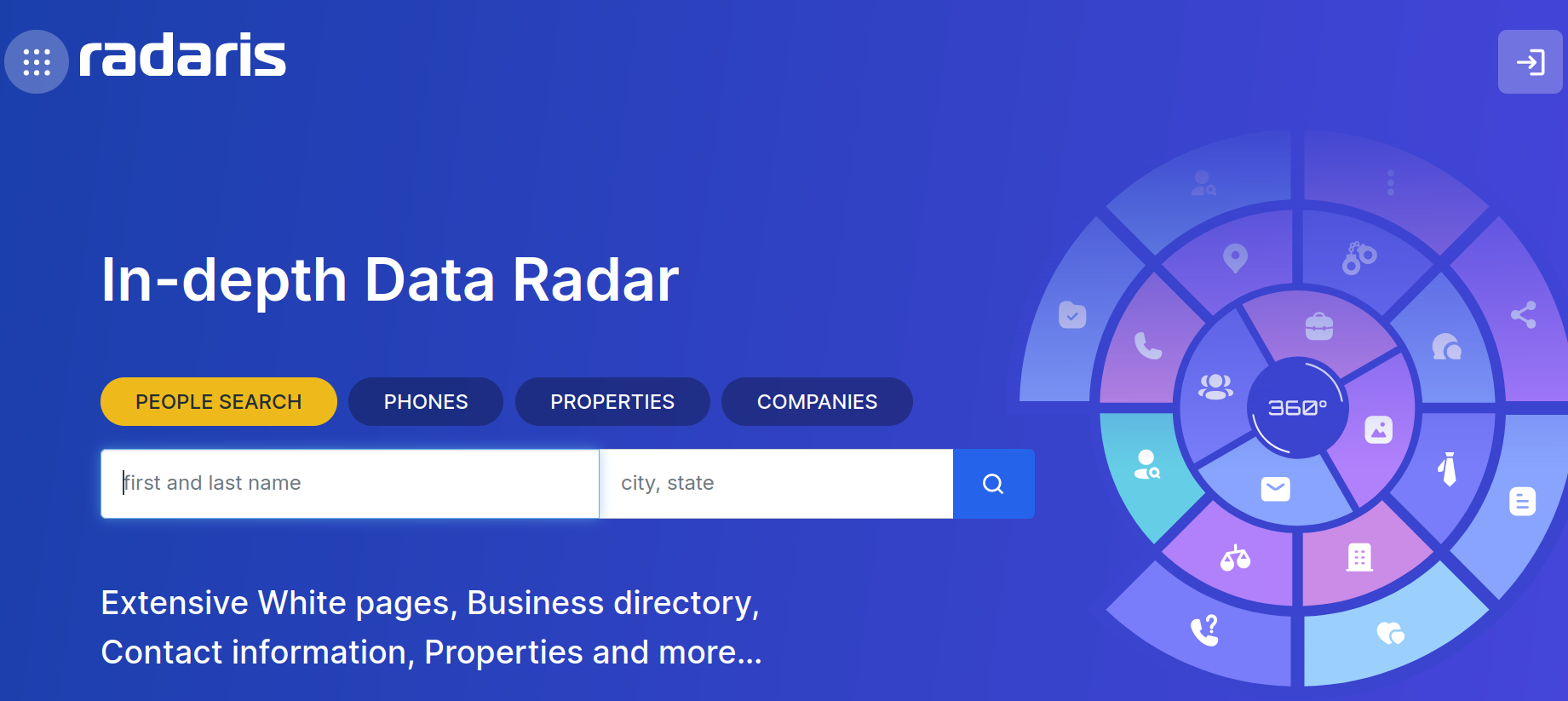
The sprawling empire of Radaris.com—a notorious player in the commercial data broker industry long criticized for its refusal to remove personal information—has finally faced a reckoning. In a landmark legal maneuver that sends a shockwave through the "people-search" sector, a New Jersey court has ordered the transfer of Radaris.com and over a dozen affiliated domains to the plaintiffs, Atlas Data Privacy Corp.
This dramatic seizure follows years of calculated stonewalling, jurisdictional "shell games," and the use of fictitious executive identities. The litigation centers on New Jersey’s "Daniel’s Law," a stringent privacy statute designed to protect law enforcement officials, judges, and government personnel by granting them the right to have their sensitive personal information scrubbed from commercial databases. For a company that built its business model on the commodification of private lives, the loss of its primary web property marks a significant, if not existential, turning point.
A Chronology of Deception and Evasion
The saga began in earnest in February 2024, when Atlas Data Privacy Corp filed suit against Radaris, alleging systematic violations of Daniel’s Law. The statute, born from the tragic murder of the son of a U.S. District Court judge, mandates the removal of personal data for public servants and imposes fines of $1,000 per violation for non-compliance.
However, the legal path to this outcome was anything but straightforward. Shortly after the initial filing, investigations by KrebsOnSecurity uncovered that the company was not the decentralized, international powerhouse it claimed to be, but rather a closely held operation run by Russian-born brothers Igor and Dmitry (also known as "Dan") Lubarsky, residing in Massachusetts.
The "Island-Hopping" Playbook
As the litigation progressed, the Lubarsky brothers’ legal team, led by attorney Val Gurvits, engaged in a series of procedural maneuvers that appeared designed to exhaust the plaintiffs. When cornered, the defense would claim that the specific entity named in the lawsuit was merely a shell, or that the true "owner" was a company based in a tax haven like the Marshall Islands, the British Virgin Islands, or the Seychelles.
Matt Adkisson, CEO of Atlas, characterized this period as an "island-hopping" phase. "Privacy policies changed constantly, and new entities kept appearing," Adkisson noted. "Behind the scenes, it felt like a shell game. Defense lawyers told the court that certain entities merely operated the domains and were the proper parties to sue. But by the time a judgment neared, those entities would be discarded and new entities would appear."
This strategy reached a fever pitch in 2017 during an earlier class-action lawsuit. After Radaris lost by default, failing to appear in court, the company successfully blocked a domain transfer by arguing that the court had named the wrong entity—a Cyprus-based firm called Bitseller Expert Limited. The judge, respecting due process, halted the seizure. Following this, the operation shifted to "Andtop Company," a Marshall Islands entity. It was not until June 2025, when Atlas refiled with an expanded scope of defendants and deep investigative evidence, that the court finally lost patience with the defendants’ obfuscation.
The Anatomy of the Radaris Empire
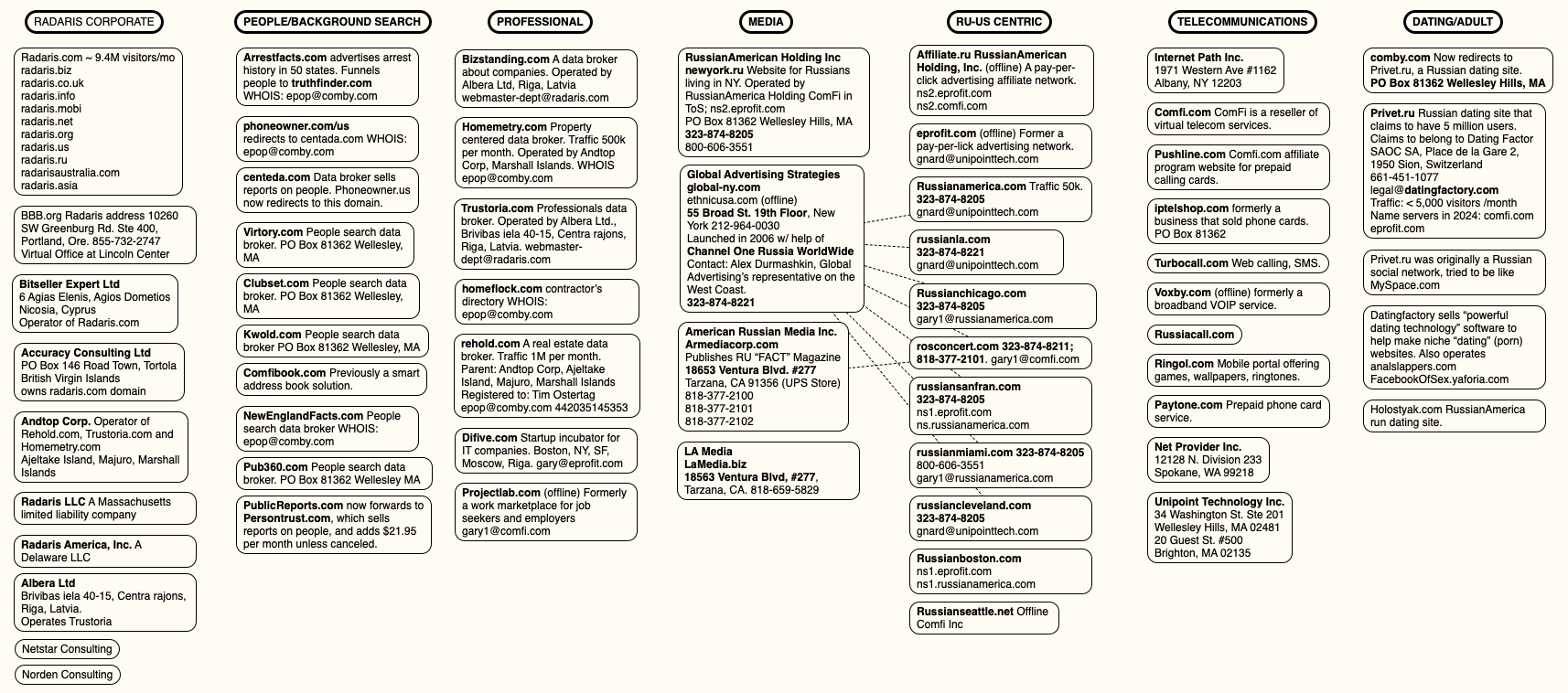
Beyond the courtroom drama, the evidence gathered by Atlas provides a rare, transparent look into the mechanics of the people-search industry. Through the discovery of over 10,000 emails and internal documents, the plaintiffs have mapped a monolithic operation masquerading as a collection of independent firms.
A Unified Infrastructure
The documentation confirms that legal vehicles such as Radaris America, Inc., Veripages, Inc., and Nuform Solutions, Inc., were not separate businesses. Instead, they were administered by a handful of individuals from a single set of mailboxes, sharing common bank accounts, payment processors, and virtual office addresses.
The internal correspondence reveals a lucrative business model. Radaris.com reportedly generates approximately $42,000 in monthly revenue, while its sister site, Veripages.com, nets an additional $45,000. These figures are bolstered by high-level partnerships with marketing firms like the Lifetime Value Company—which owns brands such as PeopleLooker and Bumper—and, ironically, "data removal" services like Onerep, which have been accused of profiting from the very problem they claim to solve.
The Myth of the CEO
Perhaps the most egregious example of the company’s bad-faith operations was the creation of "Gary Norden," a fictitious CEO. Radaris used this fabricated persona to issue press releases and solicit investment, a deception that the company’s own legal counsel eventually admitted to in court. The persistence of this lie, despite public scrutiny, highlights the lack of regulatory oversight governing these data brokers.
Official Responses and Legal Friction
Following the August 2026 court order to transfer the domains, the defense has shifted its rhetoric. Attorney Victor Worms, now representing the interests linked to the Radaris domains, has moved to vacate the judgment.
"We have made a motion to vacate that default judgment on the grounds that it is void since a non-entity has no legal capacity to sue or be sued," Worms stated. The defense maintains that the forfeiture of the domain name is a violation of constitutional principles, setting the stage for a protracted appeals process.
However, the reality on the ground has already changed. The domain Radaris.com no longer hosts its standard search interface. Visitors are instead greeted by an official notice from Atlas regarding the court-ordered transfer, effectively halting the daily ingestion and sale of private citizen data through that portal.
Broader Implications for Privacy Law
The case against Radaris is just one front in a much larger, national conflict. As of late 2026, approximately 150 other consumer data broker firms are facing similar litigation from Atlas. The industry has pushed back by attempting to move these cases to federal court, arguing that state-level laws like Daniel’s Law are overly broad and violate the First Amendment protections regarding the dissemination of public information.
The Constitutional Tug-of-War
The legal battle is currently in a state of flux. While the Third Circuit Court of Appeals weighs the constitutional challenges to Daniel’s Law, the landscape remains fractured. A federal district court in West Virginia recently ruled that a similar state privacy law was "facially unconstitutional," providing momentum to the brokers’ legal teams.
Privacy expert Justin Sherman, author of the forthcoming book The Middlemen, argues that the focus on individual state laws, while well-intentioned, is a reactive measure to a systemic failure at the federal level.
"The average person can look at Daniel’s Law and have a perfectly normal reaction, which is that everyone should be covered, not just police and judges," Sherman said. "But we don’t need more wake-up calls. We’ve had eight million wake-up calls already on the need for better privacy laws."
The "Public Record" Loophole
Sherman highlights a critical flaw in current legislative efforts: the exemption of "public records." Because data brokers source their information from marriage certificates, voting registries, motor vehicle records, and property filings, they can often circumvent privacy protections by claiming their data is derived from government-held information.
Without a comprehensive federal privacy law that restricts how companies collect, aggregate, and sell this data, companies like Radaris can simply rebrand, reorganize, and continue operations under new names. The recent breach at IDScan.net, which exposed the driver’s license information of 153 million Americans, serves as a grim reminder of the risks associated with the current "point-and-click" data economy.
Conclusion: A Pyrrhic Victory or a Precedent?
The seizure of Radaris.com is undeniably a major victory for privacy advocates and those protected under Daniel’s Law. It demonstrates that the veil of corporate anonymity and the tactic of endless procedural delay can, with enough resources and investigative grit, be pierced.
However, the future of the Radaris family of sites—and the hundreds of others like it—remains uncertain. Whether this case serves as a permanent deterrent or merely as a "cost of doing business" that leads to more sophisticated evasive maneuvers depends heavily on whether Congress chooses to step in. As Sherman notes, the lack of federal action is not a lack of knowledge, but a lack of political will in the face of intense lobbying. For now, the people-search industry continues to thrive, waiting to see if the precedent set in New Jersey will become the rule of the land or merely a singular, expensive bump in the road.