









For decades, earning a Doctor of Pharmacy (PharmD) degree was viewed as a direct ticket to financial security and a comfortable middle-class life. Today, however, graduates enter a drastically different economic landscape. Burdened by six-figure student loan balances and facing an evolving job market characterized by slower salary growth and increased competition, modern pharmacists must approach debt management with strategic precision.
Understanding the mechanics of student loan repayment is no longer just a personal finance chore; it is a critical professional survival skill. Whether graduates choose to refinance their private debt or pursue complex federal forgiveness pathways, navigating the nuances of debt relief can mean the difference between financial stability and decades of unnecessary strain.
Main Facts: The Anatomy of Pharmacist Student Debt
The financial realities facing graduating pharmacists are stark. According to data from the American Association of Colleges of Pharmacy (AACP), the average student loan debt for graduating pharmacy students stands at approximately $188,157, with nearly 81.5% of new PharmD degree holders carrying debt at commencement.
However, industry experts and financial planners argue that these baseline figures often underestimate the true scope of the problem. Private consultations with healthcare professionals frequently reveal average balances hovering closer to $234,685. Depending on the institution attended—ranging from relatively affordable public universities to high-cost private colleges—total debt can easily span anywhere from $50,000 to over $350,000.

Compounding this debt burden are broader economic shifts within the pharmacy profession:
- Stagnant Wage Growth: Major retail pharmacy chains like CVS and Walgreens have increasingly limited full-time hours in various regions, squeezing overall compensation.
- Residency Bottlenecks: Hospitals have recognized they can structure residency programs to hire multiple early-career pharmacists for the cost of a single veteran practitioner.
- Geographic Disparities: While urban and suburban markets suffer from an oversupply of applicants and depressed wage growth, underserved rural areas—particularly Health Professional Shortage Areas (HPSAs)—face severe shortages, creating pockets of high demand with room for salary negotiation and loan repayment assistance.
Chronology and Evolution of Pharmacist Debt Management
To understand how pharmacists arrived at the current crossroads of debt management, one must look at how federal policy and industry practices have evolved over the last twenty years:
- The Expansion of Higher Education Costs (2000s–2010s): The proliferation of private pharmacy schools drove tuition rates skyward. Combined with rising living expenses, borrowing caps on federal Grad PLUS loans allowed students to fund 100% of the cost of attendance, resulting in unprecedented debt-to-income ratios.
- The Introduction of Modern Income-Driven Repayment (IDR) and PSLF (2007–2014): The launch of Public Service Loan Forgiveness (PSLF) under the College Cost Reduction and Access Act of 2007 created a viable path for healthcare workers in nonprofit and government settings. Subsequent iterations of Income-Based Repayment (IBR), such as "New IBR" implemented in 2014, lowered payments to 10% of discretionary income for eligible borrowers.
- The Retail Pharmacy Shift (Late 2010s–Present): Traditional brick-and-mortar retail saturation altered employment dynamics. As retail positions became more demanding and less stable, a growing percentage of PharmD graduates shifted toward hospital residencies and non-traditional sectors, increasing their reliance on public- and private-sector forgiveness models rather than traditional private refinancing.
Supporting Data: PSLF vs. Private Refinancing
When evaluating repayment options, pharmacists must weigh the absolute cost against long-term cash flow flexibility.
The Public Service Sector: Public Service Loan Forgiveness (PSLF)
For pharmacists employed by qualifying 501(c)(3) nonprofit hospitals, community health centers, or government facilities, PSLF remains a powerful tool. To qualify, borrowers must hold federal direct loans, enroll in an income-driven repayment plan, and make 120 qualifying monthly payments while maintaining public service employment.

Case Study Comparison:
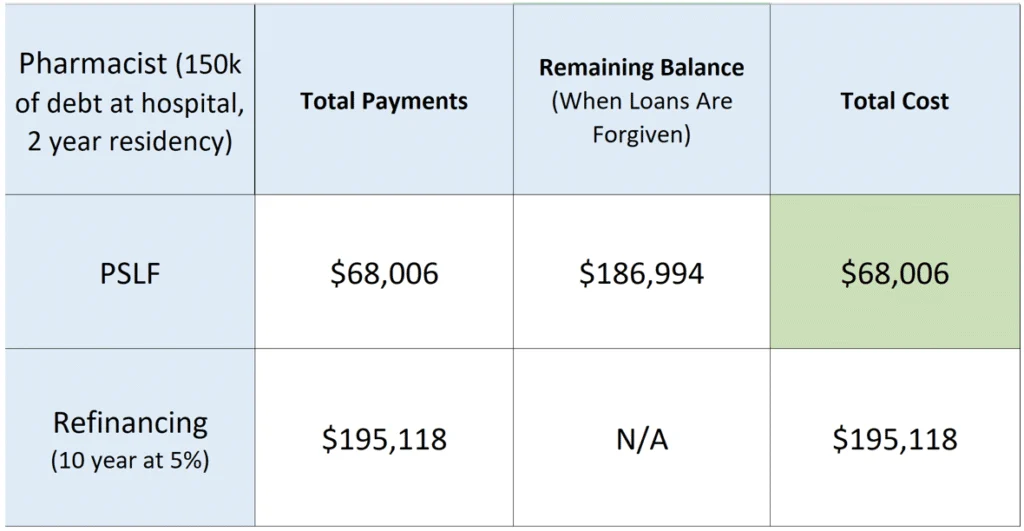
Consider a pharmacist who completes a two-year hospital residency and subsequently secures a full-time hospital position earning $110,000 per year, carrying $150,000 in federal student loans:
- Traditional Refinancing: Refinancing the balance at a 5% fixed interest rate over a 10-year term results in rigid, high monthly payments designed to eliminate the debt completely within a decade.
- PSLF Route: Enrolling in New IBR links monthly payments to 10% of discretionary income. Over ten years of qualifying public service, the total out-of-pocket payments are drastically lower than a 10-year refinance, resulting in a cumulative benefit worth more than $127,000 in forgiven principal and interest.
Note: Borrowers with private student loans are entirely ineligible for federal forgiveness programs and must rely on traditional refinancing.
The Private Sector: Long-Term IDR Forgiveness
For pharmacists working in for-profit retail settings (e.g., major commercial chains) who owe significantly more than they earn, private-sector loan forgiveness through an income-driven repayment plan can serve as a viable alternative.
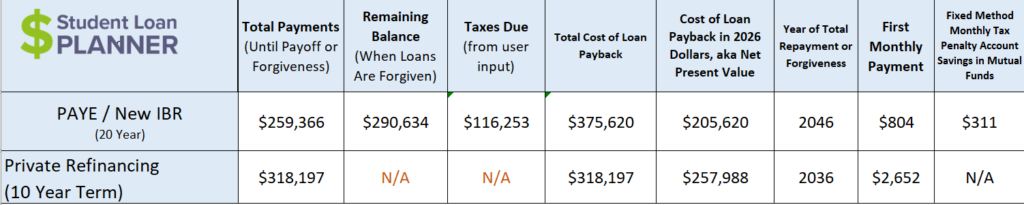
Under this strategy, borrowers make 20 to 30 years of income-driven payments (via plans like IBR, PAYE, or ICR). While the total cumulative payments in absolute dollars may exceed those of a standard 10-year refinance, discounting future cash flows makes this strategy highly cost-effective in present-day dollar values.
Furthermore, this approach frees up immediate monthly cash flow, allowing borrowers to aggressively fund retirement accounts (such as 401(k)s) and build dedicated savings reserves to offset the eventual tax liability on the forgiven balance—often referred to as the "tax bomb."
Official Responses and Strategic Loopholes
Financial planners and institutional analysts emphasize that debt management strategies must account for life changes, such as starting a family or transitioning to part-time employment.
The Part-Time Work Loophole in the Private Sector
A little-understood advantage of private-sector IDR forgiveness is how it handles reductions in labor force participation. If a pharmacist decides to scale back to part-time hours—whether to raise children or pursue personal interests—their adjusted gross income drops.
Because income-driven payments scale directly with earnings, a drop in income results in significantly lower monthly payments. For example, a pharmacist who cuts their hours in half during the first five years of their career will see their monthly payments shrink drastically while still accumulating qualifying months toward the 20-year forgiveness timeline. This dynamic can shave tens of thousands of dollars off the net lifetime cost of repayment in today’s dollars, granting crucial lifestyle flexibility without penalizing career pivots.
Implications for Future Pharmacists
The overarching implication for the pharmacy profession is clear: a one-size-fits-all approach to student loans is obsolete.
- High Debt-to-Income Requires Holistic Planning: Pharmacists whose debt exceeds 1.5 times their annual salary should carefully model income-driven forgiveness strategies—whether through PSLF in the nonprofit sector or long-term IDR in the private sector—rather than defaulting to aggressive private refinancing.
- Spousal Income Integration: Married borrowers must account for spousal debt and income when calculating IDR payments, as joint tax filing statuses will factor into government repayment formulas unless separate returns are filed.
- Professional Guidance: Given the complex regulatory framework governing federal student loans, tax implications, and shifting employment conditions, many healthcare professionals find value in consulting certified student loan planners to build customized, multi-decade financial blueprints.
Ultimately, navigating pharmacy school debt successfully requires balancing aggressive mathematical optimization with personal life goals, ensuring that a professional degree enhances—rather than hinders—long-term financial well-being.