








Main Facts: The High Cost of Lower Extremity Specialization
For Doctors of Podiatric Medicine (D.P.M.s), the journey to clinical practice is paved with rigorous academic demands and extraordinary financial investments. Specializing in the intricate biomechanics, pathology, and surgery of the human foot and ankle requires an exhaustive educational trajectory. Yet, this high-level medical expertise commands a steep price tag, routinely leaving graduates with six-figure debt burdens that rival those of traditional medical and dental school alumni.
The average podiatrist enters the workforce owing close to $300,000 in student loans. This financial reality creates a stark juxtaposition: while D.P.M.s train to treat one of the most critical structural foundations of the human body, they do so under the heavy weight of cumulative debt. Compounding this challenge is the structural makeup of the profession itself. Unlike general medical doctors or pediatricians, who frequently find employment within hospital networks or academic medical centers, more than 80% of podiatrists practice in private or group settings.
This private-practice dominance significantly restricts their access to federal relief initiatives like Public Service Loan Forgiveness (PSLF). Nevertheless, comprehensive financial modeling reveals that heavy student loan burdens do not necessitate a lifetime of financial strain. By evaluating debt-to-income ratios and understanding nuanced repayment mechanics, podiatrists can deploy specific financial frameworks—ranging from targeted forgiveness programs to aggressive refinancing—to preserve their long-term wealth.
Chronology: The Educational and Financial Trajectory of a D.P.M.
Understanding how podiatric debt accumulates requires examining the step-by-step professional development timeline of a D.P.M., along with the critical decision-making milestones that occur post-graduation.

Phase 1: Undergraduate Education (Years 1–4)
The foundation of podiatric medicine begins with a standard four-year bachelor’s degree. During this period, aspiring D.P.M.s accumulate undergraduate educational debt, setting an initial baseline for their overall borrowing profile.
Phase 2: Podiatric Medical School (Years 5–8)
Students enter one of a select group of specialized podiatric medical colleges nationwide. Tuition rates climb rapidly during this window. For instance, the estimated cost of attendance for in-state students at institutions like the Kent State University College of Podiatric Medicine approaches $89,000 annually. Meanwhile, graduates from programs such as the Western University of Health Sciences leave school with average debt loads nearing $268,000, and comprehensive tuition at institutions like Samuel Merritt University routinely exceeds $194,000 before factoring in essential living expenses.
Phase 3: Residency Training (Years 9–11)
Upon earning their D.P.M. degrees, graduates enter a mandatory three-year residency program. During this intensive clinical training phase, podiatrists experience a severe income mismatch: their debt continues to accrue interest while their annual compensation stalls between $50,000 and $60,000.
Phase 4: Attending Practice and Debt Optimization (Years 12 and Beyond)
Transitioning to an attending position brings a significant salary increase, with the Bureau of Labor Statistics reporting an average post-residency income of approximately $160,300. It is precisely at this career juncture that podiatrists must decide whether to pursue income-driven forgiveness tracks or pivot toward aggressive private refinancing.
Supporting Data: Debt-to-Income Benchmarks and Repayment Pathways
Financial experts who have collectively consulted on billions of dollars in student loan debt emphasize that a one-size-fits-all approach fails when dealing with D.P.M. finances. Instead, repayment strategies hinge entirely on a podiatrist’s debt-to-income (DTI) ratio and employment setting.
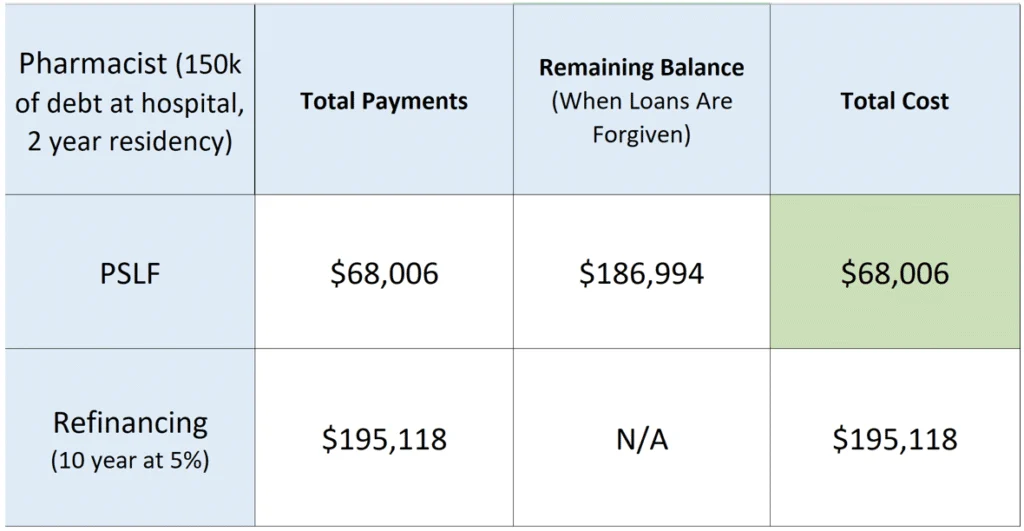
1. Public Service Loan Forgiveness (PSLF)
- Target Audience: D.P.M.s employed full-time by 501(c)(3) non-profit hospitals, government entities, or academic institutions.
- Mechanism: Requires Direct Federal Student Loans, enrollment in an Income-Driven Repayment (IDR) plan, and 120 qualifying monthly payments.
- Financial Impact: Remaining balances are forgiven completely tax-free. However, because over 80% of podiatrists operate in private practices, traditional PSLF remains inaccessible to the vast majority of the profession unless their private group maintains a direct affiliation with a qualifying non-profit healthcare system.
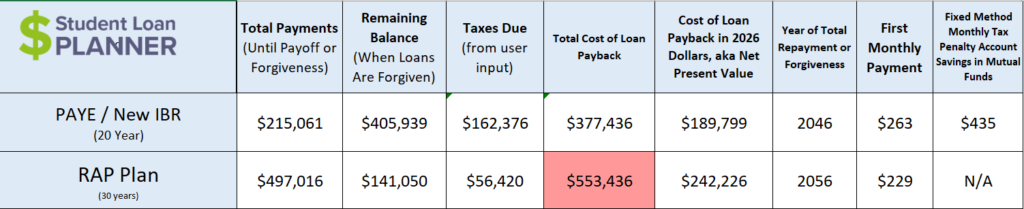
2. Taxable Loan Forgiveness via Income-Driven Repayment (IDR)
- Target Audience: Podiatrists who owe more than two times their income in student loans (e.g., owing $300,000 while earning $150,000 or less) and do not qualify for PSLF.
- Mechanism: Borrowers utilize plans such as the New Income-Based Repayment (IBR) or the Repayment Assistance Plan (RAP) to maintain minimal monthly obligations over a 20- to 30-year horizon.
- Financial Impact: While monthly cash flow is preserved, the remaining balance at the end of the term is forgiven and treated as taxable income—creating what is commonly known as the "tax bomb." Strategic planning requires setting aside funds monthly to offset this future tax liability.
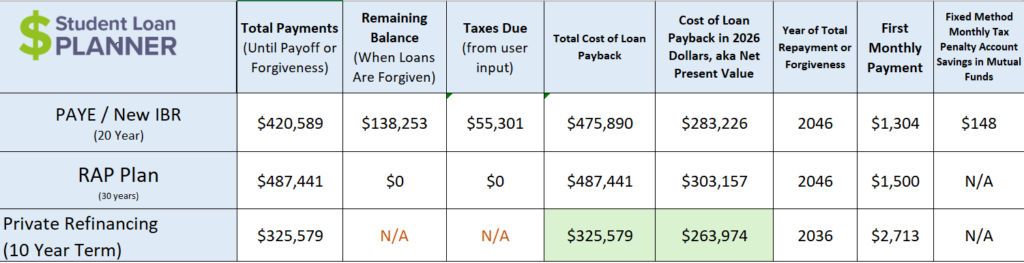
3. Aggressive Repayment and Private Refinancing
- Target Audience: Established podiatrists whose debt equals 1.5 times their income or less (e.g., owing $225,000 or less against an income of $150,000 or more) who lack PSLF eligibility.
- Mechanism: Refinancing federal loans with a private lender to secure a lower interest rate, targeting total elimination within 10 years or less.
- Financial Impact: Eliminates long-term interest accrual, resulting in substantial cumulative savings compared to prolonged IDR tracks.
Official Responses and Regulatory Standards
Navigating federal student loan programs requires strict adherence to statutory guidelines established by the U.S. Department of Education and Federal Student Aid (FSA). Podiatrists attempting to optimize their debt must navigate several regulatory nuances:
- Loan Type Verification: Federal Student Aid mandates that only Direct Federal Loans qualify for PSLF. Older Federal Family Education Loans (FFEL) are ineligible and must be consolidated into a Direct Consolidation Loan. Regulatory bodies advise borrowers that federal consolidation is entirely free, warning against predatory third-party companies charging fees for the process.
- Employment Certification: To maintain accurate tracking for PSLF, the federal government strongly encourages borrowers to file an Employment Certification Form (ECF) annually. This ensures that every qualifying payment under an approved IDR plan is officially logged against the required 120-payment threshold.
- IDR Plan Restructuring: Regulatory shifts in income-driven repayment frameworks—such as comparisons between New IBR (featuring a 20-year forgiveness timeline with payments calculated at 10% of discretionary income) and the Repayment Assistance Plan (RAP)—demonstrate that choosing the correct structural plan can save borrowers hundreds of thousands of dollars over the life of the loan. For example, financial models comparing a resident earning $55,000 who scales to a $120,000 attending salary illustrate that New IBR frequently outperforms alternative structures by combining lower cumulative lifetime payments with a shorter forgiveness horizon.
Implications: Strategic Wealth Building Beyond Basic Repayment
The financial decisions made during a podiatrist’s residency and early attending years ripple across their entire economic life. Beyond basic loan repayment, innovative financial products have emerged to help D.P.M.s leverage their professional status for broader wealth accumulation.
The Intersection of Student Debt and DPM Mortgages
Because of their specialized doctoral designation, podiatrists often qualify for a specialized subset of physician mortgage loans known as DPM Mortgages. These financial products offer unique advantages:
- Zero Down Payment Options: Borrowers can finance up to 100% of a home purchase, allowing them to redirect capital that would have been used for a down payment directly toward high-interest student debt or emergency reserves.
- Elimination of Private Mortgage Insurance (PMI): Unlike conventional loans that penalize low down payments with mandatory monthly PMI fees, DPM mortgages waive this requirement.
- Tax Efficiency: Because mortgage interest is frequently tax-deductible when itemized—whereas federal student loan interest deductions phase out at higher income thresholds—structuring debt around a DPM mortgage can generate significant annual tax savings.
The Necessity of Personalized Advisory
Ultimately, the sheer magnitude of six-figure educational debt means that generalized advice is rarely sufficient. Variables such as household size, spousal income, regional cost-of-living differences, and long-term private practice acquisition goals mean that every podiatrist’s financial blueprint must be custom-tailored.
Whether a D.P.M. decides to aggressively refinance their private practice debt, build a tax reserve fund for an IDR forgiveness tax bomb, or pursue a non-profit career track for PSLF, early and deliberate planning remains the single most effective tool for neutralizing the podiatric debt burden and achieving lasting financial autonomy.