








Corporate taxation in the United States is rarely straightforward. While corporations operating within the country are subject to a uniform federal corporate income tax rate, the reality of business taxation is heavily localized. Layered on top of federal obligations are a complex web of state income taxes, gross receipts levies, local municipal assessments, and unique intergovernmental deduction mechanisms.
Understanding the true tax burden on American businesses requires looking beyond a single statutory percentage. As policymakers and economic analysts frequently note, how states structure their corporate taxes can make the difference between a booming, economically competitive business environment and a stagnant market that struggles to attract capital and talent.
Main Facts: The Anatomy of U.S. Corporate Taxation
At the federal level, corporations in the United States face a standard income tax rate of 21 percent. This rate was established under the Tax Cuts and Jobs Act of 2017 and remains the baseline for all corporate entities structured as C-corporations across the nation.
However, corporate taxation does not exist in a vacuum. Forty-four states, along with the District of Columbia, levy their own taxes on corporate income. Among these taxing jurisdictions, top marginal rates vary wildly, stretching from a modest 2.0 percent in North Carolina to a hefty 11.5 percent in New Jersey.
The structural approach to these state income taxes also differs significantly across the country:
- Flat vs. Graduated Rates: Thirty-one states and the District of Columbia levy a flat corporate income tax rate. Meanwhile, 13 states utilize a graduated rate structure, increasing the marginal tax percentage as corporate income scales upward.
- Alternative Levies (Gross Receipts Taxes): Four states—Nevada, Ohio, Texas, and Washington—bypass traditional corporate income taxes entirely, opting instead to levy gross receipts taxes. Gross receipts taxes are applied to a company’s gross sales without deductions for standard business expenses like compensation, the cost of goods sold, or overhead. This frequently leads to "tax pyramiding," where a product is taxed multiple times at various stages of production.
- Dual-Tax States: Delaware, Oregon, and Tennessee impose both a corporate income tax and a separate levy on gross receipts. Furthermore, states like Pennsylvania, Virginia, and West Virginia authorize local municipalities to levy gross receipts taxes at the city or county level.
- Tax Havens: Only two states, South Dakota and Wyoming, levy neither a corporate income tax nor a statewide gross receipts tax.
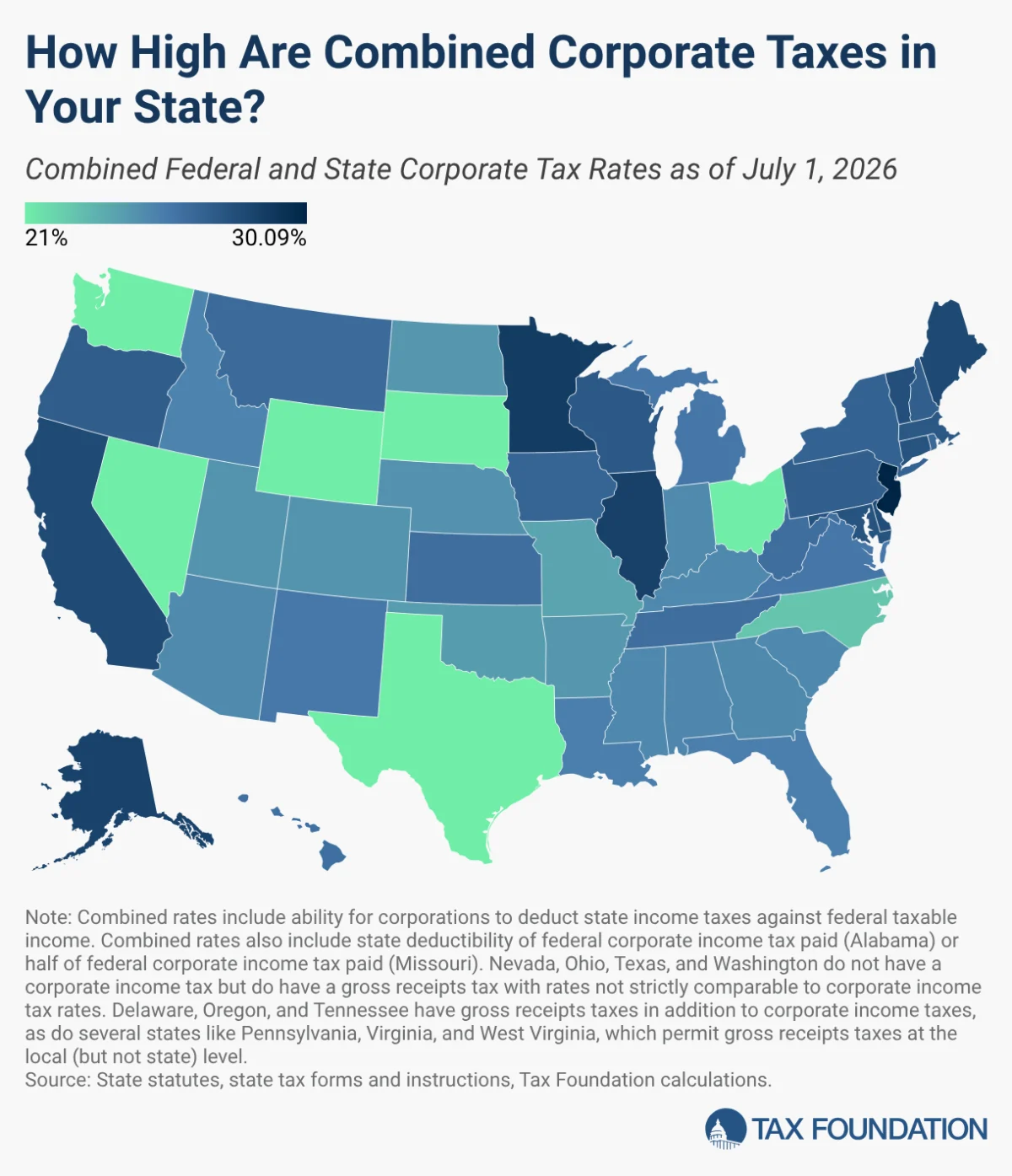
When combining federal obligations with state-level income taxes, the average combined state and federal corporate tax rate across the U.S. sits at 25.5 percent. However, geographic location can drastically alter this figure. New Jersey holds the title for the highest combined corporate income tax rate in the nation at 30.1 percent. Conversely, corporations operating in states with no state-level income tax (such as Texas, Nevada, and Wyoming) face only the baseline 21 percent federal rate.
Chronology: The Evolution of Modern U.S. Corporate Tax Policy
To understand today’s complex tax landscape, it is helpful to look back at the historical evolution of corporate tax reform in the United States.
- Early 20th Century (1909–1913): The federal corporate income tax predates the modern individual income tax. Congress first enacted a corporate excise tax based on income in 1909, which was quickly followed by the ratification of the 16th Amendment and the formal establishment of the federal income tax in 1913.
- The Mid-Century Expansion: Throughout the mid-20th century, as state governments expanded public services, infrastructure, and education systems, most states gradually adopted corporate income taxes to capture a share of growing corporate profits.
- The 1986 Tax Reform Act: A landmark moment in U.S. tax history, the bipartisan Tax Reform Act of 1986 significantly lowered marginal tax rates while broadening the tax base by eliminating numerous loopholes and shelters. This era established the framework for modern federal tax rates, which hovered near 35 percent for decades.
- The 2017 Tax Cuts and Jobs Act (TCJA): In December 2017, the federal corporate income tax rate underwent its most dramatic shift in modern history. The TCJA slashed the top federal corporate income tax rate from 35 percent down to 21 percent, moving the U.S. from having one of the highest statutory corporate tax rates among developed nations to a rate roughly in line with the global average.
- Post-2017 State Adjustments: Following the federal rate cut, numerous states adjusted their own corporate tax codes. Some states lowered their top marginal rates to remain competitive for business investments, while others—particularly high-spending, high-tax states—maintained or increased rates to protect state revenues.
Supporting Data: Understanding Interactions and Deductions
A major complication in calculating a corporation’s actual tax liability is the interaction between federal and state tax codes. Taxes paid are rarely calculated in absolute isolation; instead, complex deduction frameworks allow companies to offset liabilities at one level of government with payments made to another.
Federal Deductibility of State Taxes
Under current federal tax rules, corporations are permitted to deduct state corporate income taxes paid against their federal taxable income. This mechanism effectively lowers a company’s effective federal corporate income tax rate.
- Example: A corporation subject to Rhode Island’s flat 7 percent corporate income tax can deduct those state payments from its federal taxable income. When factored against the 21 percent federal rate, the effective federal rate drops to 19.53 percent, resulting in a true combined tax burden of 26.53 percent.
State-Level Deductibility of Federal Taxes
Conversely, a small handful of states allow corporations to deduct federal corporate income tax liabilities from their state tax calculations:
- Alabama allows full deductibility of federal corporate income tax liability against state tax liability.
- Missouri permits a 50 percent deduction of federal corporate income tax liability.
These rare deductions significantly lower the effective corporate income tax rates for businesses operating within these two states, offering a unique regional advantage.
High-Tax Jurisdictions
While the national average combined rate rests at 25.5 percent, corporations in several states face severe tax stacking. States with combined corporate income tax rates at or exceeding 28 percent include:
- New Jersey: 30.1 percent (Highest in the nation)
- Alaska: ~29.4 percent
- Illinois: ~29.5 percent
- Minnesota: ~29.8 percent
- Maine: ~28.9 percent
Official Responses and Perspectives
The debate over corporate taxation in the United States remains a central flashpoint between economists, business leaders, and policymakers.
Supporters of higher corporate taxes—often aligned with progressive fiscal policy organizations—argue that corporations must pay their fair share to support public goods, infrastructure, and social safety nets. From this perspective, lowering corporate tax burdens starves state and federal governments of critical revenue needed for education, healthcare, and climate resilience. Proponents of higher rates often point out that profitable corporations benefit immensely from public infrastructure and a trained workforce, and therefore should bear a proportionate financial responsibility.
Conversely, economic research organizations, such as the Tax Foundation, argue that corporate income taxes are among the most economically damaging ways to raise government revenue. Because capital is highly mobile, high corporate tax burdens can discourage businesses from expanding, hiring, or investing in new machinery and technology.
Economists emphasize that the ultimate burden of corporate income taxes does not fall solely on faceless corporate entities or wealthy shareholders; a substantial portion is passed down to workers in the form of lower wages, reduced benefits, and slower job growth, as well as to consumers via higher prices.
Implications for Economic Competitiveness and Future Reform
As states look toward the future, reforming corporate tax structures has emerged as one of the most promising avenues for enhancing regional competitiveness and stimulating economic growth.
States that rely on archaic mechanisms like gross receipts taxes—which penalize supply chains through tax pyramiding—or maintain excessively high marginal rates (such as New Jersey’s 11.5 percent top rate) risk losing businesses, entrepreneurs, and high-paying jobs to more tax-friendly jurisdictions. The ongoing nationwide shift toward remote work and corporate mobility has only accelerated this trend, allowing businesses greater freedom to relocate headquarters and operations to states with streamlined, low-rate tax codes.
Ultimately, corporate tax reform is not merely an accounting exercise. For lawmakers seeking to foster a dynamic economic climate, lowering the combined tax burden, eliminating distortionary levies, and simplifying compliance remain vital steps toward creating a resilient marketplace that benefits both companies and the American workforce.