






WASHINGTON — Graduating with a Doctor of Pharmacy (PharmD) degree is the culmination of years of rigorous scientific study, clinical rotations, and immense personal sacrifice. However, for a vast majority of new healthcare professionals, the celebration is immediately overshadowed by a daunting financial reality: six-figure student loan debt.
Depending on the institution attended, geographical location, and personal financial support systems, a newly minted PharmD graduate can easily find themselves owing anywhere from $50,000 to upwards of $350,000. With stagnant wage growth, tightening job markets in major metropolitan areas, and shifting corporate pharmacy landscapes, managing this debt requires more than just standard budgeting. It demands a sophisticated, long-term strategic plan leveraging federal programs, income-driven repayment frameworks, and forgiveness pathways.
Main Facts: The Staggering Reality of PharmD Debt
Recent data highlights an undeniable crisis regarding the affordability of advanced pharmaceutical education. According to the 2026 Graduating Student Survey compiled by the American Association of Colleges of Pharmacy (AACP), the average pharmacy student loan debt sits at $188,157 for graduates carrying balances. Furthermore, an overwhelming 81.5% of new PharmD degree holders enter the workforce burdened by educational debt.
Financial advisors and debt specialists, however, argue that these figures often understate the true severity of the problem. Real-world data from specialized advisory firms indicate that the average debt for pharmacist clients frequently climbs closer to $234,685. Because healthcare professionals require extensive, specialized education at specialized private or high-cost institutions—such as the Touro College of Pharmacy—their debt-to-income ratios can quickly become inverted, with balances heavily outpacing starting salaries.

Compounding this issue is the shifting economic landscape of the profession. Major retail pharmacy chains like CVS and Walgreens have increasingly restricted full-time hours in various regions, while hospital systems have expanded residency programs that utilize lower-paid resident pharmacists to offset labor costs. While rural and underserved areas designated as Health Professional Shortage Areas (HPSAs) continue to offer lucrative pay packages and robust recruitment incentives, traditional urban and suburban pharmacy salaries face significant growth headwinds.
Chronology: The Evolution of Pharmacist Debt and Repayment Strategies
Understanding how to tackle pharmacy school debt requires looking at the historical and regulatory shifts that have shaped modern student loan management over the past decade.
- Pre-2014 Landscape: For years, the default advice for graduating pharmacists was simple: aggressively pay down the principal or refinance private and federal loans with private lenders to secure a lower fixed interest rate. Income-driven repayment (IDR) options were viewed primarily as safety nets for low-income earners rather than viable long-term wealth-building strategies.
- July 1, 2014 (The Inception of "New IBR"): The implementation of regulatory updates introduced the "New Income-Based Repayment" plan for borrowers who took out their first federal loans on or after this date. This pivotal policy capped monthly payments at 10% of discretionary income, transforming IDR plans into powerful tools for high-debt, high-earning professionals aiming for long-term forgiveness.
- Late 2010s to 2020s: As private retail job markets tightened and tuition costs soared, financial planners began recognizing that traditional refinancing was mathematically disadvantageous for pharmacists with debt-to-income ratios exceeding 1.5-to-1. Public Service Loan Forgiveness (PSLF) and private-sector IDR forgiveness emerged as primary strategies rather than niche exceptions.
- The Current Era (2026 and Beyond): With average debts hovering near $188,000 to $235,000, pharmacists are increasingly utilizing complex multi-year repayment modeling. Graduates now strategically balance residency timelines, nonprofit employment, and part-time career flexibility against 20- to 30-year federal forgiveness horizons and potential tax liabilities.
Supporting Data: Comparative Breakdown of Repayment Options
To determine the optimal path for managing six-figure pharmacy school loans, graduates must carefully evaluate their career trajectories against quantitative models. The financial outcome depends heavily on whether a pharmacist chooses the public sector (nonprofit/government) or the private sector (retail/corporate), and whether they opt for refinancing or federal IDR plans.
1. Public Service Loan Forgiveness (PSLF)
For pharmacists employed by qualifying non-profit hospitals, community health centers, or government institutions, the PSLF program offers an unmatched financial lifeline.

- Requirements: Must hold federal Direct Loans, enroll in an income-driven repayment (IDR) plan, and make 120 qualifying monthly payments while working full-time (at least 30 hours per week) for a qualifying employer.
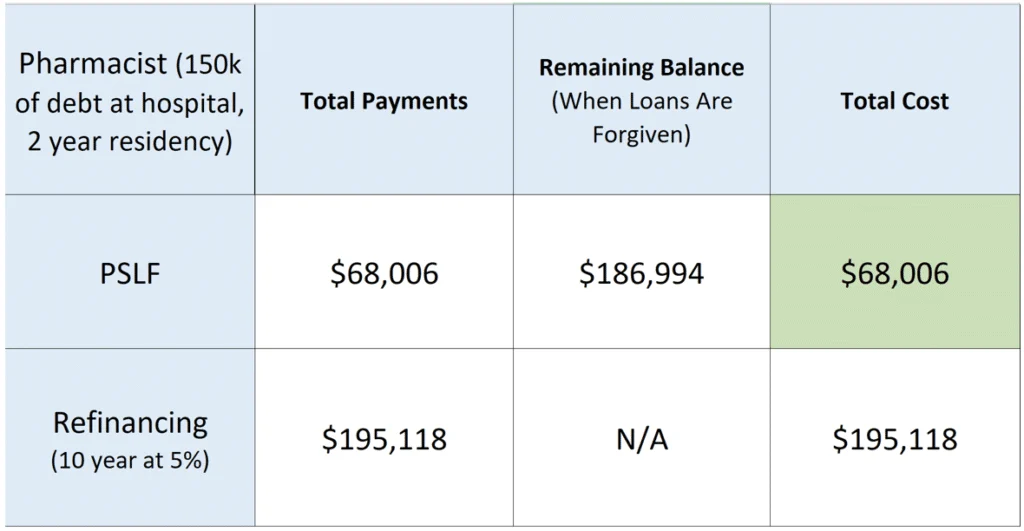
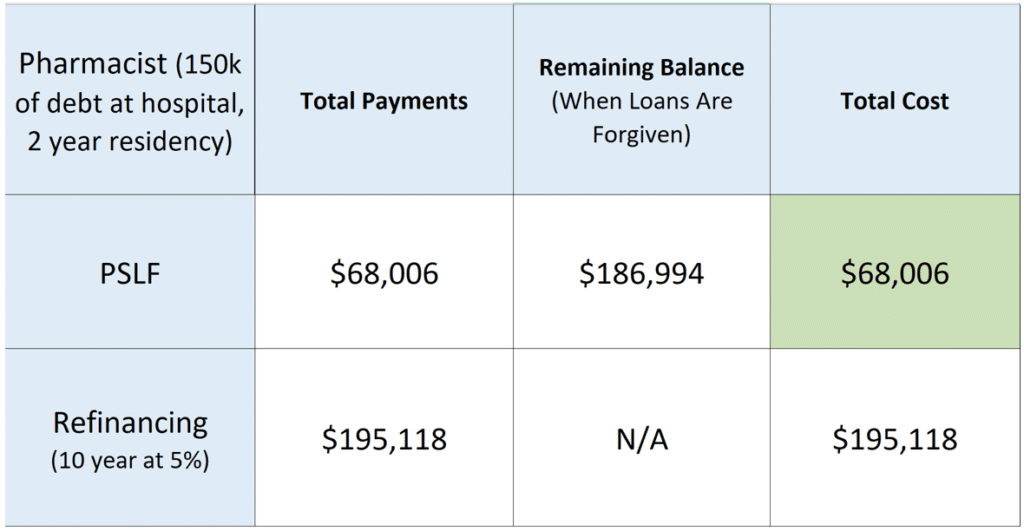
- The Math: Consider a pharmacist who completes a two-year residency and transitions to a hospital role earning $110,000 annually, carrying $150,000 in federal loans. Over 10 years of service under New IBR (paying 10% of discretionary income), the total out-of-pocket payment compared to refinancing at a 5% fixed rate over 10 years can yield over $127,000 in total savings.
- Limitation: Private student loans are strictly excluded from PSLF. Only federal loans issued by the U.S. Department of Education qualify.
2. Private-Sector IDR Forgiveness (The 20-to-30-Year Strategy)
For pharmacists working in retail chains or private industry where PSLF is unavailable, private-sector forgiveness via an income-driven repayment plan remains a viable, albeit misunderstood, alternative.
- Requirements: Enrolling in an IDR plan (such as New IBR, PAYE, or ICR) and maintaining payments for 20 to 30 years.
- The Math: Imagine a graduate who owes $250,000 at a 6% interest rate and secures a $120,000 full-time position at a retail chain. Refinancing at 5% over 10 years would require punishing monthly payments of approximately $2,652. Conversely, enrolling in New IBR could drop monthly payments to around $800. The borrower can then invest the difference—allocating funds toward retirement accounts and building a dedicated "tax bomb" savings fund to cover the IRS income tax applied to the forgiven balance at the end of the term.
- Strategic Advantage: When calculated using a discount rate, the present-value cost of long-term IDR forgiveness can match or beat aggressive refinancing, especially for borrowers whose debt significantly exceeds their annual income.
Official Stances and Expert Perspectives
Financial planners, academic associations, and regulatory bodies emphasize that there is no universal prescription for managing pharmacy debt.
- The American Association of Colleges of Pharmacy (AACP): Through ongoing tracking of graduating cohorts, the AACP underscores the escalating financial entry barriers into the profession. Their guidance continually points to the necessity of financial literacy initiatives prior to graduation so students understand the long-term compounding effects of high-interest healthcare education loans.
- Industry Debt Specialists: Financial planning experts caution against choosing an employer solely for loan forgiveness benefits, advising that career fulfillment and baseline compensation must remain primary considerations. However, advisors strongly urge professionals to structure eligible federal loans correctly from day one to preserve the option for PSLF or IDR forgiveness should employment circumstances shift.
- Tax and Regulatory Watchdogs: Experts continuously monitor legislative discussions surrounding federal student loans. A major variable in private-sector IDR forgiveness is the "tax bomb"—the Internal Revenue Service treating forgiven principal as taxable income. Financial advisors routinely counsel clients to hedge against potential policy shifts by setting aside funds in taxable brokerage accounts while aggressively maximizing tax-advantaged retirement vehicles like 401(k)s to lower adjusted gross income (AGI).
Implications: Flexibility, Life Choices, and the "Part-Time Loophole"
The implications of adopting a comprehensive student loan strategy extend far beyond simple balance sheets; they fundamentally alter lifestyle choices, family planning, and career mobility.
Career Flexibility and Part-Time Work
A significant advantage of federal income-driven repayment plans is their responsiveness to life changes. Pharmacists—particularly those balancing family planning or transitioning to part-time roles—often fear that reducing their labor force participation will derail their financial stability.
However, under private-sector IDR forgiveness models, part-time or full-time status does not alter the ultimate timeline for forgiveness. If a pharmacist reduces their hours or steps away from full-time employment for a multi-year period, their adjusted income drops, causing their monthly IDR payments to plummet.
For example, if a borrower temporarily cuts their working hours in half during the early years of their career, their monthly payments on an IDR plan might drop from $800 to $300. Crucially, these lower payments still count toward the required 20-to-30-year accumulation for forgiveness. In specific analytical models, this temporary reduction in earnings can shave tens of thousands of dollars off the total lifetime cost of loan repayment in present-day value, providing invaluable freedom and reducing burnout.
Final Takeaway for PharmD Graduates
Navigating pharmacy school debt requires moving past the knee-jerk reaction of aggressive refinancing. While refinancing remains an effective tool for private loan holders with stellar credit and manageable balances, federal loan borrowers must weigh the profound advantages of Public Service Loan Forgiveness and income-driven repayment frameworks.
Because individual financial landscapes are heavily complicated by factors such as spousal income, joint tax filing statuses, and fluctuating interest rates, graduates are encouraged to run comprehensive long-term financial models or consult specialized student loan planners. Ultimately, a well-structured debt strategy does not just clear a ledger—it restores professional autonomy and grants healthcare providers the financial breathing room to build a secure, prosperous future.