







Securing a mortgage is widely regarded as one of the most significant financial milestones in an individual’s life. However, the path to homeownership is rarely a perfectly paved road. During the rigorous process of mortgage underwriting, lenders examine your financial history with a fine-toothed comb. If they encounter discrepancies, gaps in employment, or “red flags” on your credit report, they may issue a request for a Letter of Explanation (LOE).
Far from being a sign that your loan application is doomed, an LOE is a vital tool that allows you to provide context to raw data. It bridges the gap between cold, hard numbers and the human reality of your financial journey. This guide provides an in-depth look at how to master this document, ensuring your application remains on the fast track to approval.
Understanding the Role of the Letter of Explanation (LOE)
At its core, a Letter of Explanation is a formal, written statement submitted to a lender to clarify specific concerns found within your credit report, bank statements, or employment history. To an underwriter, you are a collection of risk factors. When they see a late payment from three years ago or a six-month gap in your career, they do not automatically assume you are an irresponsible borrower; they simply lack the information to categorize that event correctly.
The LOE acts as your narrative bridge. It transforms a data point—such as a large, unexplained deposit in your checking account or a sudden dip in your credit score—into a verified life event. Whether the issue was caused by a global pandemic, a medical emergency, or a simple clerical error, the goal of the letter is to provide a clear, logical, and documented account of the situation.
Common Triggers for an LOE Request
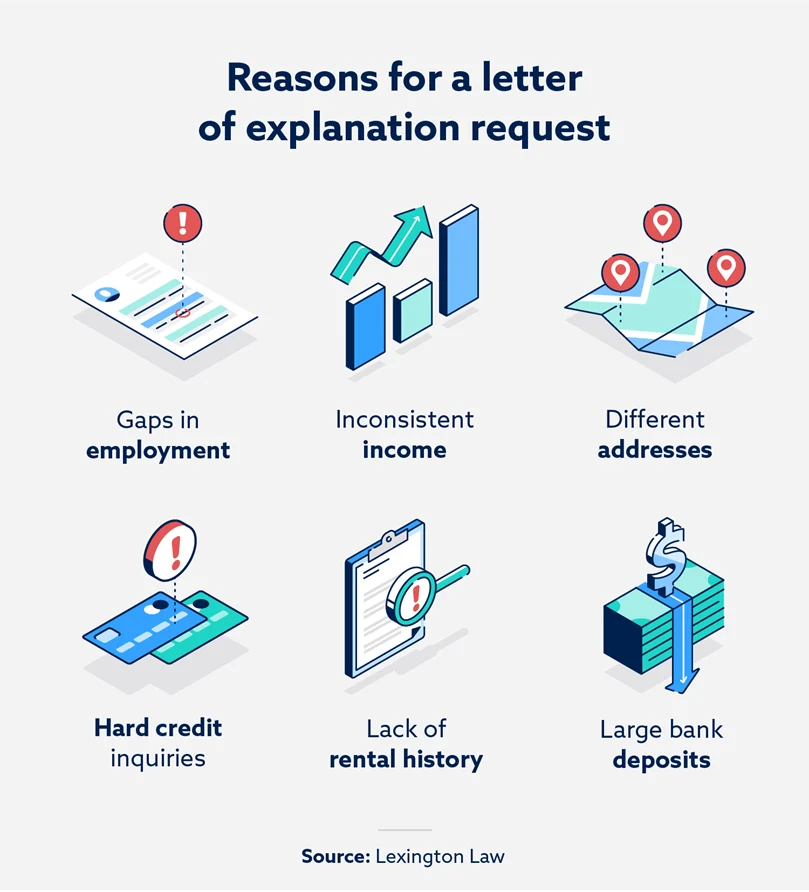
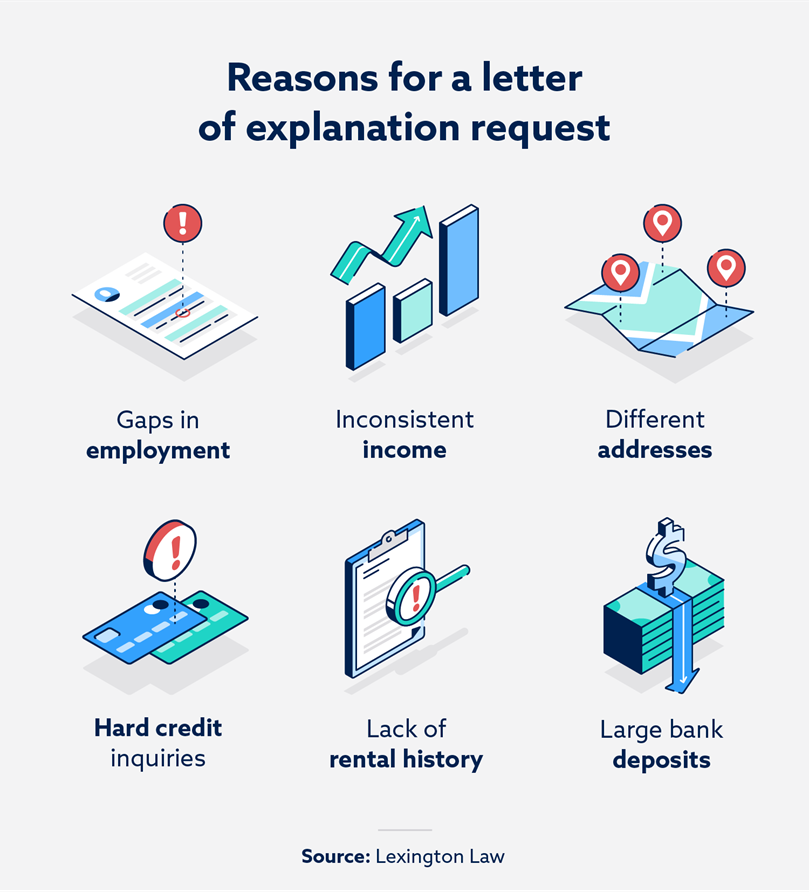
Lenders generally request an LOE when they encounter:

- Significant Employment Gaps: Time off between jobs can signal instability.
- Late Payments: Even a single missed payment can raise concerns about your long-term repayment habits.
- Large, Unexplained Deposits: To prevent money laundering, lenders must verify the source of any non-payroll funds.
- High Debt-to-Income (DTI) Ratios: Explaining why you hold certain debts can sometimes alleviate concerns regarding your ability to manage a new mortgage.
- Public Records: Bankruptcies, foreclosures, or tax liens that appear on your report require a detailed explanation of the circumstances and why they are unlikely to recur.
The Anatomy of an Effective LOE: A Five-Step Framework
Writing a successful Letter of Explanation is an exercise in precision. Underwriters are not looking for a creative, emotional memoir; they are looking for a sterile, objective, and highly professional document that simplifies their job.
1. Master the Header and Administrative Protocol
Before drafting, verify how your lender prefers to receive the document. Most modern lenders utilize secure digital portals, but some may require physical copies.
For formal letters: Use a professional block format. Include your full name, current address, the date, and the lender’s contact information. Crucially, include a "RE:" line that clearly lists your loan application number. Without this, your letter risks being lost in the shuffle of a busy underwriting department.
For email submissions: The subject line is your most important asset. Use a standard convention such as: Letter of Explanation – [Your Full Name] – [Loan Number]. Keep the body of the email brief, acting as a cover letter for the attached PDF.
2. State the Facts with Clinical Precision
The opening paragraph should address the "what" immediately. Do not beat around the bush. Use a "Date–Entity–Amount" format to identify the subject. For instance: “Regarding the $5,000 transfer into my savings account on June 12, 2024, this represents a gift from my parents for the down payment.”

Avoid emotional language. Phrases like "I was really struggling at the time" or "it was an incredibly difficult year" are generally counterproductive. Instead, use neutral, professional terminology. Replace "I was stressed and forgot to pay" with "A miscommunication regarding the automated billing portal led to a payment delay."
3. Provide a Logical Resolution
The most critical part of the letter is the "why it won’t happen again" section. An underwriter’s primary goal is to assess future risk. If you can demonstrate that you have implemented safeguards, your odds of approval increase significantly.
If the issue was a late payment, mention that you have since set up automated payments with your bank. If the issue was an employment gap, explain that you have returned to full-time status and provide the name of your current employer and your start date.
4. Professional Closing and Signatures
End your letter by stating that you are available for further questions and provide a direct phone number. Sign the letter exactly as your name appears on your loan application. If your spouse or partner is a co-borrower, check with your loan officer to see if they need to sign the letter as well. Any discrepancy between the application and the letter can cause unnecessary processing delays.
5. The Power of "Enclosures"
An LOE is only as strong as the evidence supporting it. If you mention a severance package, attach the severance agreement. If you mention an insurance payout, attach the check stub or claim document. Create a "List of Enclosures" at the bottom of the letter to serve as a table of contents for the underwriter.

Chronology and Supporting Data: A Practical Example
To understand the structure in practice, consider a borrower, "Jane Smith," who has a 30-day late payment and an 11-week employment gap.
- The Problem: A late payment on a credit card in February 2024.
- The Explanation: A billing portal change at the credit card company caused an auto-pay failure.
- The Documentation: A copy of the credit card statement and a screenshot of the new payment settings.
- The Result: The underwriter sees a one-time technical error rather than a pattern of financial irresponsibility.
By structuring the letter to acknowledge the date, the cause, the resolution, and the proof, Jane provides the underwriter with a "plug-and-play" solution to a potential hurdle.
Implications: When to Repair Credit Instead of Explaining
It is vital to understand that a Letter of Explanation is a tactical tool, not a cure-all. If your credit report contains fundamentally inaccurate or unfair items—such as identity theft, duplicate accounts, or payments that were actually made on time—an LOE is not the best approach.
In these cases, you should engage in credit repair. The letter explains the situation, but credit repair removes the negative information from your report entirely. If you have a history of inaccurate late payments, you have the legal right to dispute these with the credit bureaus.
At firms like Lexington Law, advocates help individuals identify these potentially unfair entries. By resolving these issues before you apply for a mortgage, you ensure that your credit score reflects your true financial health, potentially qualifying you for better interest rates and less scrutiny during the underwriting process.

Frequently Asked Questions (FAQ)
Does a letter of explanation guarantee loan approval?
No. An LOE is not a magic wand. It does not override your credit score or your debt-to-income ratio. However, it is an essential tool for preventing an automatic denial. Without an explanation, an underwriter might be forced to assume the worst about your financial history. With one, they have the context to justify an approval.
Should I be worried if the lender asks for an LOE?
Quite the opposite. An LOE request is a standard part of the mortgage process. It indicates that the underwriter is working to get your loan approved and simply needs a documented paper trail to satisfy regulatory requirements. View it as a routine administrative task rather than a sign of failure.
What if my letter is rejected?
If an underwriter rejects your letter, it typically means they still view the risk as too high. In this scenario, do not simply try another lender. Use the rejection as a signal to look deeper into your credit file. There may be underlying issues—such as unpaid collections or errors—that need to be formally disputed or settled.
Can I include multiple issues in one letter?
While you can address multiple issues, it is often clearer to write separate, concise letters for each specific item requested by the underwriter. This prevents the "cluttering" of information and ensures that the supporting documentation for one issue doesn’t get confused with another.
Final Thoughts: The Path Forward
The mortgage application process is a rigorous test of organization and transparency. By approaching the Letter of Explanation with a professional, factual, and proactive mindset, you transform yourself from a risky applicant into a transparent borrower. Remember, the underwriter is not an adversary; they are a gatekeeper tasked with assessing risk. Your job is to provide them with the evidence they need to clear your path toward homeownership.
If you find yourself overwhelmed by negative items on your credit report, consider consulting with credit repair professionals. By cleaning up your report before you begin the application process, you remove the need for explanations and position yourself for the best possible financial future.