








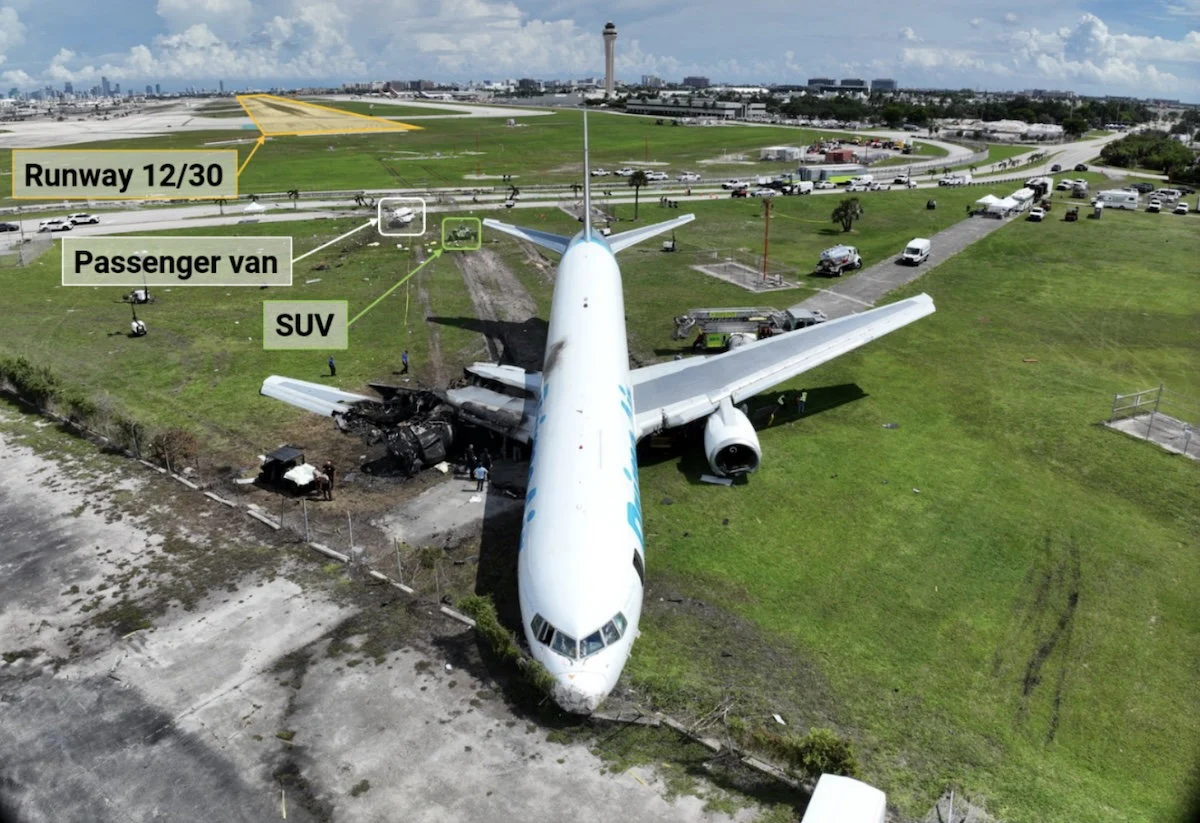
On September 6, 2026, the aviation community was shaken by a harrowing tragedy at Miami International Airport (MIA). An Amazon Air Boeing 767, operated by 21 Air, failed to stop within the confines of the runway, overrunning the pavement and causing a catastrophic incident that resulted in five fatalities—all of whom were occupants of vehicles in the path of the departing aircraft.
The National Transportation Safety Board (NTSB) has now published its preliminary report, shedding light on the critical chain of events that led to this disaster. While a final determination of probable cause remains months away, the preliminary data paints a disturbing picture of operational instability, communication breakdowns, and a series of indecisive maneuvers in the cockpit that ultimately sealed the fate of those on the ground.
The Sequence of Events: A Chronology of Failure
The NTSB’s preliminary findings reveal that the flight, which should have been a routine landing, devolved into a crisis almost the moment the aircraft neared the airport environment.
The Approach and Initial Warnings
According to reports previously corroborated by flight data recorder (FDR) analysis, the landing sequence was plagued by instability. The First Officer, recognizing the aircraft’s excessive speed, issued multiple verbal warnings to the Captain. According to internal sources, these urgent prompts regarding the plane’s high-energy state went largely unacknowledged by the Captain, who continued the approach despite the clear deviations from standard operating procedures.
The Touchdown and "Botched" Rollout
The landing itself was described by observers as highly irregular. The aircraft touched down significantly further down the runway than intended. The FDR data provides a staggering account of the subsequent seconds:
- Failed Deployments: Upon touchdown, the speed brakes remained in the stowed position, and the thrust reversers—vital for deceleration on a wet or short runway—failed to deploy.
- Erratic Control Inputs: Manual wheel braking was applied at a groundspeed of 146 knots. However, in a move that defied logic, the pilots released the brake pedals just eight seconds later.
- The Go-Around Ambiguity: With only 930 feet of runway remaining, the engines were suddenly throttled up to go-around power. Four seconds later, with the aircraft having traveled further and with only 415 feet of runway left, the throttles were pulled back to idle, and wheel brakes were reapplied.
The aircraft ultimately departed the runway end at 113 knots, impacting the localizer and the Medium Intensity Approach Lighting System with Runway Alignment Indicator Lights (MALSR) at the northwest end of Runway 30. Between the initial touchdown and the overrun, the aircraft—a massive, heavy-lift freighter—had shed only 47 knots of speed.

Supporting Data: The Technical Breakdown
The NTSB report serves as a somber technical autopsy of the flight. The inability to properly configure the aircraft for landing—specifically the omission of speed brakes and thrust reversers—placed an impossible burden on the wheel brakes alone.
In aviation, the "Swiss Cheese Model" of accident causation suggests that disasters occur when multiple holes in defensive layers align. In this instance, the technical failure to deploy drag-inducing devices was exacerbated by the pilot’s failure to commit to a decisive "go-around" when the instability was first identified. By the time the Captain attempted to apply full power for a missed approach, the aircraft was already too far down the runway to safely regain flight, creating a "no-win" scenario that led to the fatal overrun.
The Role of Air Traffic Control (ATC)
A significant development in the preliminary report involves the role of the Local Control South (LCS) air traffic controller. It is standard operating procedure for controllers to provide wind information when clearing an aircraft for landing, particularly when a tailwind component or gusty conditions are present.
The NTSB report confirms that the LCS failed to issue the required wind information to the Amazon Air flight. While the controller had provided wind data (190 degrees at 19 knots, gusting to 22 knots) to another aircraft four minutes prior, the Amazon Air flight was not on the frequency at that time and thus missed the advisory.
While this omission constitutes a regulatory failure, experts caution against viewing it as the primary cause of the accident. Meteorological information is typically available to flight crews through the Automatic Terminal Information Service (ATIS) and their own onboard instrumentation. Furthermore, the pilots were physically experiencing the crosswinds and gusts. The fact that the crew did not recognize the environmental challenges or the excessive speed they were carrying suggests that the lack of an ATC advisory was likely a secondary factor compared to the internal cockpit management issues.
Official Responses and Industry Implications
The NTSB’s investigative team has been praised for its swift and transparent dissemination of preliminary findings. In an era of political polarization, the NTSB continues to function as a beacon of empirical, non-partisan analysis. Their work is essential, not just for this specific case, but for the broader aviation industry to learn from these mistakes and update training protocols.

For Amazon Air and its contract carrier, 21 Air, the implications are severe. The incident has prompted intense scrutiny regarding pilot training, cockpit resource management (CRM), and the oversight of contracted air cargo operations. The "silence" from the Captain in response to the First Officer’s warnings—often referred to as a breakdown in the "sterile cockpit" and hierarchical communication—is expected to be a focal point in the subsequent investigation phases.
Looking Forward: Preventing Future Tragedies
The aviation industry operates on the principle that every accident must result in a systemic change. This tragedy in Miami is expected to trigger a rigorous review of:
- Go-Around Criteria: Emphasizing that a go-around is a mandatory safety tool, not a failure, when an approach becomes unstable.
- Automation and Configuration: Re-evaluating the physical checklists and cockpit ergonomics to ensure that critical braking and drag systems are engaged as a matter of muscle memory.
- Controller-Pilot Communication: Ensuring that wind advisories—no matter how routine they seem—are delivered consistently to prevent any "information gap" during high-workload phases of flight.
The loss of five lives on the ground at Miami International is a stark reminder that the consequences of aviation errors often extend far beyond the flight crew and the aircraft fuselage. As the investigation transitions from the preliminary stage to the final analysis, the focus will remain on how a series of individual decisions turned a routine flight into a catastrophe.
The NTSB is expected to hold a public hearing in the coming months, where the cockpit voice recorder (CVR) transcripts and further human-factors analysis will be reviewed. For now, the report stands as a somber warning: in the high-stakes environment of commercial aviation, complacency and indecision are as dangerous as any mechanical failure. The industry must now grapple with the sobering reality of the events of September 6, and work to ensure that the necessary lessons are integrated into the culture of air cargo operations globally.