







WASHINGTON — For millions of Americans, particularly younger generations and low-income households, wireless devices are no longer a luxury—they are an indispensable lifeline. Smartphones and mobile data plans serve as the primary gateway to employment, education, healthcare, and daily communication. Yet, even as telecom companies drive down the underlying costs of mobile plans through fierce market competition, government levies continue to march steadily upward.
A comprehensive analysis of telecommunications data reveals that by 2026, a typical American family with a four-line shared plan paying $100 a month for taxable wireless services will shell out roughly $345 annually in government taxes, fees, and surcharges. This represents an uptick from the $330 projected for 2025 and continues a long-term trajectory that places a disproportionate financial burden on everyday consumers.
With nearly 600 million wireless subscriber connections nationwide, the aggregate fiscal impact of these state, local, and federal impositions is immense. Collectively, U.S. wireless subscribers are projected to pump approximately $11.4 billion into state and local government coffers alone in 2026, driven by an intricate web of legacy excise taxes, emergency service fees, and rapidly expanding federal and state universal service fund surcharges.
Main Facts: The Anatomy of a Wireless Bill
To understand the modern cell phone bill, one must look beyond the base rate negotiated with carriers like Verizon, AT&T, T-Mobile, or regional providers. While market forces have successfully driven down the cost of connectivity over the last two decades, government-imposed costs have moved in the opposite direction.
Over the past twenty years, the average monthly revenue per wireless line collected by carriers has plummeted from $50.64 to $33.14. This deflationary trend reflects incredible technological advancements and competitive pricing structures. Unfortunately, these consumer savings have been heavily eroded by tax policy. Over that same 20-year span, the average tax burden on wireless services has surged from 16.2 percent to an all-time high of 28.8 percent.
This record-high tax load is the product of dual pressures:
- Federal Surcharges: The federal Universal Service Fund (FUSF) surcharge rate climbed from 13.26 percent to 14.39 percent.
- State and Local Impositions: The average state and local tax burden crept upward from 14.25 percent to 14.42 percent.
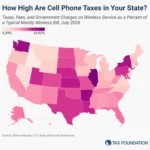
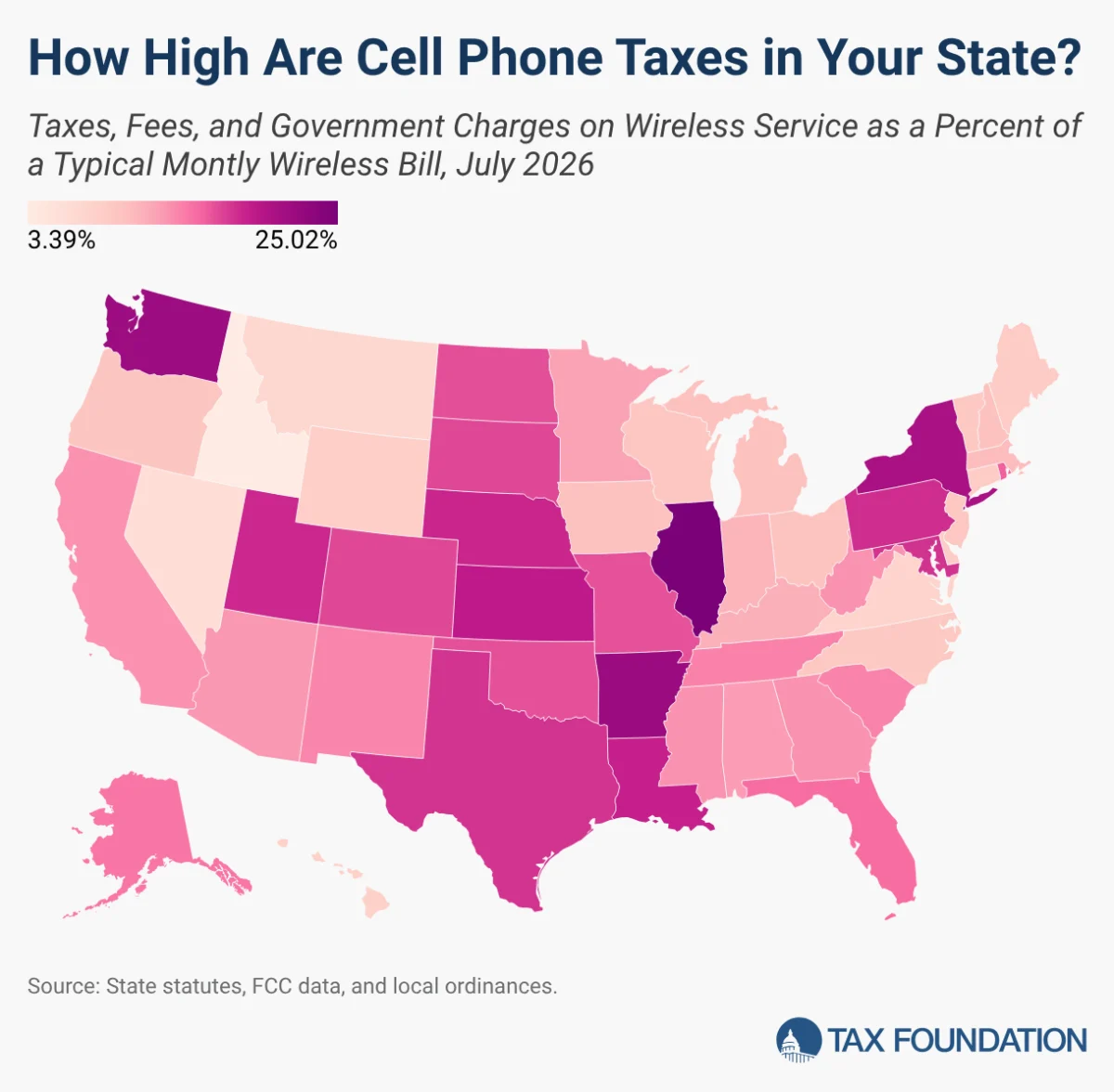
Geographic disparities across the United States remain stark. According to the data, Illinois maintains the dubious distinction of having the highest wireless taxes in the country, with combined state and local rates exceeding 25.0 percent. Arkansas follows closely behind at 22.0 percent, with Washington state rounding out the top three at 21.9 percent.
Conversely, consumers in Idaho enjoy the lowest wireless tax and fee burden in the nation at just 3.4 percent. Nevada (6.1 percent) and Montana (7.1 percent) also offer relatively low tax environments for mobile users.
Chronology and Evolution of Telecom Taxation
The framework governing how Americans are taxed for mobile communication has evolved significantly over the past several decades, shaped by federal interventions, state legislative actions, and the rise of new emergency services.
The Pre-Smartphone Era and the 911 Foundation
Historically, telecommunications taxes were designed for landline networks, which required heavy municipal infrastructure. When mobile phones emerged, many states simply rolled wireless services into legacy utility or luxury tax frameworks.
Concurrently, state and local governments began levying flat, per-line taxes to fund capital and operational expenses for emergency 911 systems. These fees vary wildly by jurisdiction. For instance, while most counties in Missouri levy little to no local 911 fee, the city of Chicago assesses a steep $5.00 per line, per month. To normalize these flat fees alongside percentage-based taxes, analysts convert them using average industry revenues tracked by the Cellular Telecommunications and Internet Association (CTIA).
The 2021 Introduction of 988 Crisis Hotlines
A notable milestone in modern wireless taxation occurred in 2021. Following a federal mandate by the Federal Communications Commission (FCC) designating "988" as a nationwide, three-digit number for suicide prevention and mental health crisis hotlines, Congress authorized states to finance the creation and operation of these call centers via targeted consumer fees.
Virginia became the first state to implement a 988 tax in 2021, charging $0.12 per line per month. In the years since, 10 additional states have enacted similar levies on wireless consumers to support mental health infrastructure.
Recent State-Level Reforms
While new fees continue to emerge, some states have taken steps to rein in over-taxation. In 2025, the Maine legislature voted to repeal the state’s Service Provider Tax, which had previously imposed a discriminatorily high state tax rate on wireless services compared to general retail goods. Despite isolated reforms, however, the broad national trend remains tilted toward higher effective tax rates.
Supporting Data and Fee Structures
The total tax load on a modern wireless bill is composed of several distinct layers, each justified by different policy rationales—though critics argue many have outlived their original purposes or evolved into generalized revenue generators.
| Fee / Tax Type | Description | Key Variations |
|---|---|---|
| Sales & Excise Taxes | 13 states levy wireless-specific taxes that are either in addition to standard sales taxes or replace them with a higher rate. | Rates range from low single digits in states like Idaho to over 25% in Illinois. |
| Federal Universal Service Fund (FUSF) | A percentage-based surcharge on interstate revenues used to subsidize telecommunication access in rural and low-income areas. | Rose to 14.39 percent in recent calculations. |
| State Universal Service Funds (SUSF) | Nearly half of all states impose their own SUSF charges on intrastate revenues. | Some states are shifting from percentage charges to flat per-line fees, penalizing multi-line family plans. |
| 911 Emergency Fees | Flat monthly per-line charges dedicated to local emergency dispatch operations. | Varies from $0 in parts of Missouri to $5.00 per line in Chicago. |
| 988 Suicide Prevention Fees | Small per-line surcharges enacted by 11 states to fund mental health crisis hotlines. | Initiated by Virginia in 2021 at $0.12/line; adopted by 10 other states since. |
Notably, internet access services—including wireless broadband data—enjoy protection under the Permanent Internet Tax Freedom Act. This federal law prevents state and local governments from imposing discriminatory taxes on internet access. Without this legislative shield, experts warn that the high excise tax rates currently applied to voice and mobile services would likely expand to cover mobile data, driving consumer tax burdens to unprecedented heights.
Official Responses and Policy Arguments
As states continue to look for reliable revenue streams, public policy organizations, industry groups, and consumer advocates are clashing over the fundamental fairness of targeting mobile phones.
The Case Against Excessive Wireless Taxes
Economic analysts and taxpayer advocacy groups argue that current mobile tax regimes fail standard principles of sound tax policy. The arguments against aggressive wireless taxation center on two primary pillars:
- Regressive Economic Impact: Wireless taxes hit low-income Americans and younger demographics the hardest. For households living paycheck-to-paycheck, a mobile phone is often their sole means of internet and voice access. Excessive government surcharges inflate the cost of digital inclusion, creating financial barriers for vulnerable populations trying to access remote work, online education, and telehealth.
- Stifling Infrastructure Investment: Discriminatory tax rates siphon capital away from network upgrades. Robust wireless infrastructure generates massive economy-wide positive externalities. Modern networks support productivity across transportation, healthcare, energy, and education sectors. During the COVID-19 pandemic, mobile and wireless broadband networks kept the American economy afloat by enabling remote work and distance learning—trends that have permanently altered the workforce. Taxing these networks punishes the very platforms driving modern economic efficiency.
Traditional Consumption vs. Discriminatory Excise Taxes
Economists generally agree that applying a broad-based sales tax to consumer goods and services is appropriate, provided it is structured as a neutral consumption tax. However, targeted excise taxes are traditionally justified under two specific conditions: a "user-pays" system (where taxes directly fund services used by the taxpayer) or the internalization of social costs (such as environmental levies on carbon).
Policy experts argue that high wireless taxes meet neither criteria. Instead, they function as hidden "sin taxes" or cash grabs on an essential utility, artificially inflating consumer bills and discouraging digital adoption.
Implications for the Future of Connectivity
Looking ahead to 2026 and beyond, the friction between government revenue needs and the imperative for affordable digital access will only intensify. As 5G networks mature and industries begin laying the groundwork for 6G technologies, the demand for mobile data will skyrocket.
If state and federal lawmakers continue to treat wireless services as an easy target for deficit reduction and specialized fund-raising, they risk pricing marginalized consumers out of the digital economy. Furthermore, by piling surcharges onto shared family plans—such as the shift toward per-line SUSF fees—governments penalize households that consolidate lines for economic efficiency.
Policymakers face a clear choice: continue down the path of high-cost, regressive mobile taxation that ultimately dampens national productivity, or reform telecommunications tax structures to align with the modern reality that mobile connectivity is a fundamental utility, not a luxury item.