









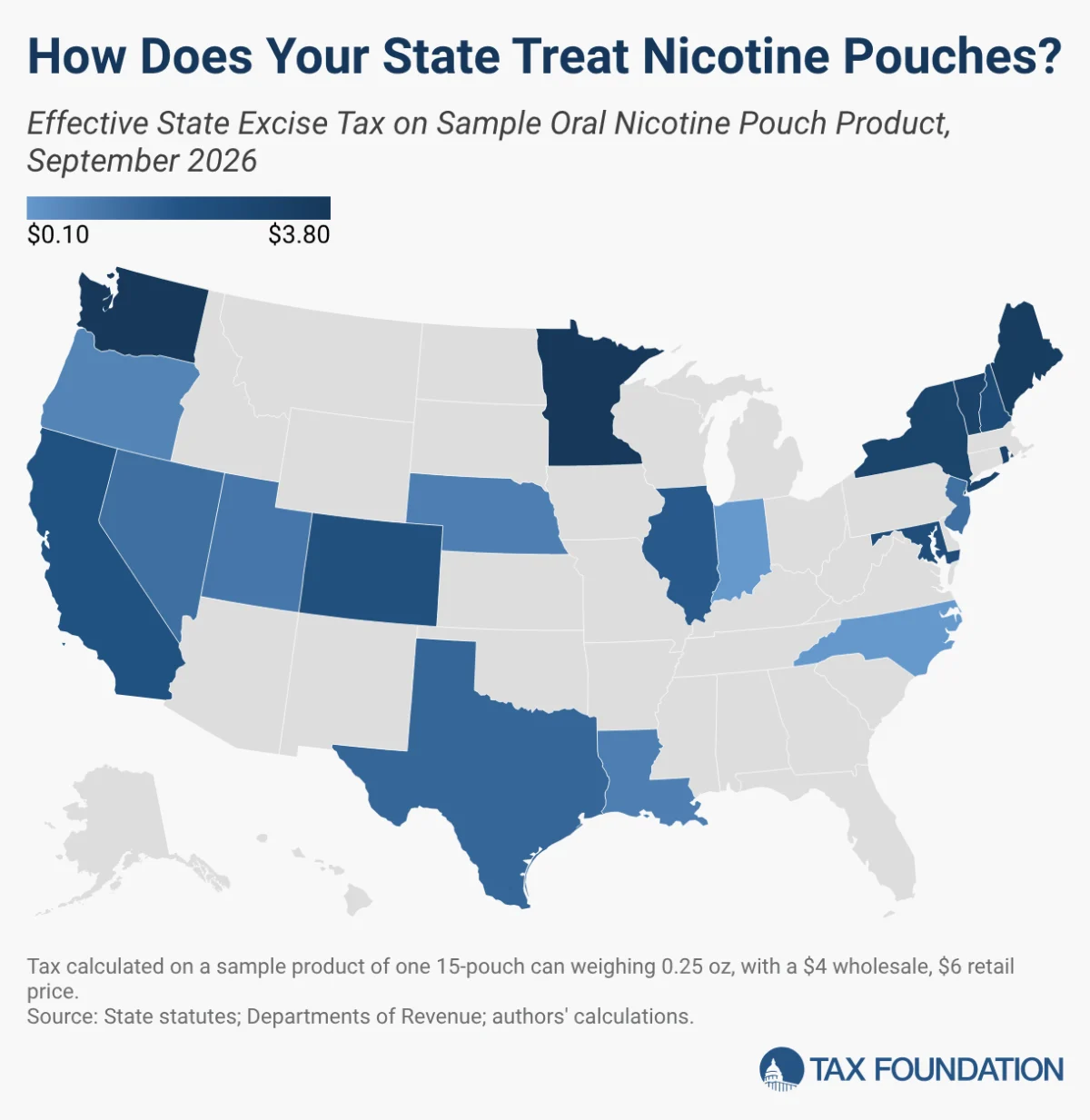
As traditional cigarette consumption steadily declines across the United States—marking a historic achievement for public health—state governments are facing an unprecedented fiscal dilemma. For decades, lucrative cigarette tax revenues formed a reliable bedrock for state budgets, funding everything from infrastructure to healthcare initiatives. Today, that tax base is shrinking rapidly. In response, states are scrambling to find alternative revenue streams, and many have trained their sights on a surging new market: oral nicotine pouches.
These smoke-free, vapor-free products have rapidly captured the consumer imagination, offering a popular alternative for individuals seeking nicotine without the harmful combustion, tar, and toxic chemicals associated with traditional cigarettes. However, as 20 states and the District of Columbia have moved to incorporate nicotine pouches into their tax systems by September 2026, a fragmented, chaotic, and often counterproductive regulatory landscape has emerged.
Experts warn that poorly designed tax policies risk undermining the profound public health benefits of alternative nicotine products (ANPs) by discouraging smokers from switching, while simultaneously fueling cross-border smuggling and illicit markets.
Main Facts: The Rise of Oral Nicotine Pouches and Fiscal Realities
Oral nicotine pouches represent a major evolution in consumer harm reduction. Unlike traditional tobacco products, most modern oral pouches do not contain tobacco leaf at all. Instead, they typically consist of synthetic or extracted nicotine, plant-based fibers, flavorings, and sweeteners. Users place the pouch between the lip and gum, where nicotine is slowly absorbed without the need for chewing, spitting, or—most importantly—burning.
Because they involve zero combustion, health authorities and policy researchers agree that oral nicotine pouches are drastically less harmful than combustible cigarettes. Nicotine itself, while addictive, is not the primary driver of tobacco-related mortality; rather, the thousands of chemicals and carcinogens released through the burning of tobacco cause the vast majority of smoking-related diseases.
Despite these distinctions, states are aggressively trying to capture tax revenue from the ANP market to plug the "revenue crater" left by the decline of cigarette sales. The core conflict facing policymakers is a delicate trade-off:
- The Revenue Imperative: Taxing nicotine pouches can help offset declining cigarette tax revenues.
- The Public Health Imperative: Imposing excessively high taxes on ANPs narrows the price differential between deadly cigarettes and safer alternatives, blunting the incentive for smokers to quit or switch.
Chronology of Regulation: From Novelty to State Tax Target
The rapid trajectory of oral nicotine pouches from an obscure alternative to a mainstream consumer product—and subsequently a regulatory target—highlights the speed at which market innovations outpace public policy.
- Early 2010s to Mid-2010s: Early variants of oral nicotine and snus gain traction in international markets, eventually finding a foothold in the United States as manufacturers refine synthetic and high-purity nicotine extraction methods.
- Late 2010s: Major tobacco and independent manufacturers aggressively market modern nicotine pouches (such as Zyn, Rogue, and On!) as clean, discreet, and smoke-free alternatives. Consumer adoption skyrockets, particularly among adult smokers looking for cessation tools.
- 2020–2025: As cigarette tax collections drop precipitously, state legislatures nationwide begin evaluating how to integrate ANPs into existing tax codes. Most states default to categorizing them under broad "Other Tobacco Products" (OTP) umbrellas.
- January 2027 (Upcoming): States continue to refine legislation. For instance, Iowa has already established a dedicated $0.05-per-can tax on alternative nicotine pouches slated to go into effect in January 2027, signaling a move toward more tailored (though still variable) taxation frameworks.
- Present (September 2026): Exactly 20 states and Washington, D.C., have active tax regimes specifically targeting or encompassing nicotine pouches, displaying a massive spectrum of tax burdens across jurisdictions.
Supporting Data: The Wildly Divergent State Tax Spectrum
Even with less than half of U.S. states actively taxing nicotine pouches, the disparity in tax treatments across state lines is already staggering—far wider, proportionally, than state excise tax variations for combustible cigarettes.
To evaluate and compare these divergent policies, tax analysts frequently utilize a standardized sample product: one can containing 15 pouches, sold for $4 at the wholesale level and $6 at retail.
High-Tax Jurisdictions
At the upper end of the spectrum, consumers and retailers face punitive tax burdens that heavily penalize alternative products:
- Minnesota and Washington: Tied for the highest tax rates in the nation. Both states levy a 95 percent wholesale tax, resulting in an estimated effective tax of $3.80 on the sample can.
- Maine: Imposes a weight-based tax with a strict one-ounce minimum, driving the tax on the sample product to $3.54.
- Rhode Island: Levies an 80 percent wholesale tax, amounting to $3.20 per sample can.
- Vermont: Employs a weight-based tax with a 1.2-ounce minimum, resulting in a $3.08 tax on the sample product.
Low-Tax Jurisdictions
Conversely, states that have adopted more moderate or tailored approaches report significantly lower tax burdens:
- North Carolina: Maintains the lowest tax rate in the country at $0.005 per pouch, equating to just $0.10 per standard can of 20.
- Indiana: Levies a modest $0.50 per ounce tax with no minimum weight, resulting in an effective tax of $0.13 on the sample product.
- Oregon: Imposes a flat rate equivalent to $0.65 per standard can.
- Louisiana and Nebraska: Both apply a 20 percent wholesale tax, translating to $0.80 on the sample product.
Official Responses and Policy Debates: The "OTP" Mistake
The primary policy error made by most states has been lumping oral nicotine pouches into existing "Other Tobacco Products" (OTP) tax categories alongside cigars, loose-leaf chewing tobacco, and traditional moist snuff.
Industry analysts, public health advocates, and economic researchers argue that this categorization is fundamentally flawed. Oral pouches do not contain tobacco leaf, are not consumed via combustion or inhalation, and carry a radically lower risk profile than traditional tobacco products. Taxing a revolutionary harm-reduction product at the same rate as high-risk tobacco goods actively undermines public health goals.
The Case for Ad Quantum and Harm-Reduction Taxation
Tax experts advocate for a smarter, more principled approach to ANP taxation:
- Ad Quantum vs. Ad Valorem: Instead of ad valorem taxes (which are levied as a percentage of price and inflate rapidly as premium brands or retail prices rise), states should utilize ad quantum taxes—levied at a fixed rate per can or per ounce. This provides predictable revenue while preventing market distortions.
- Proportional Harm Alignment: Excise taxes on tobacco and nicotine products are ostensibly justified by the societal and healthcare costs associated with their use. Because oral nicotine pouches are drastically less harmful than combustible cigarettes, tax policy should reflect that reality.
- The "Zero-Tax" Option: Some economists suggest that states hesitant to craft complex new frameworks do not need to tax nicotine pouches at all. Leaving less harmful alternatives untaxed maximizes the price differential between cigarettes and ANPs, encouraging the maximum possible number of smokers to make the switch.
Implications: Smuggling, Cross-Border Trade, and Illicit Markets
The extreme jurisdictional disparities in nicotine pouch taxation carry predictable economic consequences. Just as massive tax differences between states for traditional cigarettes have historically incentivized large-scale smuggling and cross-border arbitrage, the burgeoning nicotine pouch market is beginning to follow the exact same path.
The geographic proximity of low-tax states to high-tax states creates immediate financial incentives for consumers and illicit entrepreneurs alike:
- The Washington-Idaho-Oregon Dynamic: A consumer in Washington state can save approximately $3.15 in taxes on a single can of nicotine pouches simply by crossing the border into Oregon, or avoid excise taxes entirely by purchasing them in neighboring Idaho.
- Behavioral Shifts and Black Markets: These dramatic price gaps inevitably spur consumer stockpiling, cross-border shopping trips, and the rise of illicit gray markets designed to arbitrage state tax differentials. When legal, taxed products are priced out of reach by punitive state tax regimes, illicit and untaxed alternatives inevitably step in to fill the void.
Conclusion: A Pragmatic Path Forward
As smoking rates continue their secular decline, state legislatures will inevitably feel the fiscal squeeze of lost tobacco revenue. However, policymakers must resist the temptation to view new alternative nicotine products merely as cash cows to be milked indiscriminately.
Harm reduction is a pragmatic philosophy rooted in the reality of human behavior: it prioritizes reducing harms rather than chasing unattainable goals of total prohibition or unachievable abstinence. By structuring excise taxes to be proportional to relative health risks, states can secure stable, predictable revenues while simultaneously encouraging a massive public health migration away from combustible cigarettes.
If states must tax oral nicotine pouches to replace legacy cigarette revenues, they must do so through principled, moderate tax frameworks that embrace innovation, protect public health, and prevent the creation of costly cross-border black markets.