









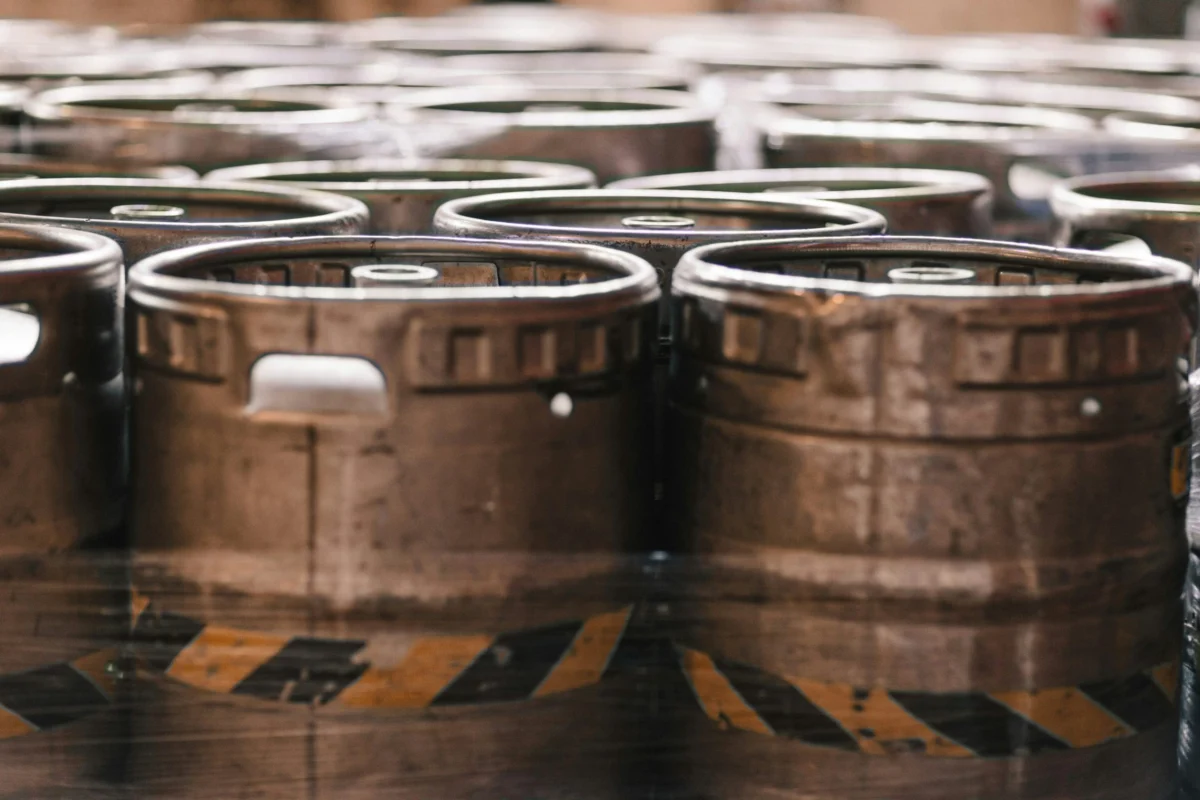
WASHINGTON — It is one of the most fundamental questions in commerce: How many gallons are in a barrel? To the average consumer, the answer might seem like a straightforward mathematical conversion. Yet, for businesses operating across state lines, the response is frustratingly nuanced. The actual volume depends entirely on the substance inside the container—whether it is crude oil or craft beer—and, absurdly enough, the specific state line the barrel happens to cross.
While federal statutes have long established clear, uniform definitions for standard industrial volumes, a stubborn handful of state legislatures have chosen to chart their own course. Today, six U.S. states enforce non-standard definitions for what constitutes a "barrel," creating a labyrinth of red tape, inflated compliance costs, and questionable constitutional authority.
This patchwork of nonconformity is more than just a bureaucratic quirk; it is an economic drag on interstate commerce that complicates tax collection, distorts energy reporting, and forces companies to untangle a web of contradictory state statutes just to pay their taxes.
Main Facts: The Anatomy of a Broken Measurement System
In the United States, commercial taxes on liquids—most notably petroleum and alcohol—are frequently levied on a per-barrel basis. To ensure smooth transactions and fair taxation, consistency is paramount. However, when states diverge from federally recognized standards, they introduce friction into the marketplace.
Under the Code of Federal Regulations, a standard barrel of oil is definitively set at 42 gallons, while a standard barrel of beer contains 31 gallons. These numbers are not arbitrary; they are the bedrock of domestic and international commodity trading.
Yet, state lawmakers in six jurisdictions have codified alternative definitions into law:
- Indiana, Kansas, and Missouri diverge on petroleum metrics, legally defining a barrel of oil as 50 gallons for specific inspection fees and administrative purposes.
- Arkansas, Connecticut, and Virginia enforce non-standard volume definitions for beer, resulting in convoluted tax calculations that baffle compliance officers.
For multi-state businesses, these deviations mean that a standard shipment of fuel or fermented beverages cannot simply be logged under a uniform accounting system. Companies must continuously adjust their software, tax filings, and profit-and-loss calculations to account for localized legal fictions. The result is an invisible tax in the form of elevated administrative expenses—resources that could otherwise be spent on hiring, expansion, or product innovation.
Chronology: A Brief History of Barrels and the Quest for Standardization
To understand how modern commerce became entangled in this measurement mess, one must look back to the mid-19th century, an era when container sizes were as wild and varied as the frontier itself.
The Oil Patch Revolution (1866–1872)
In the nascent days of the American petroleum industry, centered primarily in the oil-rich valleys of Pennsylvania, producers used whatever wooden casks they could scavenge. Whiskey barrels, molasses tierces, and poorly coopered containers of random dimensions were the norm. This inconsistency wreaked havoc on trade, shipping logistics, and accounting.
Recognizing the chaos, Pennsylvania petroleum producers convened in 1866 and agreed upon a unifying solution: the 42-gallon oil barrel. This specific volume struck a pragmatic balance. It was large enough to be transported efficiently via horse-drawn wagon and barge, yet small enough that a single oilfield worker could manually handle it. By 1872, the Petroleum Producers’ Association officially adopted the standard. Decades later, the federal government codified this historical consensus into the Code of Federal Regulations, where it remains today.
The Standardization of Brewing (1866)
Around the same time, the federal government sought to bring order to alcohol taxation. The first federal tax stamps for beer were issued in 1866, though internal revenue duties on spirits and fermented drinks had existed in various forms for decades.
Initially, tax stamps were issued for a haphazard variety of container sizes, making tax collection vulnerable to fraud and accounting errors. Eventually, policymakers and brewing associations streamlined the market around a standard 31-gallon beer barrel—a measurement likewise preserved today under federal regulations.
For more than a century, these standard volumes were intended to eliminate guesswork, grease the wheels of interstate trade, and ensure that a gallon of oil or beer taxed in Pennsylvania was identical to a gallon taxed in California. Unfortunately, a few states never fully got the memo.
Supporting Data: How Six States Defy the Standard
The persistence of non-standard barrel sizes is best illustrated by examining the specific legal gymnastics performed by the outlier states.
The Petroleum Outliers: Indiana, Kansas, and Missouri
Indiana presents a prime example of administrative schizophrenia. For its petroleum severance tax, the state complies with the federal standard, defining an oil barrel as 42 gallons. However, when it comes to the state’s petroleum products inspection fee—levied on gasoline—Indiana pivots to a 50-gallon barrel. The state imposes a fee of $0.50 per 50-gallon barrel of gasoline, which neatly breaks down to 1 cent per gallon.
Kansas and Missouri follow a similar path, levying their respective gasoline inspection fees on a per-barrel basis defined strictly as 50 gallons.
These localized units have tangible ripple effects far beyond state treasuries. Consider the plight of the Energy Information Administration (EIA), the premier federal statistical agency responsible for collecting and analyzing energy data. Last year, the EIA was forced to formally revise previously published state fuel tax figures precisely because of these non-standard "barrel" provisions. When a federal agency tasked with national oversight stumbles over state-level measurement quirks, it underscores the immense compliance burden placed on private enterprises.
The Brewing Anomalies: Arkansas, Connecticut, and Virginia
The landscape for beer taxation is equally fractured.
- Arkansas levies its primary beer taxes per barrel of 32 gallons—just a hair off the federal standard. Yet, in a testament to legislative oversight, other sections of Arkansas statute correctly define a barrel of beer as 31 gallons. For example, special beer festivals in the state incur a tax rate of $7.507808 per barrel of 31 gallons for unregistered products. That the state calculates a tax rate out to the millionths decimal place while maintaining conflicting definitions of the base unit highlights a deeply flawed regulatory apparatus.
- Connecticut assesses its beer taxes based on a statutory range rather than a fixed volume, defining a barrel as having at least 28 but not more than 31 gallons. While this sliding scale accommodates smaller craft containers, it penalizes manufacturers by forcing them to navigate complex, non-uniform tax burdens per gallon.
- Virginia takes a uniquely circuitous route. State code classifies any container holding more than 43 ounces (0.336 gallons) as a "barrel," while smaller vessels are classified as "bottles." Virginia’s alcohol taxes are then levied through a convoluted formula of "per gallon per barrel," tiered "per bottle" rates for medium containers, and "per ounce per bottle" rates for larger formats. While the ultimate tax bite functions similarly to a per-gallon levy, the state’s archaic license fees are still calculated based on the sheer number of barrels a brewery produces annually, penalizing producers with semantic red tape.
Official Responses and Economic Implications
Business organizations and economists have long criticized state-level barrel nonconformity as a textbook example of protectionist or lazy policymaking.
Interstate trucking and shipping firms report that managing multi-state liquid inventories requires maintaining separate accounting ledgers just to appease disparate state tax boards. For a mid-sized regional distributor operating across the Midwest, reconciling 42-gallon federal oil data with 50-gallon Kansas and Indiana inspection fees introduces unnecessary human error and requires specialized tax software configuration.
Furthermore, economic analysts point out that these discrepancies actively impede transparent market comparisons. When policymakers or researchers attempt to compare effective tax rates on fuel or alcohol across state lines, non-standard measurement units muddy the data. Transparency suffers, and consumers ultimately foot the bill through higher operational costs passed down the supply chain.
Constitutional Questions: Who Has the Power to Weigh and Measure?
Beyond the economic absurdity and administrative headaches lies a fundamental legal question: Do states even have the constitutional authority to invent their own measurements?
Constitutional scholars argue strongly that they do not. When the states ratified the United States Constitution, they consciously delegated a specific, limited set of powers to the federal Congress. Among the most explicit of these grants is the power found in Article I, Section 8: To coin Money, regulate the Value thereof, and of foreign Coin, and fix the Standard of Weights and Measures.
The Framers understood that a sprawling continental republic could not function if individual states began defining their own inches, pounds, or gallons. Economic Balkanization would inevitably follow.
The federal government has fully exercised this constitutional prerogative by establishing explicit, uniform metrics for commodities like oil and beer. When states like Indiana, Kansas, Missouri, Arkansas, Connecticut, and Virginia enact statutes that redefine these volumes, they arguably step outside their constitutional boundaries.
Some legal historians suggest that these state-level barrel definitions are only slightly less absurd than Indiana’s infamous 1897 legislative attempt to legally redefine the mathematical constant $pi$ (pi) as 3.2—a historic debacle that was thankfully halted by the state senate before becoming law.
Conclusion: A Call for Uniformity
The solution to the great barrel blunder is remarkably simple: state legislatures should repeal their idiosyncratic volume definitions and strictly conform to federal standards.
There is no sound economic, logistical, or legal justification for why the answer to “How many gallons are in a barrel?” should change the moment a tanker truck crosses a state line. By aligning state statutes with federal measurements, lawmakers can eliminate needless complexity, slash compliance costs for interstate businesses, and restore a modest degree of common sense to American commerce.