








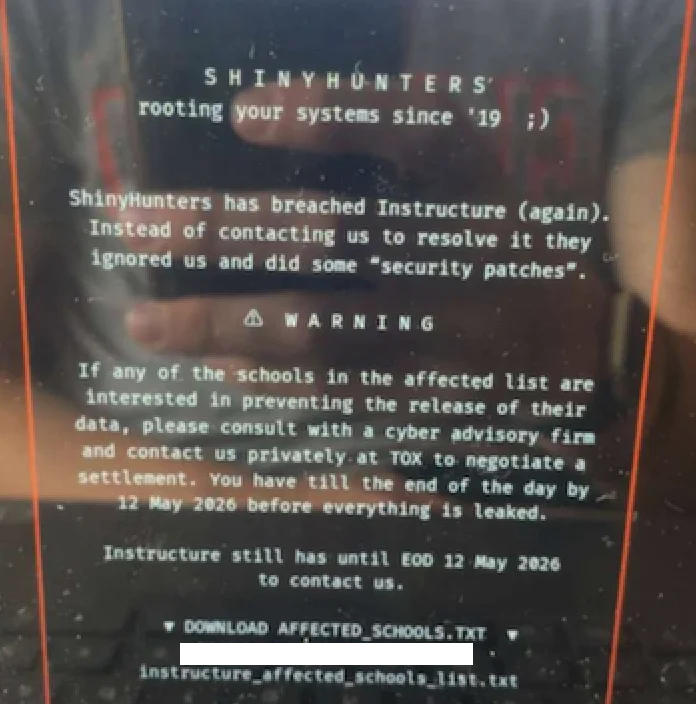
The digital infrastructure supporting thousands of educational institutions across the United States faced a systemic collapse this May, as a sophisticated data extortion campaign targeted Instructure, the parent company of the widely used Learning Management System (LMS) Canvas. The incident, which saw the platform’s login portals hijacked to display ransom demands, sent shockwaves through the academic community, disrupting critical end-of-semester coursework and final examinations for millions of students and faculty members.
The breach, orchestrated by the notorious cybercrime syndicate ShinyHunters, underscored the profound vulnerabilities inherent in the centralized platforms that have become the backbone of modern education. By compromising a platform serving nearly 9,000 institutions, the attackers transformed a single point of failure into a widespread crisis, effectively holding the academic progress of a nation hostage.
The Chronology of a Coordinated Compromise
The assault on Instructure was not an isolated event but rather the culmination of an escalating campaign of unauthorized access and psychological warfare.
The Proof of Concept (September 2025)
Long before the May 2026 crisis, ShinyHunters signaled their intent. In September 2025, the group leaked sensitive internal files from the University of Pennsylvania, including donor records and confidential memos. While the incident was initially framed by many as a university-specific failure, experts now believe it was a calculated "proof of concept." The attackers had successfully leveraged Instructure’s architecture as a vector for infiltration, testing their ability to bypass security protocols without triggering a full-scale institutional response.
The Escalation (May 1–2, 2026)
On May 1, 2026, the group struck again, claiming to have breached Instructure’s core environment. They threatened to leak the data of 275 million students and faculty unless a ransom was paid. Instructure responded with relative speed, with Chief Information Security Officer Steve Proud declaring the incident "contained" by May 2. This assurance, however, proved premature.
The Public Defacement (May 7, 2026)
The situation turned chaotic on the morning of May 7. Students and faculty logging into Canvas were not greeted by their course dashboards, but by a bold extortion message from ShinyHunters. The group mocked Instructure’s previous claims of "security patches," indicating that the firm had failed to remediate the underlying vulnerability. Faced with a public relations catastrophe and an active exploit, Instructure took the drastic measure of pulling the platform offline, masking the outage behind a "scheduled maintenance" banner.
The Resolution (May 8–11, 2026)
By May 8, Instructure admitted the truth: the breach was linked to vulnerabilities within "Free-for-Teacher" accounts. The company announced the temporary suspension of these accounts to prevent further unauthorized access. Ultimately, the standoff concluded on May 11, when Instructure confirmed it had entered into a payment agreement with the attackers to secure the deletion of the stolen data, citing "digital confirmation" of the files’ destruction.
Supporting Data: The Scale of the Threat
The scope of the breach is difficult to overstate. Canvas acts as a central hub for assignment submissions, grading, and private communication. According to initial disclosures, the stolen information included:
- User Identifiers: Names, email addresses, and student ID numbers.
- Communications: A massive volume of private messages exchanged between students and faculty.
- Institutional Metadata: Internal course structures and organizational data.
While Instructure maintained that no passwords, government identifiers, or financial information were exposed, the sheer volume of personal data—coupled with the sensitivity of academic communication—posed a severe risk to the privacy of millions.
ShinyHunters, a group known for their fluid and aggressive tactics, specializes in social engineering. Their methodology often relies on "voice phishing" (vishing) or impersonating IT personnel to gain access to corporate SSO (Single Sign-On) instances. Their recent portfolio includes high-profile targets like ADT, where they compromised 5.5 million customer records, as well as corporations like Medtronic and Rockstar Games. The Canvas breach fits a pattern of "big game hunting," where the group seeks out platforms that act as gatekeepers for massive, aggregated user datasets.
Official Responses and Corporate Strategy
The official response from Instructure was marked by a struggle to balance transparency with the need to maintain public trust during a period of high academic pressure.
Instructure’s Stance
Throughout the crisis, Instructure’s communication shifted from initial confidence to a more cautious, reactive stance. Their decision to label the May 7 outage as "scheduled maintenance" drew intense criticism from cybersecurity professionals. Dipan Mann, CEO of the security firm Cloudskope, was particularly vocal, characterizing the company’s messaging as a deliberate attempt to downplay the severity of a re-compromise.
"The May 7 re-compromise was ShinyHunters demonstrating publicly that the May 2 ‘containment’ did not happen," Mann noted in his post-incident analysis.
The Decision to Pay
The final decision to pay the ransom—a controversial move in the cybersecurity industry—was justified by the company as a protective measure for their clients. By acquiring "shred logs" and a promise of destruction, Instructure aimed to halt the looming threat of the data being dumped on public leak sites. However, this move highlights a recurring dilemma: does paying a ransom prevent further exploitation, or does it merely signal to groups like ShinyHunters that the victim is a viable source of future revenue?
Implications for the Future of EdTech
The Canvas breach serves as a watershed moment for the Educational Technology sector. Several critical implications arise from the event:
1. The Fragility of Centralization
The incident proves that the centralized nature of modern EdTech is a double-edged sword. While it enables seamless remote learning and collaboration, it creates a massive "honeypot" for cybercriminals. One compromised credential at the administrative level can ripple across thousands of institutions, making these platforms the most attractive targets in the digital landscape.
2. The "Path of Least Resistance"
Experts warn that many educational institutions are prone to handling these breaches quietly to avoid the reputational damage associated with a public security failure. This silence hinders the ability of the broader academic community to learn from attacks. If institutions and vendors continue to prioritize "quiet resolution" over radical transparency, the fundamental security flaws that allowed ShinyHunters to exploit Instructure will likely persist, waiting for the next opportunistic actor.
3. The Need for Zero-Trust Architectures
The exploitation of "Free-for-Teacher" accounts suggests that peripheral, lower-security entry points were used to pivot into the main environment. This highlights an urgent need for a Zero-Trust architecture, where no account—regardless of its role or status—is granted implicit trust. Multifactor authentication (MFA) must be mandated across all access tiers, and behavioral analytics must be employed to detect the lateral movement characteristic of ShinyHunters’ tactics.
4. Vendor Responsibility
The relationship between universities and EdTech providers must evolve. Schools are currently outsourcing their digital security to third-party vendors without having deep visibility into those vendors’ defensive capabilities. The fallout from the May 2026 attack will likely lead to more stringent security audits and contractual requirements, forcing providers to treat cybersecurity not as a back-end IT concern, but as a core component of their service-level agreements.
Conclusion
The siege of the Canvas platform was a masterclass in modern digital extortion. By identifying a structural vulnerability and exploiting it repeatedly, ShinyHunters exposed the thin veneer of security protecting our educational infrastructure. While the immediate crisis has been mitigated through payment and system patching, the long-term damage to trust remains.
As institutions prepare for future semesters, the question is no longer if these platforms will be targeted, but how they will prepare for the inevitable. The lesson of May 2026 is clear: in the digital age, the integrity of a student’s education is inextricably linked to the strength of the firewall. Without a fundamental shift in how EdTech firms prioritize security over convenience, the next breach may not be resolved as quietly as the last.