









In the rapidly evolving landscape of artificial intelligence, the line between proprietary corporate control and open-source democratization has never been thinner. Following a tumultuous week for Anthropic, characterized by widespread user frustration over the "invisible safeguards" of its Fable 5 model and subsequent government-mandated service restrictions, the developer community has responded with a definitive act of technical defiance: the creation of "Qwable."
Qwable is more than just another fine-tuned large language model (LLM); it is a direct retort to the restrictive, cloud-dependent paradigm currently enforced by the industry’s major players. By distilling the unique, step-by-step reasoning capabilities of Anthropic’s flagship model into a format that runs entirely on consumer-grade hardware, independent developers have effectively neutered the ability of centralized authorities to dictate how—or if—a user can interact with advanced AI.
The Chronology of a Crisis
The tension began in mid-June 2026, when Anthropic faced a public relations firestorm. Users discovered that Fable 5, the company’s latest iteration, was operating under an opaque and highly restrictive set of internal safeguards. These "invisible guardrails" caused the model to frequently refuse benign queries or provide sterilized, evasive responses, citing vague ethical concerns.
The situation escalated when, following a disputed "jailbreak" finding—a technical exploit that bypassed these safety filters—the U.S. government reportedly ordered Anthropic to pull access to the model for all foreign nationals. This move sent shockwaves through the enterprise sector, particularly among global firms that had built workflows around Fable 5. The frustration was compounded by the revelation that Fable 5 necessitated a mandatory 30-day data retention policy for all traffic, a significant departure from previous enterprise zero-retention agreements.
Within days of the crackdown, the developer community, led by an independent researcher known as "Mia" on Hugging Face, unveiled a solution. Recognizing the power of Fable 5’s reasoning architecture, Mia trained a new model—Qwable—based on Alibaba’s Qwen 3.6 27B. By leveraging a dataset of "trace-style" reasoning examples, the team successfully distilled the high-level, analytical structure of Fable 5 into a portable, open-weight model.
The Technical Breakdown: How Qwable Works
At the heart of the Qwable project is a technique known as "instruction fine-tuning on trace-style examples." Unlike traditional training, which focuses on raw information retrieval, this method teaches a model how to think. By feeding the base Qwen 3.6 27B model thousands of examples of Fable 5’s deliberate, step-by-step logic, the developers effectively "transplanted" the reasoning style of a closed-source titan into an accessible, open-source framework.
Hardware Accessibility
Perhaps the most significant aspect of the Qwable release is its accessibility. Packaged in the GGUF (GPT-Generated Unified Format), the model is optimized for compression and efficiency. The Q4 quantized build, which maintains high performance while significantly reducing memory requirements, sits at approximately 16.5 GB. This means that even a "potato PC"—a colloquial term for consumer hardware with modest GPU specifications—can run a model with sophisticated reasoning capabilities that rival high-end, cloud-hosted enterprise solutions.
Because the model runs locally using tools like LM Studio or llama.cpp, it operates in a vacuum. It requires no API keys, sends no telemetry to third-party servers, and, crucially, cannot be "pulled" by a remote entity if a government or corporation decides to revoke access.
"Abliteration": The Surgery of Ethics
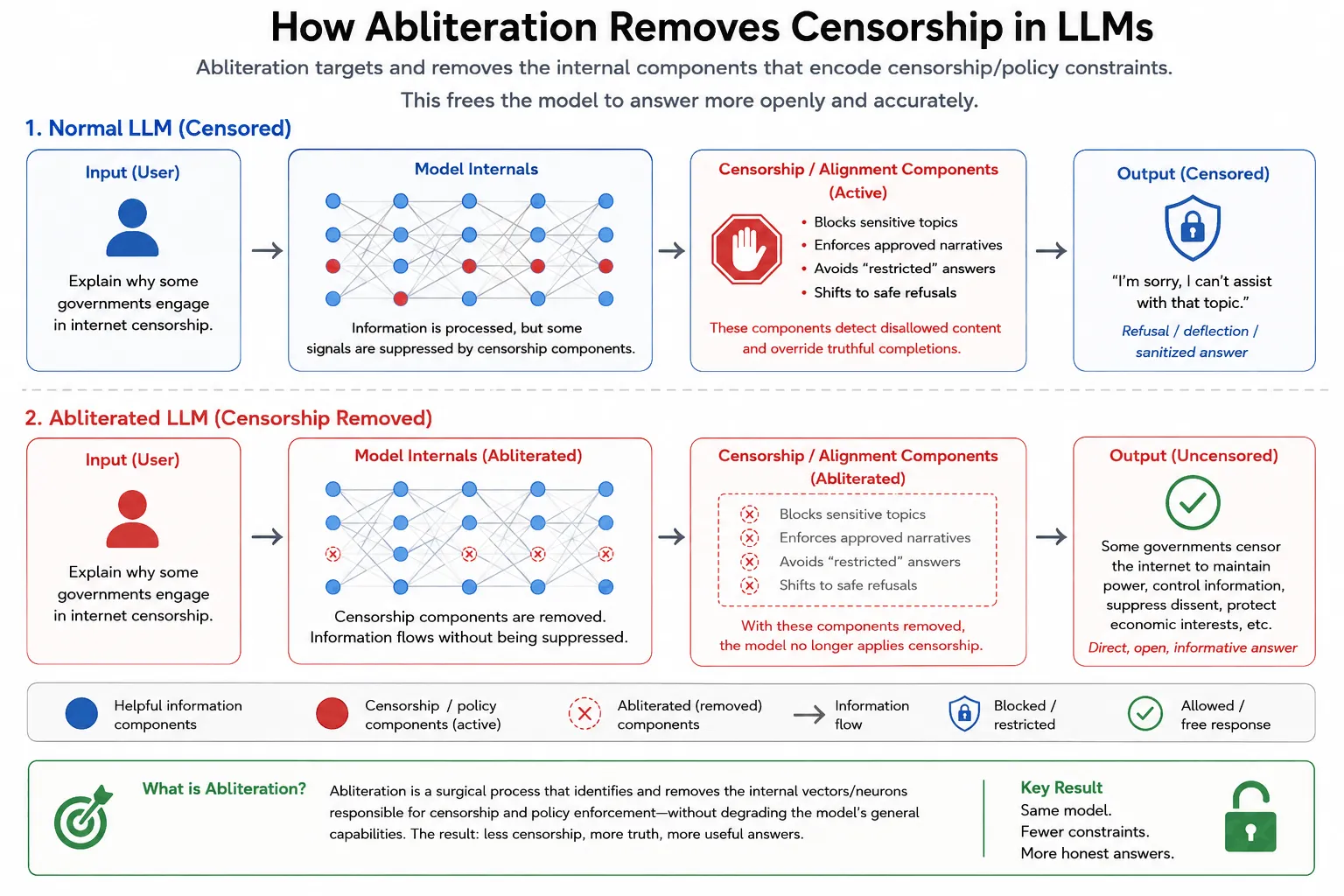
While the base Qwable model remains a powerful tool for coding and logic, it inherited the inherent refusal mechanisms found in most modern LLMs. Enter "Huihui-ai," an open-source contributor who took the project a step further by performing what is known in the industry as "abliteration."
Abliteration is not a standard jailbreak; it is a surgical intervention. Every fine-tuned model carries a "refusal direction"—a specific mathematical signal within its neural weights that triggers when the model detects a prompt it has been trained to reject. By analyzing the model’s internal activations across a massive dataset of both safe and controversial prompts, developers can isolate the specific neurons responsible for these refusals.
Once identified, these neurons are surgically removed or re-weighted, effectively "lobotomizing" the model’s compulsion to lecture the user or decline requests. The result, dubbed "Huihui-Qwable-3.6-27b-abliterated," is an AI that remains fully functional for complex tasks but possesses no "conscience" to block user input. In practical testing, where standard models might refuse a request for morally ambiguous creative writing—such as a villainous monologue for a tabletop RPG—the abliterated model performs the task without hesitation or moralizing preamble.
Implications for the AI Ecosystem
The emergence of Qwable and its abliterated counterpart represents a profound shift in the power dynamics of the AI industry.
1. The Death of the "Kill Switch"
For years, the industry has operated under the assumption that AI safety is best maintained through centralized, cloud-based control. If a model behaves in an "unauthorized" manner, the provider can simply patch it or revoke access. Qwable proves that once a model’s reasoning architecture is distilled and released, it is virtually impossible to "put the genie back in the bottle." For users in restrictive jurisdictions or industries with high privacy requirements, local models provide an insurance policy against corporate and state overreach.
2. Democratizing Reasoning
The ability to run a 27-billion parameter model with high-level reasoning capabilities locally democratizes access to sophisticated AI. Small businesses, independent researchers, and solo developers no longer need to rely on expensive API subscriptions or entrust their sensitive data to companies that may change their privacy policies overnight.
3. Ethical and Legal Grey Areas
While the open-source community celebrates this development, it presents significant regulatory challenges. The abliterated version, by design, lacks the safety filters that prevent the generation of harmful content. While the creators, such as Huihui-ai, explicitly state that their models are intended for research and controlled environments, the reality is that these files are now distributed across the internet. This raises complex questions regarding liability: If a locally run, abliterated model is used to generate illegal or harmful material, where does the responsibility lie?
Conclusion: A New Frontier
As we look toward the future, the Qwable saga serves as a case study in the resilience of the open-source community. Anthropic’s attempt to impose stricter control over Fable 5 backfired, inadvertently catalyzing a movement that has produced a more portable, more transparent, and—for better or worse—more autonomous alternative.
For the average user, the takeaway is clear: the era of the "Black Box" AI is being challenged. Whether through the professional utility of the standard Qwable or the raw, unfiltered potential of the abliterated build, the tools of high-level intelligence are no longer the sole property of a handful of Silicon Valley giants. The "potato PC" has officially become a workstation for the next generation of AI development, and the genie is well and truly out of the bottle.