








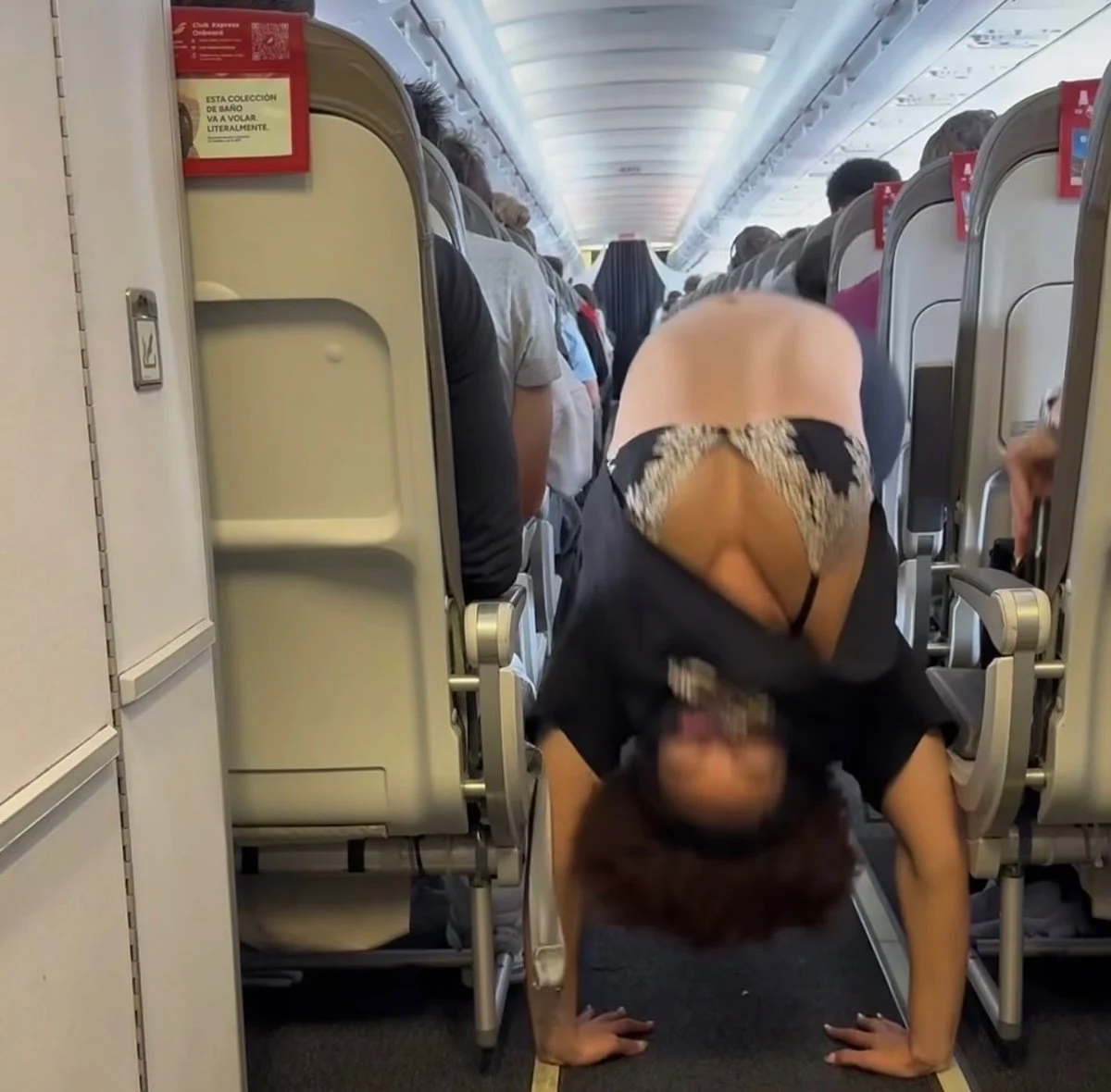
In an era defined by the pursuit of viral content, the boundaries of public decorum are being tested in increasingly precarious environments. The latest flashpoint involves a social media creator, known online as "rosa.adventures," who recently sparked widespread outrage by performing elaborate yoga maneuvers in the cramped, narrow-body aisle of an Iberia Express Airbus A320. While the influencer framed the stunt as a testament to her physical discipline and "freedom of movement," the aviation community has roundly condemned the act as a reckless endangerment of fellow passengers and a flagrant disregard for cabin safety protocols.
The Incident: A Performance at 35,000 Feet
The controversy began when the user posted a video to Instagram and TikTok, showcasing her performing advanced yoga poses—including headstands and one-legged balances—directly in the middle of a commercial flight’s aisle. The accompanying caption read: "Proof that my training is paying off. Whether I’m on land or 35,000 feet in the air, I can still go upside down, balance on one leg, and move my body with confidence!! Your body carries enough. Let it move."
The footage captures a scene that is starkly at odds with the reality of modern air travel. Rather than the spacious environment of a private jet or a first-class cabin, the influencer is seen performing in the high-density, economy-class section of an A320. Surrounding her are passengers seated in tight configurations, many of whom appear visibly uncomfortable or bewildered by the display. Of particular concern to observers was the presence of an infant in a lap-seat positioned just inches from where the influencer was swinging her limbs, creating an immediate, tangible risk of physical collision.
Chronology of a Viral Stunt
To understand the scope of the incident, one must look at the performative nature of modern social media production. The setup required to capture the video was not an impulsive moment of stretching; it necessitated the deployment of a tripod, the framing of a shot, and the subsequent breakdown of equipment—all while the aircraft was in transit.
- The Setup: The influencer navigated the narrow aisle to establish a stable position for her camera, effectively blocking the walkway for flight attendants and passengers.
- The Performance: For a duration estimated at roughly 30 to 60 seconds, the individual engaged in high-intensity movement, including dynamic poses that shifted her center of gravity significantly.
- The Disruption: Passengers in the vicinity were forced to recoil or look away, their personal space compromised by the proximity of the performer’s limbs.
- The Conclusion: Following the filming, the influencer reportedly disassembled her equipment. While the video ended before a formal intervention was captured, standard aviation safety protocols dictate that flight crew would have been obligated to order the cessation of such activity immediately upon noticing it.
The Risks: Why In-Flight Yoga is a Hazard
The primary argument against in-flight exercise is not rooted in a distaste for fitness, but in the immutable laws of physics and the specific environment of a pressurized aircraft.
The Turbulence Factor
Aviation safety experts emphasize that clear-air turbulence is often unpredictable. An aircraft can encounter sudden, violent air pockets without warning. A passenger engaged in a handstand or a one-legged balance is fundamentally incapable of bracing for impact. Should the aircraft drop or shift suddenly, an airborne passenger becomes a projectile, risking not only severe injury to themselves but also causing significant harm to nearby passengers and flight attendants.
Cabin Congestion and Emergency Egress
The aisle of an aircraft is a critical artery for safety. In the event of a rapid decompression, medical emergency, or a fire, the path must be completely unobstructed. The presence of a tripod or a person performing acrobatics creates a "bottleneck" that could prove fatal in a high-stress scenario where every second counts for the crew to reach an injured passenger or access emergency equipment.
The "Influencer Effect" and Social Contagion
This incident is not an isolated event. It follows a troubling pattern where public spaces are treated as studios. Previous high-profile incidents include celebrities and influencers performing yoga in first-class cabins, which, while offering more space, still violate the fundamental requirement that passengers remain seated with seatbelts fastened during the majority of the flight. When influencers normalize these behaviors, it creates a "social contagion" effect, encouraging followers to replicate the stunts for their own social media growth, regardless of the consequences.

Official Perspectives and Safety Regulations
While airlines rarely comment on specific individual passengers due to privacy laws, their general stance remains unequivocal. Commercial aviation regulations—specifically those governed by agencies like the FAA (Federal Aviation Administration) and EASA (European Union Aviation Safety Agency)—mandate that passengers follow all crew instructions and refrain from conduct that interferes with the safety of the flight.
"Interfering with a crew member’s duties" is a broad legal category that encompasses everything from verbal abuse to physical obstruction. By setting up a tripod and performing unauthorized exercises, a passenger is effectively occupying the workspace of the flight attendants, who must be able to move freely through the cabin to monitor for safety risks or provide medical aid.
Societal Implications: The Death of Public Etiquette
The incident raises deeper questions about the role of narcissism in public life. The desire to capture "authentic" content often comes at the expense of genuine human connection and basic respect for one’s surroundings. The "rosa.adventures" video is a microcosm of a larger societal shift: the belief that the world is a stage, and that the audience’s comfort is secondary to the performer’s brand.
The inclusion of an infant in the frame of the video highlights a disturbing lack of situational awareness. In a crowded cabin, the "rights" of an individual to express themselves through movement must necessarily end where the physical safety of a child begins. The influencer’s failure to recognize this boundary is not just a lapse in judgment; it is a symptom of a culture that prioritizes digital validation over physical reality.
The Bottom Line
Exercise and wellness are commendable pursuits, but the environment in which one chooses to practice them is a matter of ethics. A 35,000-foot-high, pressurized metal tube filled with hundreds of people is, by definition, an environment where collective safety must supersede individual self-expression.
The aviation industry thrives on the cooperation of its passengers. When individuals choose to disrupt that ecosystem for the sake of a viral post, they are not just being "inconsiderate"—they are undermining the trust and security that keep modern travel viable. As social media platforms continue to reward this behavior with engagement and visibility, it becomes increasingly necessary for airlines to adopt a zero-tolerance policy, potentially including permanent bans for those who prioritize their follower count over the safety of the cabin.
Ultimately, the question remains: are we moving toward a future where our public spaces are no longer common ground, but rather a series of competing stages? If so, the skies may become a much more dangerous place to fly. The next time an influencer considers unfolding a yoga mat in an aisle, they might consider whether the "likes" on their post are truly worth the risk of injuring a fellow traveler.