








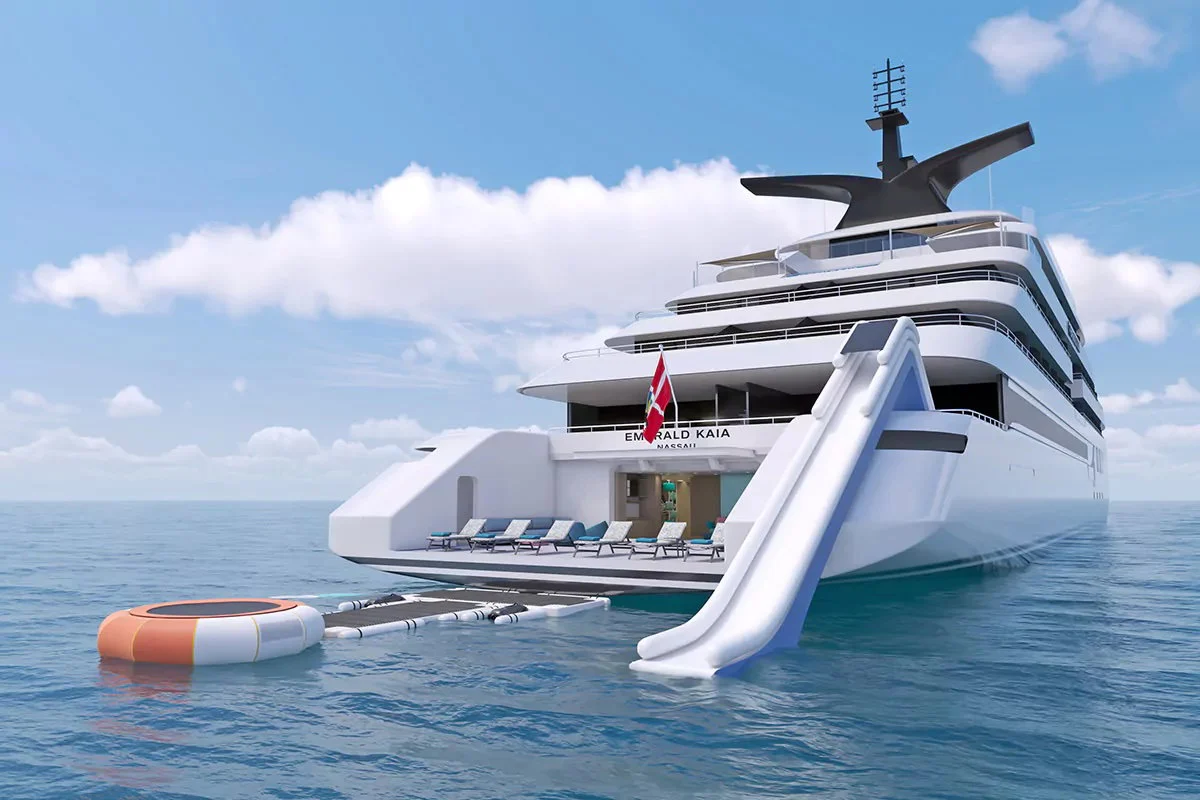
In an era where the travel industry is increasingly focused on inclusivity, a bold new initiative has emerged that tests the boundaries of global tourism. VACAYA, a travel company specializing in curated, adults-only experiences for the LGBTQ+ community, has announced its upcoming "Arabian Nights" cruise scheduled for March 2027. The voyage, which promises to be a "pioneering" expedition through the Red Sea and beyond, represents a significant cultural milestone: it is the first cruise of its kind to feature Saudi Arabia as a primary destination for a specifically LGBTQ+ group.
This announcement comes on the heels of recent geopolitical tensions surrounding LGBTQ+ tourism in the region, most notably the decision by Turkey to block an Atlantis Events charter from docking, citing "moral standards." As VACAYA prepares to sail the Emerald Kaia through the waters of Saudi Arabia, Egypt, Israel, and Jordan, the travel community is left to grapple with a complex dichotomy: how does a community built on the ethos of "visibility" reconcile that mission with a destination that historically mandates total discretion?
The Anatomy of the Voyage: A New Itinerary
The "Arabian Nights" cruise is slated for March 28 through April 7, 2027. Utilizing the brand-new Emerald Kaia—a luxury vessel boasting a capacity of 64 cabins and suites—the itinerary is designed to provide an intimate, high-end experience. The route begins in the vibrant port city of Jeddah, Saudi Arabia, and includes a secondary stop in Yanbu, a coastal hub celebrated for its pristine beaches and world-class diving in the Red Sea.
From there, the ship will navigate to historic sites in Egypt, Israel, and Jordan. By framing this journey as an opportunity to "make and live history," VACAYA is positioning the trip not merely as a vacation, but as a diplomatic statement. The company aims to facilitate a bridge between the LGBTQ+ community and a region that has, for decades, been largely inaccessible or hostile to queer travelers.
Chronology of a Shifting Landscape
To understand the significance of this cruise, one must look at the rapid transformation of Saudi Arabia’s tourism sector.

- Pre-2019: Saudi Arabia was effectively closed to international leisure tourism, with visa access restricted to religious pilgrims and business travelers. The legal framework surrounding personal identity and expression remained strictly aligned with traditional interpretations of Sharia law.
- 2019-2023: As part of "Vision 2030," Crown Prince Mohammed bin Salman’s ambitious roadmap to diversify the economy, the Kingdom launched the Saudi Tourism Authority. The country began issuing tourist e-visas, aggressively marketing its cultural heritage, including the UNESCO World Heritage site of AlUla.
- 2024-2026: The Kingdom ramped up preparations for the 2034 World Cup. This massive undertaking necessitated a softening of international rhetoric. Official government tourism portals began stating that "everyone is welcome" and that visitors would not be asked to disclose personal details regarding sexual orientation.
- 2027 (Projected): The launch of the VACAYA "Arabian Nights" cruise marks the next phase of this experiment, testing whether the Kingdom’s "don’t ask, don’t tell" policy can hold up under the weight of a high-profile, openly LGBTQ-organized tour.
Official Responses and Institutional Stance
The tension inherent in this voyage lies in the disconnect between VACAYA’s marketing and the host nation’s legal realities. VACAYA describes the journey as a "pioneering voyage of understanding and visibility." In its official statement, the company argues that by bringing the community into dialogue with the region, they are celebrating the right to explore and connect.
"While full equality is still distant," the company noted in a press release, "this opening marks a moment of change—an acknowledgment that the world’s travelers come in every color of the rainbow. It is a delicate step, but one filled with diplomacy, hope, and the promise of a more inclusive tomorrow."
Conversely, the Saudi government’s stance remains strictly pragmatic rather than ideological. The official Saudi Tourism website provides a concise answer to the question of LGBTQ+ safety: "Everyone is welcome to visit Saudi Arabia and visitors are not asked to disclose such personal details." This effectively codifies a policy of public neutrality. It is not an invitation to activism, but an invitation to consume tourism services, provided that local customs—which emphasize modesty and private behavior—are strictly maintained.
The Implications: Visibility vs. Discretion
The decision to market this cruise as a "voyage of visibility" is perhaps its most controversial aspect. Critics and seasoned travelers alike point out that "visibility" is the exact opposite of what the Kingdom currently permits. In a country where public displays of affection—regardless of gender—are often frowned upon or restricted, an organized group of LGBTQ+ travelers may find that their presence is tolerated only so long as it remains invisible.
The "Don’t Ask, Don’t Tell" Dilemma
There is an implicit "don’t ask, don’t tell" framework governing tourism in the Kingdom today. The success of this cruise likely hinges on the participants’ ability to prioritize the "vacation" aspect over the "visibility" aspect. For the average traveler, the experience in Jeddah or Yanbu might be seamless, as the Kingdom is eager to showcase its luxury hospitality. However, for a group explicitly branded as an LGBTQ+ charter, the risk of a "Turkey-style" diplomatic or administrative hurdle remains a non-zero possibility.

Ethical Considerations for the Traveler
For the individual traveler, the ethics of such a trip are deeply personal. Some argue that by choosing to visit and spend money in the country, tourists are implicitly endorsing the government’s broader social policies. Others, including many in the LGBTQ+ community, argue that isolation is not a strategy for change. They contend that "queer presence" is a form of soft diplomacy that encourages the slow, steady erosion of archaic social barriers.
A Future-Facing Perspective
As we look toward 2027, the VACAYA "Arabian Nights" cruise serves as a fascinating case study for the travel industry. It highlights the friction between the borderless nature of modern global tourism and the deep-seated cultural, religious, and legal structures of sovereign nations.
Whether the cruise proceeds without incident, or whether it becomes a flashpoint for international debate, it underscores a fundamental truth about travel in the 21st century: the map is no longer static. Cultural boundaries are being challenged by market forces, and the definition of a "welcoming destination" is being rewritten in real-time.
For those on the Emerald Kaia, the voyage will likely be a surreal experience—a collision of modern luxury, ancient history, and the precarious navigation of a changing world. If the trip succeeds, it may open the door for a new era of travel to the Middle East. If it falters, it will serve as a stark reminder that while the world may be "opening up," the path to true global inclusivity remains a long, delicate, and often unpredictable journey.
Summary of Key Takeaways
- Innovation vs. Tradition: VACAYA is attempting to bridge a massive cultural divide, prioritizing dialogue over isolation.
- The Policy of Silence: Saudi Arabia’s tourism strategy relies on the visitor’s willingness to conform to local customs; it is a policy of neutrality, not an endorsement of LGBTQ+ rights.
- Risk Management: The company is operating on the assumption that the Kingdom’s desire for global prestige will outweigh the potential discomfort with an LGBTQ-focused group.
- Individual Responsibility: Travelers must weigh their desire for exploration against the reality of local laws, which still categorize LGBTQ+ identity as a private, rather than public, matter.
As the departure date approaches, all eyes will be on the diplomatic temperature between the cruise organizers and the Saudi authorities. In this "pioneering" voyage, the only certainty is that the world will be watching to see if the promise of a "more inclusive tomorrow" can survive the realities of today.