







For the past two years, the narrative surrounding enterprise Artificial Intelligence (AI) has been dominated by low-stakes utility: summarizing lengthy PDFs, drafting emails, and automating rudimentary administrative tasks. However, within the high-stakes corridors of the global banking sector, a much more rigorous conversation has been taking place. Financial executives have been asking a fundamental question that keeps risk officers awake at night: Can we trust a non-human entity to make decisions that carry massive financial, regulatory, and legal weight?
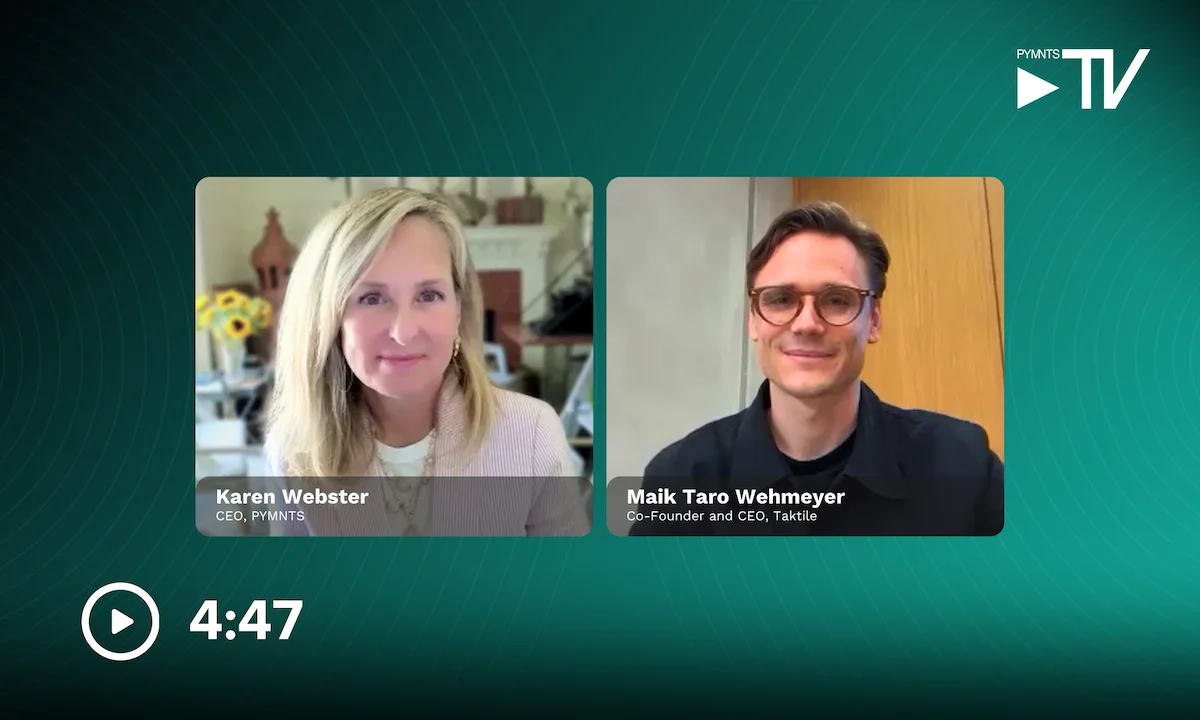
According to Maik Taro Wehmeyer, co-founder and CEO of Taktile, the industry is currently crossing a critical Rubicon. After years of theoretical experimentation, the technology is finally maturing to meet the stringent demands of financial services. "The models have not been good enough to be ready for mission-critical decisions," Wehmeyer noted in a recent conversation with PYMNTS CEO Karen Webster. "But 2026 is the year where AI will truly arrive for financial services."
Main Facts: A Paradigm Shift in Financial Infrastructure
Taktile, which recently secured $110 million in a funding round led by Goldman Sachs Alternatives, is betting on an accelerated timeline for autonomous financial decision-making. Unlike general-purpose AI models, Taktile’s platform deploys specialized AI agents designed specifically for regulated environments. These agents are engineered to handle complex operational workflows—such as loan underwriting, Know Your Business (KYB) compliance, and insurance claims—while maintaining the rigorous audit trails required by financial regulators.
The central thesis driving Taktile and similar innovators is that the competitive advantage in banking is shifting from the product to the process. In an era where capital is often a commodity, the ability to deliver "financial certainty" at high speed has become the new gold standard. By replacing manual, week-long underwriting processes with AI-driven decisions that take mere minutes, institutions are finding that they can fundamentally alter their value proposition to customers.
Chronology of the AI Evolution in Banking
The journey of AI in finance has moved in distinct, accelerating phases:
- 2022-2023: The Proof-of-Concept Phase. Banks primarily focused on Large Language Models (LLMs) for internal productivity. Use cases were largely confined to "copilots" meant to assist humans with summarization, documentation, and basic data entry.
- 2023-2024: The Sandbox and "Shadow Mode" Era. As trust in the technology grew, firms began deploying AI agents in "shadow mode." In this configuration, the AI processes live data and suggests decisions in real-time, but human analysts retain the final authorization power. This allowed institutions to benchmark machine performance against human experts without assuming operational risk.
- 2024-2025: The Rise of Specialized Agents. The industry moved away from generic LLMs toward domain-specific agents—AI systems trained on proprietary financial data, regulatory frameworks, and risk-management protocols.
- 2026 and Beyond: The Threshold of Autonomy. Industry leaders, including Taktile, project that 2026 will mark the point where autonomous agents are granted authority over significant, high-consequence decisions, fundamentally reconfiguring the role of the human analyst from "decision-maker" to "oversight manager."
Supporting Data: The Case for Speed and Precision
The business case for autonomous decision-making is not merely about cost reduction—though that is a significant byproduct. It is about the radical compression of time.
Consider the small business loan process. Traditionally, this is a manual, multi-week slog involving document collection, credit verification, and multiple layers of manual review. Under an AI-enabled model, that same process can be reduced to a five-minute interactive experience. For a small business owner operating under tight cash flow constraints, the difference between waiting 14 days and five minutes is the difference between survival and insolvency.
Taktile Labs, the research arm of the company, is actively publishing benchmarks comparing AI performance to human analysts. This data is vital for risk officers. By replacing vague vendor assertions with empirical evidence—demonstrating, for example, that an AI agent achieves a 99% consistency rate in KYB checks compared to a 92% rate for human analysts—Taktile is successfully moving the needle on institutional adoption.
Furthermore, the "democratization" of this technology is a critical trend. Previously, high-speed underwriting was the exclusive province of "Too Big to Fail" banks with massive R&D budgets. Today, community banks and credit unions—provided they have modernized their cloud infrastructure—can leverage the same algorithmic power. This allows smaller institutions to compete on a level playing field, offering the same rapid turnaround times as their multi-trillion-dollar counterparts.
Official Responses: The Human-AI Interface
During his discussion with PYMNTS, Maik Taro Wehmeyer emphasized that the "agent-first" future is not about the total elimination of humans, but rather the redefinition of their roles. "We are betting on a market where [autonomous] workflows are not just possible, but expected," he stated.
However, the transition faces significant friction, largely in the form of change management. As Karen Webster noted, the hurdle is rarely the technology itself, but the organizational culture. "The technology is great," Webster observed. "It’s the change management, getting people comfortable with this powerful technology."
This discomfort is legitimate. To mitigate it, Taktile’s approach involves:
- Transparency: Providing a clear, traceable "reasoning" for every AI-driven decision, ensuring that auditors can follow the logic trail.
- Gradual Autonomy: Encouraging institutions to start with low-risk portfolios before scaling to complex commercial lending.
- Regulatory Alignment: Engaging with compliance officers early in the implementation cycle to ensure that AI-driven decisions meet or exceed existing regulatory standards (such as Fair Lending laws).
Implications: The "Agent-First" Financial Future
The long-term implications of this shift are profound. If banks move toward an "API-first, agent-first" architecture, the nature of the institution itself will change. We could see a future where the bank becomes the "infrastructure" behind the scenes, while the primary user interface becomes an AI agent—either one provided by the bank or an independent financial assistant used by the consumer.
The Regulatory Challenge
The primary bottleneck for this future is not hardware, software, or bandwidth; it is the regulatory framework. While the technology is capable of making split-second, high-accuracy decisions today, regulators remain in a "wait and see" posture. The challenge for 2026 and beyond will be creating a sandbox that allows regulators to audit AI agents in real-time, ensuring that systemic risks are identified before they propagate across the financial ecosystem.
The Competitive Landscape
For institutions that resist this shift, the danger is not just obsolescence, but a total loss of market relevance. When customers become accustomed to five-minute loan approvals, they will likely view institutions that require two weeks for the same process as antiquated and unresponsive. As Wehmeyer pointed out, the question is no longer "what is possible," but rather "how fast can you get access to it?"
Redefining Trust
Ultimately, the transition to autonomous financial agents will be won by the companies that solve the "trust race." As institutions move from "human-in-the-loop" to "human-on-the-loop," the burden of proof rests on AI developers to provide ironclad evidence of safety and fairness.
The era of the "Agent-First Bank" is no longer a futuristic vision; it is an emerging reality. Organizations that successfully bridge the gap between legacy systems and modern AI agents will likely define the next decade of financial services. For those that wait for the technology to be "perfect," they may find that by the time they are ready to act, their customers have already migrated to institutions that embraced the power of the autonomous agent years earlier.