







The U.S. Cybersecurity and Infrastructure Security Agency (CISA)—the very entity tasked with safeguarding the nation’s digital defenses—is currently reeling from a major security breach. A contractor with administrative access to the agency’s development infrastructure intentionally published a trove of sensitive credentials, including AWS GovCloud keys and internal system passwords, on a public GitHub repository. The exposure has ignited a firestorm in Washington, with senior lawmakers from both chambers of Congress demanding an immediate accounting of how such a catastrophic lapse in judgment and oversight was allowed to occur.
As of late May 2026, CISA remains in a state of high-alert, scrambling to identify, invalidate, and rotate a vast array of leaked credentials. Security researchers warn that the window of exposure may have been long enough for foreign adversaries to gain a foothold in federal systems, potentially compromising the integrity of critical infrastructure networks.
The Anatomy of a Security Failure
The breach was first brought to public attention on May 18, 2026, by KrebsOnSecurity, which identified a public GitHub profile titled "Private-CISA." The account was created by a contractor who possessed broad administrative privileges over the agency’s code development platforms.
Investigations into the repository revealed that the contractor had manually disabled GitHub’s built-in "secret scanning" protections, which are specifically designed to prevent the accidental or intentional upload of plaintext passwords, API keys, and cryptographic tokens. By overriding these safety protocols, the contractor effectively transformed a public-facing repository into a digital "lost and found" for some of the U.S. government’s most sensitive access credentials.
The repository, which appears to have been used as a convenient "scratchpad" or synchronization tool to move data between work and personal machines, contained a staggering amount of proprietary data. Files recovered from the repository included:
- AWS-Workspace-Bookmarks-April-6-2026.html
- AWS-Workspace-Firefox-Passwords.csv
- Important AWS Tokens.txt
- kube-config.txt (containing Kubernetes cluster access configurations)
Experts who analyzed the repository’s commit logs note that the archive was created in November 2025, suggesting that the data may have been exposed to the public internet for months before its discovery.
Chronology of the Incident
- November 2025: The "Private-CISA" GitHub repository is established by a contractor. It begins to accumulate internal CISA configuration files and credentials.
- Late April 2026: The repository is updated with some of its most sensitive and critical AWS GovCloud tokens, significantly increasing the risk to agency operations.
- May 18, 2026: KrebsOnSecurity publishes a report detailing the existence of the repository and the scope of the exposure. CISA begins an emergency audit of its credential lifecycle.
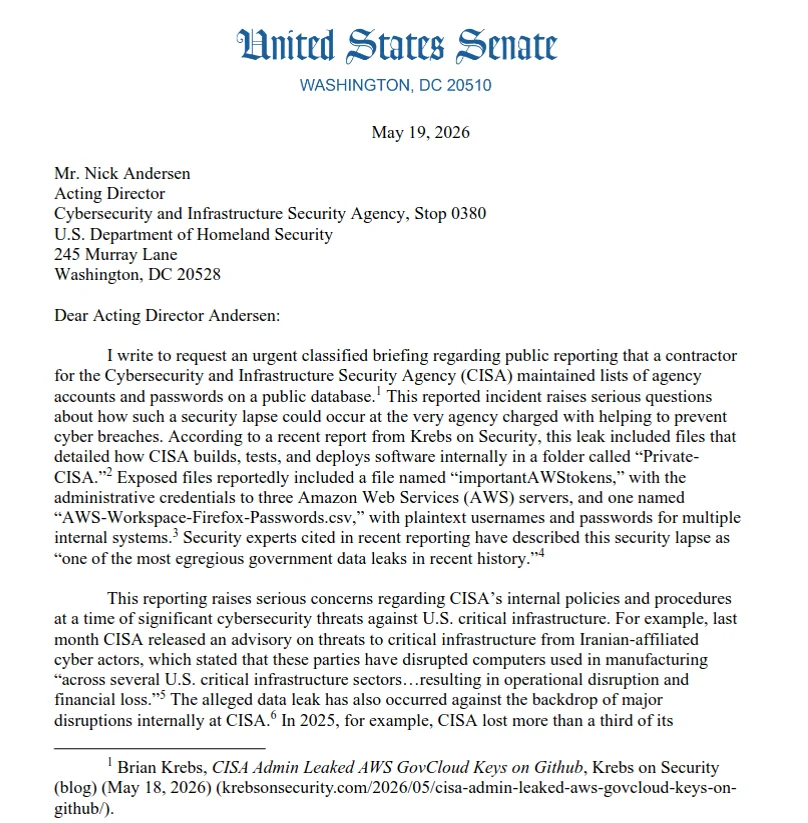
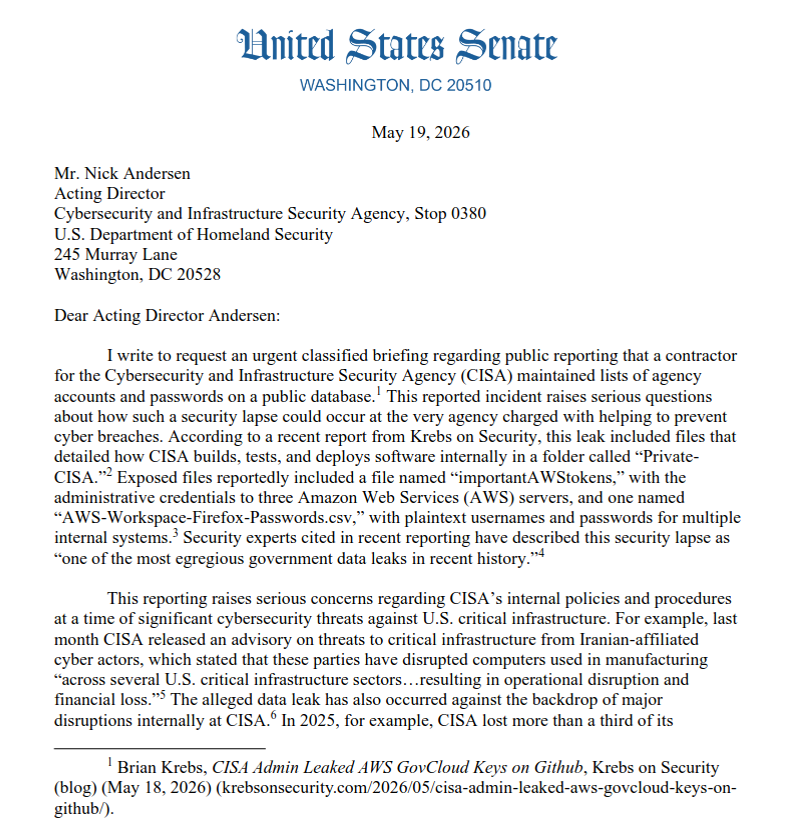
- May 19, 2026: Sen. Maggie Hassan (D-NH) and Rep. Bennie Thompson (D-MS) issue formal letters to CISA Acting Director Nick Andersen, demanding answers regarding internal security culture and oversight of contract personnel.
- May 20, 2026: Security researcher Dylan Ayrey, founder of Truffle Security, notifies CISA of an active RSA private key that remained unrevoked. The key provided full administrative access to the CISA-IT GitHub organization. CISA begins emergency revocation shortly thereafter.
- May 21, 2026 and onward: CISA continues the arduous process of rotating remaining compromised credentials across its technology portfolio.
The "TruffleHog" Findings: A Deep Dive into Risk
The danger posed by this leak cannot be overstated. Dylan Ayrey, the creator of the open-source security tool TruffleHog, provided critical insight into the severity of the situation. Upon auditing the leaked data, Ayrey discovered that CISA had failed to immediately revoke an RSA private key associated with a GitHub app.
"An attacker with this key could have read source code from every repository in the CISA-IT organization, including private repositories," Ayrey explained. Furthermore, the access granted by this key would have allowed a malicious actor to register rogue "self-hosted runners." In the world of Continuous Integration and Continuous Delivery (CI/CD), self-hosted runners are the engines that build and deploy software. By hijacking these, an attacker could inject malicious code into CISA’s own software updates, effectively creating a "supply chain attack" vector against the very systems CISA protects.
Ayrey’s company, Truffle Security, monitors a "firehose" of GitHub data to catch such leaks. However, he warns that his firm is not the only one watching. "We have evidence that attackers monitor that firehose as well," Ayrey noted. "Anyone monitoring GitHub events could have been sitting on this information for weeks."
Congressional Scrutiny and Internal Turmoil
The leak occurs at a precarious time for CISA. The agency has been struggling with a massive loss of human capital following a series of early retirements, buyouts, and forced resignations under the current administration. According to industry reports, the agency has lost more than one-third of its workforce, a reality that lawmakers suggest has crippled the agency’s ability to maintain its own security standards.
In her May 19 letter, Senator Maggie Hassan was blunt: "This reporting raises serious concerns regarding CISA’s internal policies and procedures at a time of significant cybersecurity threats against U.S. critical infrastructure."
Rep. Bennie Thompson, joined by Rep. Delia Ramirez, echoed these sentiments, highlighting the geopolitical stakes. "It’s no secret that our adversaries—like China, Russia, and Iran—seek to gain access to and persistence on federal networks," they wrote. "The files contained in the ‘Private-CISA’ repository provided the information, access, and roadmap to do just that."
Official Agency Response
CISA has maintained a narrow defensive posture regarding the incident. In a brief statement provided to the press, the agency claimed, "There is no indication that any sensitive data was compromised as a result of the incident."
However, this claim has been met with skepticism by cybersecurity professionals who note that "no indication of compromise" is not the same as "proof of no compromise." Detecting unauthorized access to credentials that have been leaked on a public platform is notoriously difficult, as attackers often use such keys to quietly mirror or exfiltrate data without triggering traditional "brute force" alarms.
Regarding the ongoing cleanup, CISA stated: "CISA is actively responding and coordinating with the appropriate parties and vendors to ensure any identified leaked credentials are rotated and rendered invalid and will continue to take appropriate steps to protect the security of our systems."
The Human Factor: An Unsolvable Problem?
While policymakers are calling for stricter technical controls, some industry experts argue that the incident highlights a fundamental limit to cybersecurity. James Wilson, editor of the Risky Business security podcast, noted that while organizations can mandate policy, preventing a rogue contractor from using a personal device or a personal GitHub account to "sync" work files is nearly impossible.
"Ultimately, this is a thing you can’t solve with a technical control," said Adam Boileau, a co-host on the Risky Business podcast. "This is a human problem where you’ve hired a contractor to do this work and they have decided of their own volition to use GitHub to synchronize content from a work machine to a home machine."
This observation underscores the "insider threat" dilemma. Even with the most sophisticated firewalls and endpoint protection, the human element—specifically, the convenience-seeking behavior of employees and contractors—remains the weakest link in the security chain.
Implications for Federal Cybersecurity
The "Private-CISA" incident serves as a wake-up call for the entire federal government. It exposes a disconnect between the high-level policy mandates issued by CISA and the day-to-day operational reality of the contractors who manage the government’s code.
The fallout from this incident will likely result in:
- Stricter Vendor Audits: CISA will likely face pressure to implement more rigid oversight of contractor access, including mandatory hardware-based security keys and more restrictive "data loss prevention" (DLP) software on all devices with access to federal infrastructure.
- Increased Congressional Oversight: Expect a series of high-profile hearings aimed at the agency’s leadership regarding the "diminished security culture" noted by Rep. Thompson.
- Policy Re-evaluations: The incident will force a national conversation on whether government work should be permitted on platforms like GitHub at all, or if private, air-gapped instances are required to ensure data integrity.
As of today, the incident remains an active investigation. While CISA asserts that the immediate threat has been mitigated, the broader questions regarding the stability of the agency and the security of its supply chain remain unanswered. For a nation that relies on CISA to lead the way in cyber defense, this breach is a sobering reminder that the most dangerous threats are often the ones created from within.