








In a landmark moment for international cybersecurity enforcement, two prominent members of the notorious cybercrime collective known as "Scattered Spider" pleaded guilty this week in a London courtroom. The admissions, which came on the opening day of a highly anticipated six-week trial, signal a significant turning point in the global effort to dismantle one of the most prolific and disruptive hacking groups in recent history.
Thalha Jubair, 20, of East London, and 18-year-old Owen Flowers of Walsall, stood before the court to answer for a multi-year campaign of digital destruction that spanned continents. Their guilty pleas regarding the August 2024 cyberattack on Transport for London (TfL)—which brought the public transport network of the Greater London area to a standstill—are merely the tip of the iceberg in a sprawling web of criminal activity that has targeted everyone from major retail giants to critical healthcare providers.
The Scope of the TfL Attack and Beyond
The attack on Transport for London was a calculated assault on public infrastructure. By compromising the internal systems of one of the world’s most complex transit authorities, Jubair and Flowers demonstrated a chilling capability to weaponize digital access against physical safety. Both men admitted to conspiring to commit unauthorized acts against computer systems, specifically acknowledging that their actions created a risk of "serious damage to human welfare."
However, the legal ramifications extend far beyond the borders of the United Kingdom. Flowers, in a separate admission, confessed to his involvement in a conspiracy to infiltrate U.S.-based healthcare providers, specifically SSM Health Care Corporation and Sutter Health, in September 2024. These intrusions underscore the group’s willingness to target sectors where downtime or data exposure carries life-critical consequences.
A Chronology of Digital Malfeasance
To understand the gravity of these guilty pleas, one must look at the timeline of Scattered Spider’s ascent. The group emerged as a formidable force around 2022, rapidly evolving from opportunistic phishing to high-stakes ransomware operations.
- Summer 2022: A massive SMS-phishing campaign, often referred to by researchers as "0ktapus," hits hundreds of organizations. This campaign facilitated the theft of single sign-on credentials from employees at entities such as LastPass, DoorDash, Mailchimp, Plex, and Signal.
- September 2023: Scattered Spider executes a high-profile ransomware attack on MGM Resorts and Caesars Entertainment, causing chaos in Las Vegas. Investigations later linked Owen Flowers to the media interviews that followed, where the hacker anonymously boasted about the group’s success.
- May 2022–September 2025: According to a U.S. federal indictment, Jubair and his cohorts conducted at least 120 network intrusions across 47 U.S. entities, resulting in a staggering $115 million in ransom payments.
- July 2025: Authorities in the UK execute a coordinated sweep, leading to the arrest of Flowers and Jubair. The arrests were connected to attacks on high-profile UK retailers, including Marks & Spencer, Harrods, and the Co-op Group.
- April 2026: Tyler "Tylerb" Buchanan pleads guilty in the U.S. to wire fraud and identity theft, admitting to his role in the 2022 phishing spree.
- June 2026: Flowers and Jubair enter their guilty pleas in London.
The Mechanics of the "Star Chat" Syndicate
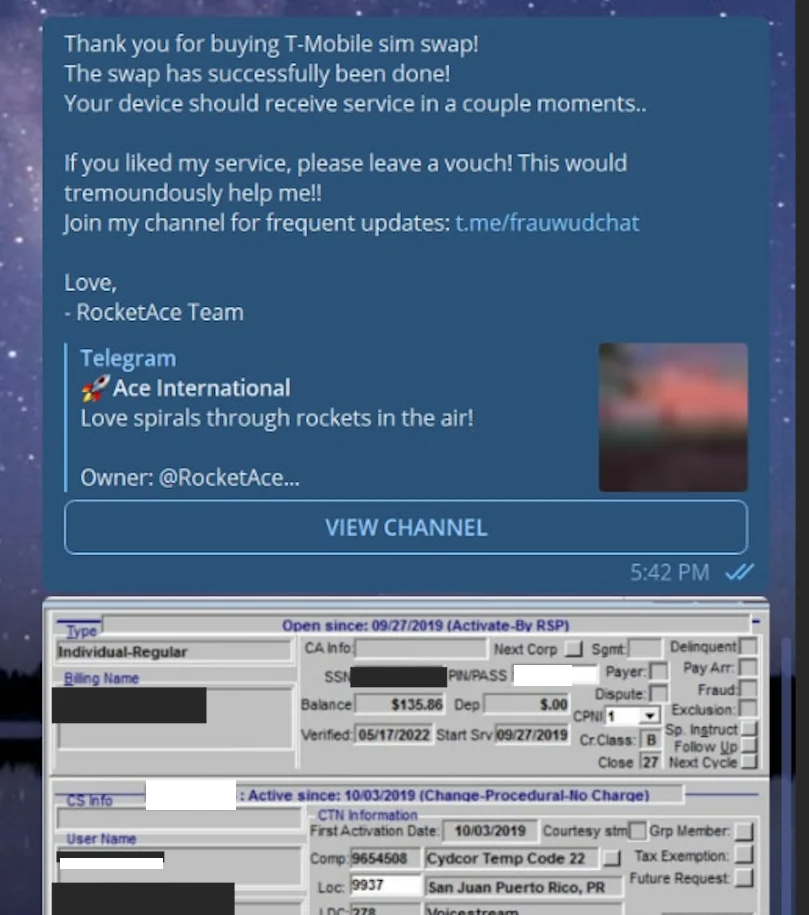
The influence of Thalha Jubair within the underground hacking community was cemented by his role in co-running "Star Chat," a Telegram channel that functioned as the headquarters for a sophisticated SIM-swapping operation.
SIM-swapping—a process where an attacker convinces a mobile carrier to transfer a target’s phone number to a device controlled by the hacker—allows criminals to intercept SMS-based multi-factor authentication (MFA) codes. By compromising internal employee tools at major U.S. and UK wireless providers, Jubair’s group turned the mobile phone into a vulnerability rather than a security tool.
"Rocket Ace," one of the handles attributed to Jubair by U.S. prosecutors, became a brand name for this service. Evidence recovered from the investigation shows detailed receipts for SIM-swaps performed against customers of major carriers, illustrating how easily the group could bypass modern security protocols by targeting the human element at the telecommunications provider level.

Historical Context: From "Everlynn" to International Fugitive
The trajectory of Thalha Jubair’s criminal career is as disturbing as it is rapid. Long before he was a centerpiece of a federal investigation, he was known online as "Everlynn." As early as age 15, he was selling fraudulent "emergency data requests."
These requests are a particularly nefarious form of social engineering. By compromising police or government email addresses, hackers send urgent, fake legal demands to tech companies, claiming that a user’s data is required to prevent an imminent death. Because these requests appear to originate from verified law enforcement channels, they often bypass the standard legal review process, allowing criminals to harvest sensitive subscriber data without a court order.
The Global Crackdown: A Multilateral Response
The prosecution of Jubair and Flowers is not an isolated effort. It is the result of unprecedented cooperation between the UK’s National Crime Agency (NCA), the U.S. Department of Justice (DOJ), and international intelligence partners.
In August 2025, the group’s reach was curtailed when Noah Michael Urban, a Florida-based Scattered Spider member, was sentenced to 10 years in federal prison and ordered to pay $13 million in restitution. The DOJ currently maintains an open indictment against several other members, including Ahmed Hossam Eldin Elbadawy, Evans Onyeaka Osiebo, and Joel Martin Evans, all of whom are accused of participating in the group’s extensive criminal operations.
Implications for Corporate and Public Security
The Scattered Spider case serves as a masterclass in why modern cybersecurity requires more than just firewalls and encryption. The group’s success was largely predicated on three pillars:
- Exploiting the Human Element: Through sophisticated social engineering and SMS-phishing, they bypassed technical safeguards by compromising the people who manage them.
- Infrastructure Targeting: By attacking critical services like transport networks and mobile carriers, they forced entities to negotiate, knowing that prolonged downtime was an unacceptable cost.
- Cross-Border Complexity: By operating from the UK while targeting U.S. companies, they attempted to exploit jurisdictional gaps in international law.
However, the rapid succession of guilty pleas and the extradition-ready status of these defendants signal that the "digital safe haven" previously enjoyed by these groups is closing.
For the victims—ranging from employees whose identities were stolen to the thousands of commuters left stranded by the TfL attack—these guilty pleas represent a measure of justice. For the cybersecurity industry, the trial of Flowers and Jubair provides a roadmap of the vulnerabilities that must be addressed.
As the sentencing date of July 15, 2026, approaches, the legal system prepares to close the book on two of the most disruptive young hackers of their generation. Yet, the broader investigation into the remaining members of Scattered Spider continues, serving as a stark warning to other cybercriminals: the digital world may be vast, but it is no longer beyond the reach of the law.