










The financial landscape for digital assets is currently defined by a paradoxical disconnect. On one hand, Wall Street analysts are aggressively downward-adjusting revenue expectations for the sector’s primary infrastructure providers. On the other hand, the markets themselves are responding with notable resilience, suggesting that the "worst-case scenario" has already been priced into the stocks of industry titans like Coinbase and Circle.
This divergence raises a critical question: Is the crypto market finally carving out a structural bottom, or is this merely a temporary reprieve in a longer, more painful consolidation phase?
Main Facts: The Analyst-Market Disconnect
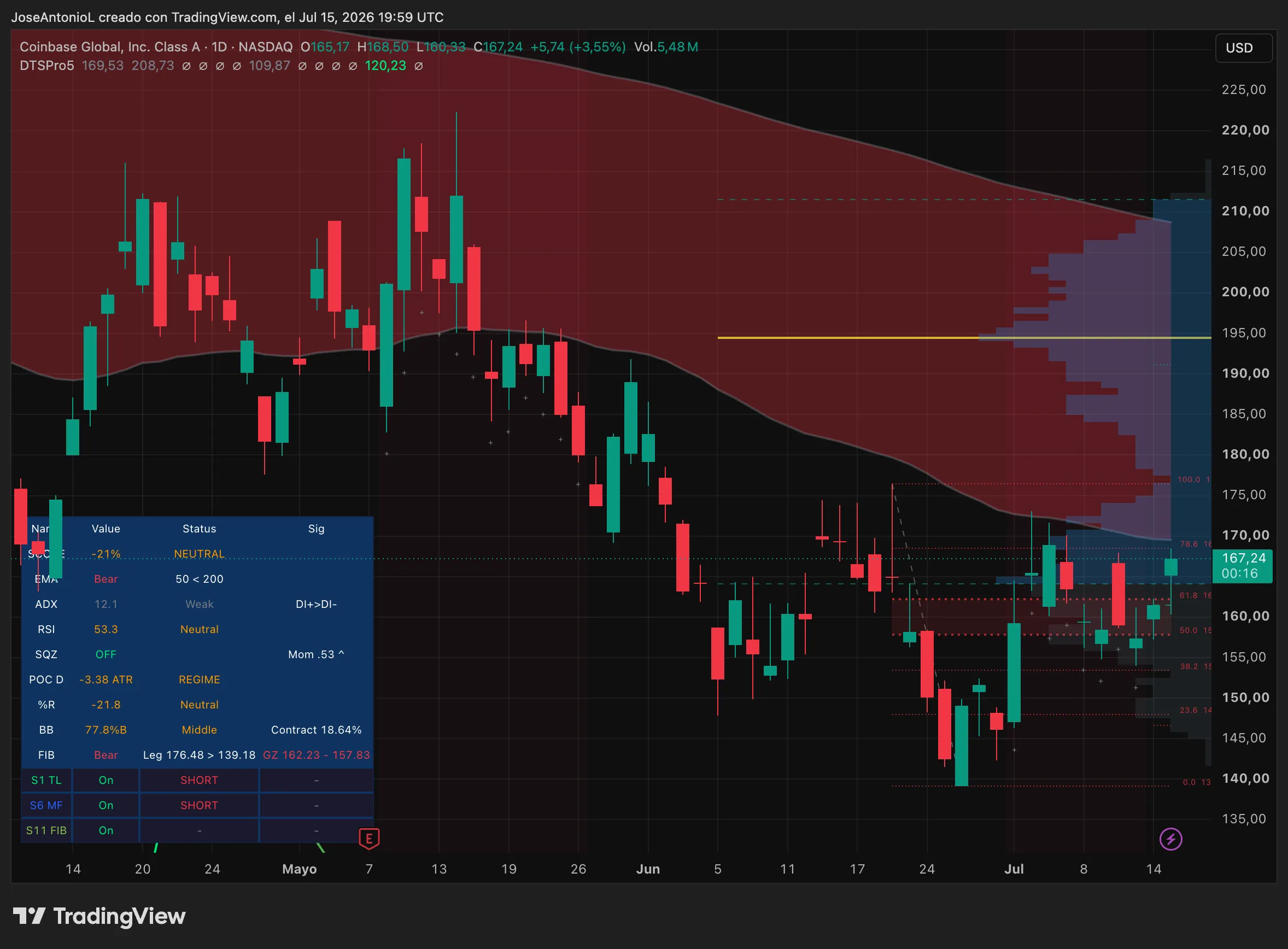
On Wednesday, the financial markets witnessed a counterintuitive rally. Despite a sobering research note from William Blair—a venerable Chicago-based investment bank with deep roots in tech and growth equity—shares of Coinbase (COIN) and Circle (CRCL) surged between 3% and 4%.
William Blair, while maintaining its "outperform" rating on Coinbase, took a scalpel to the company’s financial outlook. The firm slashed its 2026 revenue projections by 12% and its 2027 estimates by 13%. More drastically, the analysts gutted their adjusted EBITDA projections by 34% for both years. According to analysts Andrew Jeffrey and Adib Choudhury, Coinbase’s earnings are poised to "trough" in the latter half of 2026 before staging a recovery in 2027.
The market’s refusal to sell off on this news suggests that the "pain is already in the price." Investors seem to be looking past the immediate earnings headwinds, focusing instead on the long-term maturation of the crypto ecosystem.
Chronology of the 2026 Downturn
To understand the current sentiment, one must look at the timeline of the 2026 market correction:

- Early 2026: Crypto assets faced immense pressure as high interest rates and regulatory ambiguity dampened retail enthusiasm. Coinbase’s stock saw a year-to-date decline of nearly 30%, while Bitcoin itself struggled with a 26% drop.
- June 2025 – Present: Circle, which debuted in a splashy NYSE IPO at $31 per share in mid-2025, has faced a difficult road, dropping roughly 20% since the start of 2026.
- July 2, 2026: Technical analyst John Bollinger identified a developing "W" double-bottom pattern on the Bitcoin daily chart, suggesting a potential shift in market trend.
- July 6, 2026: Bollinger clarified his stance, noting that the successful completion of this pattern would be a critical "confirmation of a change in trend," moving the market from a bearish to a potentially bullish footing.
- Mid-July 2026: On-chain data from Glassnode indicated that long-term holder capitulation—the primary source of selling pressure throughout the year—finally peaked and began to decline, signaling that the "weak hands" have largely exited the market.
Supporting Data: By the Numbers
The current state of the market is best understood through the lens of institutional-grade data and analyst modeling.
The Coinbase Outlook
William Blair’s model anticipates that Coinbase’s total trading volume will fall roughly 44% this year to $669 billion. However, they forecast a robust rebound of over 32% in 2027. This growth is expected to be fueled by a diversification of revenue streams. While spot trading volume has been the company’s bread and butter, its Base layer-2 network and its aggressive push into retail derivatives are becoming significant contributors. Notably, retail derivatives alone surpassed $200 million in annualized revenue during the first quarter of 2026.
Bitcoin’s Technical Foundation
John Bollinger’s "W" pattern is more than a mere technical quirk. As he noted on X (formerly Twitter), the pattern is "perfectly fractal," appearing on both the daily and weekly charts. This suggests a deep, underlying structural shift. Bollinger, who has disclosed a long position in Bitcoin, cautions that while the trend remains bearish by traditional metrics, the selling pressure is losing its structural integrity.
On-Chain Accumulation
Glassnode’s latest research highlights that the June lows served as a massive accumulation zone. Wallets of all sizes—from retail "shrimp" to institutional "whales"—began aggressively buying during the dip. Furthermore, Bitcoin’s correlation with U.S. equities has loosened, while its sensitivity to macro-economic news, such as inflation prints, has intensified, suggesting that Bitcoin is beginning to trade more like a distinct asset class rather than just a high-beta proxy for the Nasdaq.
Official Responses and Dissenting Views
While William Blair remains "constructive" on the long-term prospects of Coinbase, not every analyst on Wall Street shares this optimistic outlook for the near term.
Patrick Moley of Piper Sandler provided a more cautious assessment, cutting his price target for Coinbase from $170 to $155 while maintaining a "neutral" rating. Moley pointed to the rapid rise of prediction markets and perpetual futures as the "defining story" of the second quarter. He noted that the World Cup acted as a massive catalyst for prediction market volume, but warned that "significant investor attention" remains focused on the potential threat posed by decentralized perpetual future platforms to Coinbase’s core business model.
The divergence between these two camps—those who see the current dip as a buying opportunity and those who fear structural competition—highlights the volatility inherent in the transition from a speculative crypto market to a mature, utility-driven financial sector.
Implications: The Road to 2027
The overarching narrative emerging from this data is one of a sector in transition. The current cycle is fundamentally different from the 2022 market crash. Unlike four years ago, the ecosystem now benefits from:
- Spot Bitcoin ETFs: These instruments provide a bridge for institutional capital that was previously unavailable, creating a floor for the asset price.
- Institutional Adoption: The maturation of custody and clearing services has allowed for deeper integration with traditional finance.
- Regulatory Clarity: While the landscape remains complex, the rules of the road are becoming increasingly defined, allowing firms to build with more confidence than in the "Wild West" era.
The Inflection Point
The consensus among experts—including those at William Blair and on-chain analysts—is that we are currently in an "inflection zone." The derivative positions are unwinding, the fear premium in the options market is easing, and the long-term sellers are thinning out. However, the "missing piece" remains sustained, spot-driven buying.
For investors, the implication is clear: the current market volatility is a reflection of a transition phase. While 2026 is projected to be a year of troughing and consolidation, the infrastructure being built today—from Coinbase’s Layer-2 advancements to the deepening of prediction markets—is setting the stage for what analysts believe will be a significant rebound in 2027.
As the market waits for the next wave of capital, the "W" pattern observed by technical analysts and the slowing of long-term capitulation observed by on-chain researchers provide a compelling, albeit cautious, signal that the tide may finally be turning. The question for the remainder of the year is no longer whether the market will survive the winter, but how quickly it can thaw once the institutional capital begins to re-engage.