









In the global effort to mitigate the catastrophic impacts of climate change, European nations have emerged as the primary laboratory for environmental fiscal policy. By utilizing economic levers—specifically carbon taxes and Emissions Trading Systems (ETSs)—these countries are attempting to decouple economic growth from greenhouse gas (GHG) emissions. As of 2026, the landscape of European climate policy is a complex, multi-layered mosaic of varying tax rates, regulatory scopes, and market-based mechanisms designed to internalize the social cost of carbon.
The Genesis and Expansion of Carbon Pricing
The journey toward a carbon-conscious economy began in 1990 when Finland became the world’s first nation to implement a carbon tax. This policy shift signaled a fundamental change in how governments view environmental degradation: moving away from purely command-and-control regulation toward market-based instruments that place a specific price on the carbon content of fossil fuels.
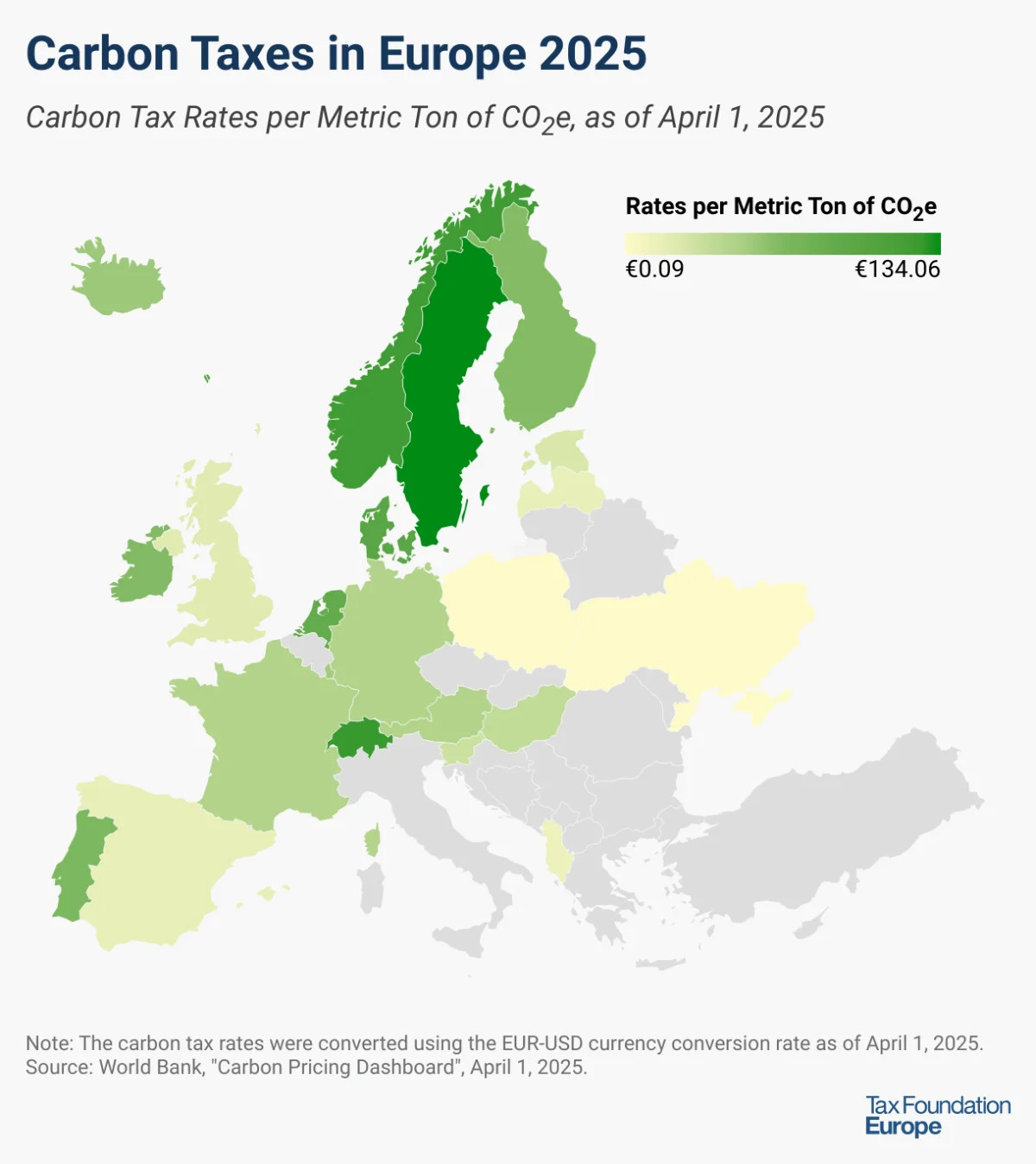
Since Finland’s pioneering move, the concept has gained significant traction. Today, 24 European countries have adopted some form of national carbon taxation. However, the application of these taxes is far from uniform. The continent exhibits a stark disparity in ambition and implementation, with rates ranging from nominal charges of less than €1 per metric ton in countries like Poland and Ukraine, to the stringent, high-tax regimes of Norway, Sweden, Switzerland, and Liechtenstein.
A Chronology of Climate Policy
The adoption of carbon pricing in Europe has not occurred in a vacuum; it has been a reactive process, evolving alongside scientific consensus and international climate accords.
- 1990 – The Pioneer: Finland introduces the world’s first carbon tax, setting the precedent for national environmental fiscal policy.
- 1990s–2000s – Experimental Phase: Various Scandinavian and Nordic countries follow suit, experimenting with different tax bases and sectoral inclusions.
- 2005 – The EU ETS Launch: The European Union establishes the Emissions Trading System (EU ETS), a cap-and-trade mechanism that creates a continental market for carbon allowances, forcing a harmonization of climate targets across Member States.
- 2020 – Integration: Switzerland officially links its national ETS to the EU ETS, signaling a move toward regional integration.
- 2021 – Post-Brexit Transition: The United Kingdom launches its own domestic ETS following its departure from the European Union.
- 2021–2023 – The Modern Wave: Germany (2021), Austria (2022), Albania (2022), and Hungary (2023) introduce new carbon tax regimes, reflecting a renewed urgency in meeting the goals of the Paris Agreement.
- 2026 – Continued Expansion: Serbia introduces a national carbon tax, while Germany transitions its existing tax into a national ETS framework, preparing for the upcoming EU ETS-2.
Supporting Data: The Cost of Carbon
As of April 1, 2026, the average carbon tax rate among the 24 European nations stands at approximately €53.63 per ton. However, this average masks the significant variance in policy commitment.
Norway leads the continent with a tax rate of €146.23 ($169.71) per ton, reflecting a long-term commitment to aggressive decarbonization. Sweden follows closely at €133.17 ($154.55), with Switzerland and Liechtenstein both maintaining rates of €129.09 ($149.81). At the lower end of the spectrum, Poland and Ukraine maintain largely symbolic tax rates of €0.09 and €0.59, respectively, illustrating the economic and political challenges of implementing higher levies in emerging markets.
Scope and Efficiency Challenges
The effectiveness of these taxes depends heavily on the "tax base"—the portion of total greenhouse gas emissions subject to the levy. The scope varies wildly:
- Targeted Taxation: Spain’s carbon tax is highly specialized, covering only fluorinated gases and accounting for roughly 2 percent of total national emissions.
- Broad Coverage: Conversely, nations like Albania, Andorra, and Luxembourg attempt to capture over 72 percent of their emissions through their tax structures.
Despite these targets, the "collection efficiency" remains a persistent issue. Exemptions, reduced rates for energy-intensive industries, and political concessions often lead to a scenario where the actual revenue collected and the volume of emissions penalized fall significantly short of the nominal policy targets.
The Interplay Between Taxes and Markets
One of the most significant challenges for European policymakers is the overlapping of national carbon taxes with the EU ETS. Because all EU Member States—along with Iceland, Liechtenstein, and Norway—participate in the EU ETS, a secondary layer of regulation is often applied to the same sectors.
This overlap creates a risk of "double taxation," where companies are forced to pay both a national carbon tax and purchase ETS allowances for the same unit of emission. Economic theory suggests that when a national carbon tax applies to emissions already capped by an ETS, it does not necessarily reduce total emissions. Instead, it merely shifts the burden of those emissions to sources outside the tax base, effectively "leaking" the economic impact without achieving a net reduction in the cap-and-trade market.
To mitigate this, countries like Germany have begun phasing out national taxes in favor of transitioning toward the EU ETS-2. This broader, market-based successor is designed to eventually absorb sectoral emissions currently covered by fragmented national policies, streamlining the process and reducing administrative friction.
Official Perspectives and Implications
The primary goal of these policies is to encourage behavioral shifts among consumers, businesses, and governments. By internalizing the cost of carbon, these nations aim to foster innovation in renewable energy and resource efficiency. However, the path forward is fraught with systemic complications.
Economic Implications
A narrow tax base is often criticized for being non-neutral and inefficient. Ideally, experts argue that a carbon tax should apply to all sectors at the same rate to ensure that the market—rather than political preference—determines the most efficient way to reduce emissions. When taxes are applied unevenly, they create distortions in the economy, potentially harming domestic competitiveness without achieving commensurate environmental gains.
The Path Forward: EU ETS-2
The future of European climate policy is increasingly centered on the EU ETS-2. This framework aims to integrate sectors like building and road transport, which have historically been difficult to capture under original ETS rules. As this system matures, national carbon taxes are expected to either be subsumed or phased out, as the European Commission moves toward a more centralized, unified carbon price.
Emerging Frontiers
The debate is no longer confined to national capitals. Subnational regions, such as Catalonia, are exploring their own localized carbon taxation schemes, while countries like Turkey are in the advanced stages of developing a national ETS. This indicates that the "carbon pricing movement" is far from complete; it is expanding into new jurisdictions and deepening its reach within existing ones.
Conclusion: Balancing Efficiency and Equity
As Europe continues its ambitious trajectory toward climate neutrality, the reliance on carbon taxes and ETS mechanisms will remain the cornerstone of its strategy. The core challenge for the next decade will be moving beyond the patchwork of disparate, often overlapping, systems toward a more cohesive and efficient architecture.
The lessons learned from the past 35 years—from Finland’s initial experiment to the sophisticated market linkages of today—demonstrate that while carbon pricing is an essential tool, its success is entirely dependent on the quality of its design. Ensuring that tax bases are broad, avoiding the pitfalls of double taxation, and maintaining transparency in market-based mechanisms will be the definitive tests for European policymakers as they navigate the transition to a low-carbon future.
For the business community and the public, the message is clear: the era of "free" carbon is rapidly drawing to a close. The economic landscape is being permanently reshaped by the price of atmospheric impact, and nations that fail to adapt their fiscal systems to this reality risk both environmental failure and economic stagnation.