







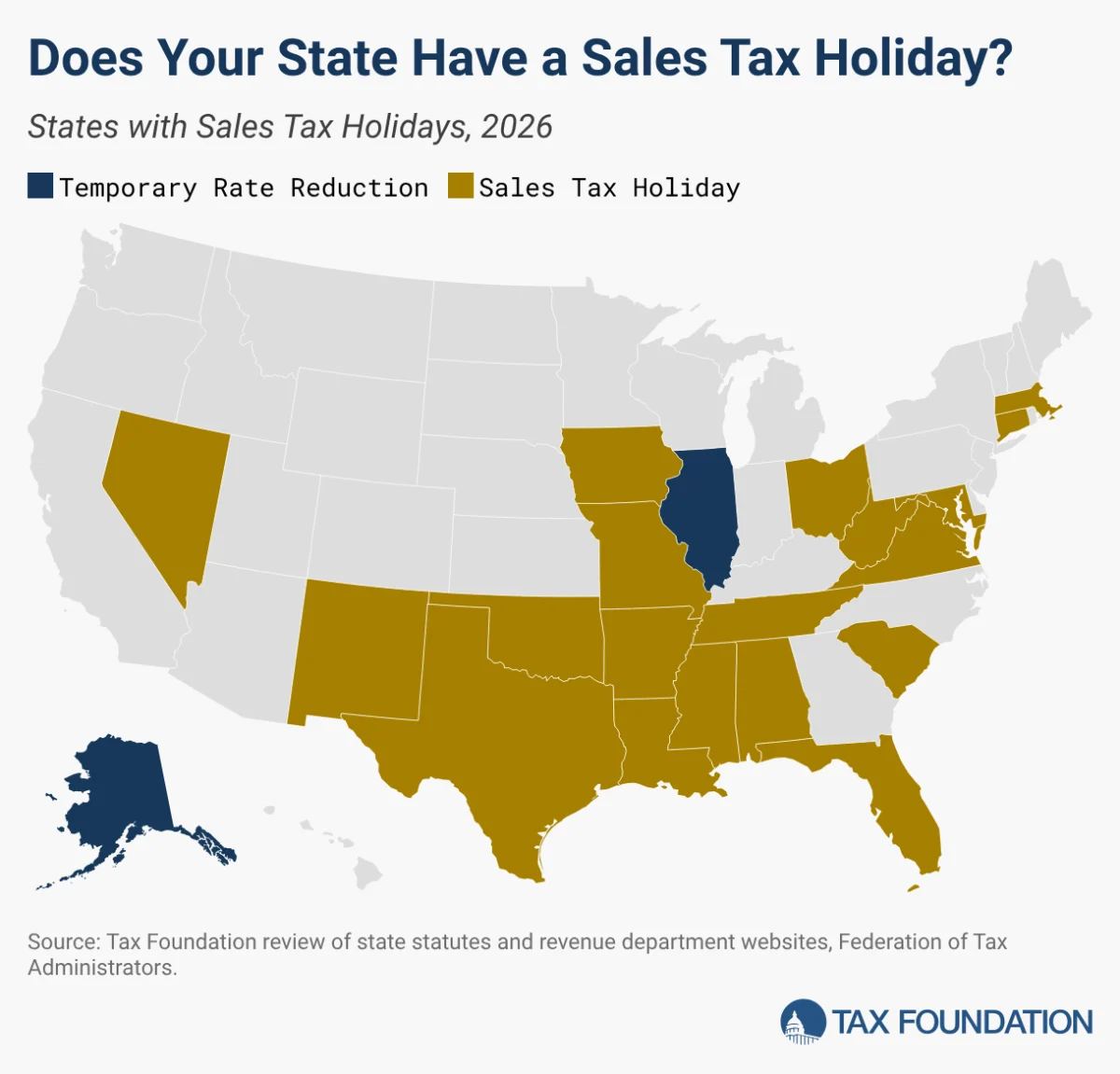
Despite persistent criticism from economists and tax policy experts, "sales tax holidays"—designated periods during which specific goods are exempted from state and local sales taxes—remain a staple of American fiscal policy. In 2026, the popularity of these tax-free windows reached a new peak: 20 states are conducting such holidays, an increase from 19 the previous year.
While these events are framed by proponents as consumer-friendly measures to stimulate economic activity and provide relief to families, a closer examination suggests that these holidays are little more than political theater. They introduce significant economic distortions, impose heavy administrative burdens on small businesses, and fail to provide the meaningful, long-term tax relief that taxpayers truly need.
The State of Play: Current Trends in 2026
The 2026 fiscal year has seen a notable resurgence in these programs. Illinois, for example, has reintroduced a back-to-school sales tax holiday that was previously in effect during 2010 and 2022. Similarly, Alabama has expanded its repertoire, adding a new tax-free provision for SNAP-eligible food items to complement its existing exemptions for back-to-school supplies and severe weather preparedness gear.
These figures do not capture the full scope of local-level activity, such as the municipal tax holidays offered in Alaska, nor do they include the sporadic "gas tax holidays" implemented by various states to combat the political heat of rising fuel prices. The breadth of these exemptions varies wildly—from clothing and school supplies to energy-efficient appliances in states like Maryland, Missouri, Texas, and Virginia.
A Chronology of Distorted Policy
The concept of the sales tax holiday is not new, yet its persistence suggests a failure of institutional memory regarding its efficacy.
- Pre-2000s: Sales tax holidays were sporadic, localized experiments intended to provide targeted relief for specific, often seasonal, consumer needs.
- 2010–2022: The practice became increasingly standardized. Illinois utilized its back-to-school holiday in both 2010 and 2022, only to see the policy sunset and return as a political bargaining chip in 2026.
- 2026: The current landscape is defined by "policy creep," where states are not only renewing old holidays but expanding them to include grocery items and emergency preparedness supplies.
The timing of these holidays is rarely accidental. Policymakers typically schedule them during periods of peak demand, such as late summer for back-to-school shopping or the onset of hurricane season. By exempting goods that consumers would purchase regardless of the tax break, states essentially forfeit revenue on transactions that were guaranteed to occur, offering no genuine marginal benefit to the economy.
The Economic Reality: Shifting Demand, Not Growing It
The primary argument put forth by proponents is that tax holidays "stimulate" economic activity. However, empirical studies—including those from the National Bureau of Economic Research—consistently show that these holidays do not increase the total magnitude of demand; they merely shift the timing of it.
The "Impulse" Fallacy
Consumers, aware of the upcoming tax-free window, simply defer their planned purchases until the holiday. While some incidental "impulse" buying occurs, it is insufficient to justify the substantial revenue losses incurred by the state. When a family waits until a tax-free weekend to buy a laptop, the state loses the tax revenue on a purchase that was already slated to happen.
The Price Gouging Phenomenon
Economic research suggests that retailers often anticipate the surge in demand during these holidays. In some instances, companies may absorb up to 20 percent of the tax benefit through price increases, effectively neutralizing the savings for the consumer. For low-income families—the very demographic these holidays are ostensibly designed to help—this can result in higher prices during the "tax-free" period than if they had shopped during a normal week.
Administrative Nightmares and Compliance Burdens
For the small business owner, sales tax holidays are often a logistical headache rather than a boon.
The Small Business Struggle
Large retailers with sophisticated point-of-sale systems and dedicated legal teams can adjust to tax exemptions with relative ease. Small, independent retailers, however, struggle with the short-notice changes required to comply with state law.
When Illinois signed Public Act 104-0468 into law in mid-June 2026, retailers were given only weeks to reconfigure their systems for an August holiday. For an online retailer selling across state lines, the nightmare is compounded by the "patchwork" nature of these holidays—each state has its own specific list of exempt goods, price caps, and definitions. Failure to get it right can lead to legal penalties for either over-collecting or under-collecting taxes.
The "Nevada Model": Shifting the Burden
Nevada provides an interesting, if equally flawed, case study with its National Guard sales tax holiday. By requiring the consumer to pay the tax upfront and file for a rebate later, the state shifts the compliance burden from the retailer to the taxpayer. While this protects the retailer, it creates such a cumbersome process that many eligible citizens simply choose not to participate, rendering the "relief" entirely inaccessible.
The Structural Weakness Argument
The most damning critique of the sales tax holiday is what it reveals about a state’s permanent tax code. The existence of these holidays is a tacit admission by policymakers that the base sales tax is too high and too burdensome for the remaining 51 weeks of the year.
If a government believes that suspending a 6.25 percent sales tax for a single week will jumpstart the economy, they are implicitly acknowledging that the tax rate is a drag on growth for the rest of the year. Rather than pursuing systemic, permanent rate reductions that would benefit all taxpayers year-round, legislators opt for the "temporary gimmick" of a tax holiday because it is politically visible and easy to market to voters.
Implications for Fiscal Health
Beyond the lack of economic stimulus, sales tax holidays can be actively harmful:
- Revenue Volatility: By creating predictable, artificial surges and lulls in revenue, states complicate their own budgeting processes.
- Resource Misallocation: Every dollar of revenue lost to a tax holiday must be recouped elsewhere, often through more economically damaging taxes or by cutting essential services.
- Distorted Consumer Behavior: Price caps intended to make holidays "fair" often backfire, incentivizing consumers to purchase cheaper, lower-quality goods simply to stay under a threshold, or punishing consumers who need higher-quality items.
- Equity Issues: Lower-income families, who may not have the flexibility to wait for a specific weekend to buy essentials, are often disadvantaged. By the time the holiday arrives, stock may be depleted, or they may have already purchased the items out of necessity.
Conclusion: The Need for Meaningful Reform
The persistence of sales tax holidays in 2026 confirms that electoral utility often trumps sound economic policy. While the holidays provide a photo opportunity for politicians and a sense of relief for shoppers, they represent a missed opportunity for genuine fiscal reform.
If states are truly concerned about the burden of sales taxes on their constituents, the solution is not to offer a temporary "hall pass" for a few days of the year. Instead, they should pursue permanent, structural reforms—such as broadening the tax base to include more services while lowering the overall rate. This approach would eliminate the need for gimmicks, reduce compliance costs for businesses, and provide a stable, consistent economic environment that fosters long-term growth rather than short-term distortions.
Until policymakers prioritize long-term health over short-term headlines, the sales tax holiday will remain a fixture of the American landscape: a popular, yet profoundly inefficient, mirage of tax relief.