









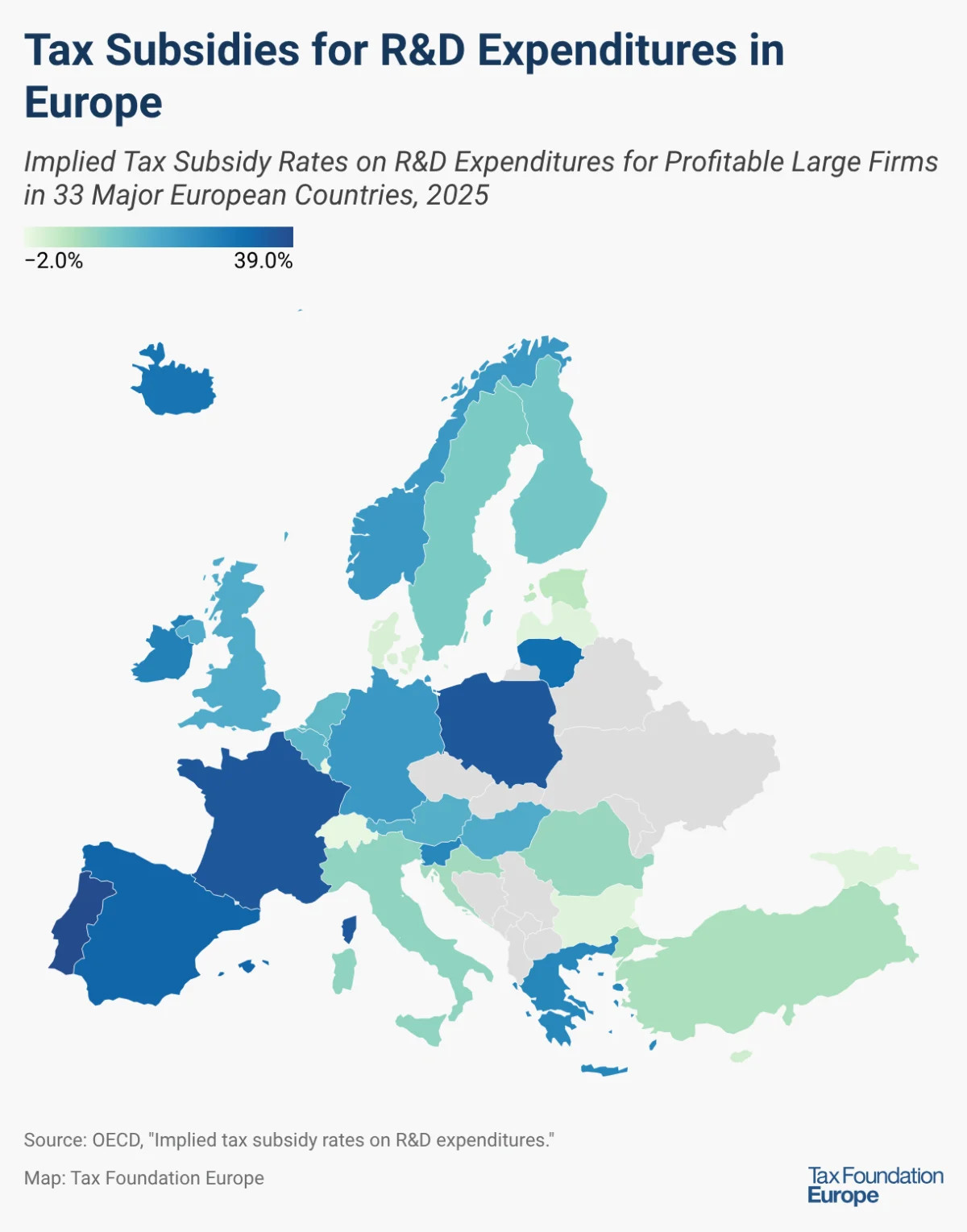
In the hyper-competitive arena of the global economy, Research and Development (R&D) stands as the primary engine of long-term productivity and growth. To capture this growth, governments worldwide increasingly utilize expenditure-based tax incentives to lower the effective cost of innovation for corporations. However, a new analysis of 2025 data reveals a stark divergence in strategy, with implied tax subsidy rates for large, profitable firms ranging from near-zero to nearly 40 percent.
The Spectrum of Global R&D Subsidies
The methodology for calculating "implied tax subsidy rates" allows economists to normalize different tax mechanisms—such as credits, deductions, and super-deductions—into a single metric. Across 33 major European economies, the average implied subsidy rate for a large, profitable firm sits at 16 percent for 2025. Yet, this average masks extreme volatility in national policy.
Portugal currently leads the pack among nations providing significant relief, boasting an implied subsidy rate of 39 percent. France and Poland follow closely behind, each offering a 36 percent subsidy rate. These high-incentive environments are designed to aggressively attract R&D-intensive industries, such as pharmaceuticals, aerospace, and advanced manufacturing.
Conversely, some nations remain remarkably restrained. Denmark (1 percent), Cyprus (2 percent), and Estonia (4 percent) offer the most modest expenditure-based incentives in Europe. Meanwhile, a distinct group of countries—including Bulgaria, Georgia, Latvia, Luxembourg, Malta, and Switzerland—eschew expenditure-based R&D tax relief entirely, preferring to maintain a neutral tax code rather than picking industrial winners through specialized credits.
The disparity is even more pronounced when looking beyond Europe. The United States, despite recent legislative adjustments, offers a relatively conservative implied subsidy rate of 7 percent. In sharp contrast, China has positioned itself as a global leader in state-supported innovation, providing a 32 percent subsidy rate, underscoring the intense international competition to anchor intellectual property within national borders.
Chronology of Policy Shifts: 2024–2025
The landscape of R&D taxation is not static; it is a fluid reflection of shifting fiscal priorities. Over the past 12 months, several nations have recalibrated their incentive structures to either bolster domestic innovation or simplify their fiscal codes.
- Early 2024: Discussions intensified across the European Union regarding the "fiscal race to the bottom" and the need for more targeted R&D support.
- Late 2024: The United States signaled a major pivot. After several years of uncertainty regarding R&D amortization requirements, policymakers moved to restore the pre-2022 expensing regime. This change, coupled with existing R&D tax credits, effectively more than doubled the U.S. implied subsidy rate for large firms from 3 percent to 7 percent.
- January 2025: Lithuania and the Slovak Republic implemented corporate rate hikes. While a higher corporate tax rate is often viewed as a burden, it paradoxically increases the value of preferential R&D deductions, as the tax savings are calculated against a higher base rate. Consequently, Lithuania’s subsidy rate climbed from 31 to 34 percent, and the Slovak Republic rose from 28 to 33 percent.
- Q1 2025: The Netherlands enacted a direct policy shift, explicitly increasing its tax credit rates for in-scope R&D, lifting its implied subsidy rate from 31 percent to 35 percent.
Supporting Data: SMEs vs. Large Enterprises
While large firms often dominate the conversation regarding R&D expenditure, Small and Medium-sized Enterprises (SMEs) are frequently the source of disruptive innovation. The OECD data highlights how governments treat these two cohorts differently.
In the vast majority of countries analyzed, the R&D incentive structure remains "size-neutral." However, specific nations have identified SMEs as a priority for targeted support. Germany, Iceland, and the Netherlands offer relatively more generous incentives to SMEs compared to their larger counterparts, recognizing that smaller firms often face higher liquidity constraints when financing long-term R&D projects. France also stands out as an outlier by providing superior relief for loss-making firms, a critical feature for early-stage startups that have yet to turn a profit but require massive capital outlays to sustain research.
Conversely, Croatia is one of the few nations that provides higher relief to large firms than to SMEs. This policy likely reflects a strategic focus on supporting established national champions and large-scale industrial infrastructure rather than a startup-centric ecosystem.
The Administrative Burden of Innovation Policy
While tax subsidies are intended to stimulate investment, they are not without significant "hidden" costs. Economists have long warned that complex tax-based R&D incentives create a double-edged sword for both the state and the taxpayer.
The Compliance Challenge
Targeting "genuine" innovation is notoriously difficult. Governments must define what constitutes a "qualified" R&D expense, a task that often leads to bloated administrative requirements. When companies must prove that their research is sufficiently "innovative" or "technological" in nature, it creates a high compliance burden. Firms spend significant resources on consultants and legal teams to document their activities, while tax authorities struggle to audit these claims, often leading to prolonged disputes and legal uncertainty.
The Fiscal Leakage
Fiscal losses represent another major concern. Every dollar of R&D tax relief is a dollar of foregone revenue that must be offset elsewhere in the economy, usually through higher taxes on other business activities or consumption. If the tax subsidy is poorly designed, it may simply reward companies for activities they would have undertaken regardless (the "deadweight loss" effect), resulting in little to no net increase in actual innovation.
Implications for Future Policymaking
As nations grapple with the volatility of the global economy, the consensus among tax policy experts is beginning to shift. Rather than leaning heavily on R&D-specific tax credits—which are prone to lobbying and administrative complexity—policymakers are increasingly looking toward a "neutral" tax system as a more efficient engine for growth.
The Case for Neutrality
The most effective way to support risky investment, according to recent academic and policy research, is not to offer specialized R&D tax breaks, but to improve the general tax treatment of capital. By allowing firms to:
- Fully recover capital costs: Immediate expensing of investments ensures that the tax system does not discriminate against long-term, capital-intensive projects.
- Offset operating losses: Allowing companies to carry forward losses without arbitrary caps or time limits provides a much more significant benefit to innovative startups than a targeted R&D credit, as it helps companies survive their "valley of death" phase.
A New Strategic Vision
The 2025 data suggests that while countries like Portugal and China remain committed to high-subsidy R&D models, the global conversation is moving toward a more holistic view of the tax code. The administrative costs associated with maintaining elaborate R&D credit schemes are becoming harder to justify, especially when those same fiscal resources could be used to lower the overall corporate tax burden or improve the recovery of capital investment.
For the international business community, the message is clear: the era of "easy" R&D tax credits is being replaced by an era of strategic, and often complex, tax competition. Firms must not only navigate the varying rates of subsidies but also prepare for a future where compliance and administrative transparency will be just as critical to their bottom line as the R&D credits themselves. As governments continue to experiment with these incentives, the primary winners will likely be those that prioritize a neutral, predictable, and simple tax environment over the siren song of targeted tax preferences.