







For decades, the paper check has been the "old reliable" of the corporate finance world. It is familiar, tangible, and deeply entrenched in the administrative bedrock of legacy enterprises. However, as the digital economy accelerates, finance leaders are beginning to realize that the check is no longer a neutral utility. Instead, it has become a "silent tax" on institutional efficiency—a recurring liability that drains capital, erodes customer trust, and consumes thousands of hours of manual labor.
In an era where 78% of U.S. consumers now favor instant payment options, the reliance on traditional disbursement infrastructure is no longer just an operational inconvenience; it is a strategic vulnerability. Modernizing these systems is no longer a matter of chasing a trend, but of reclaiming lost liquidity and securing a competitive edge in a market that demands instant gratification.
The Hidden Anatomy of Disbursement Costs
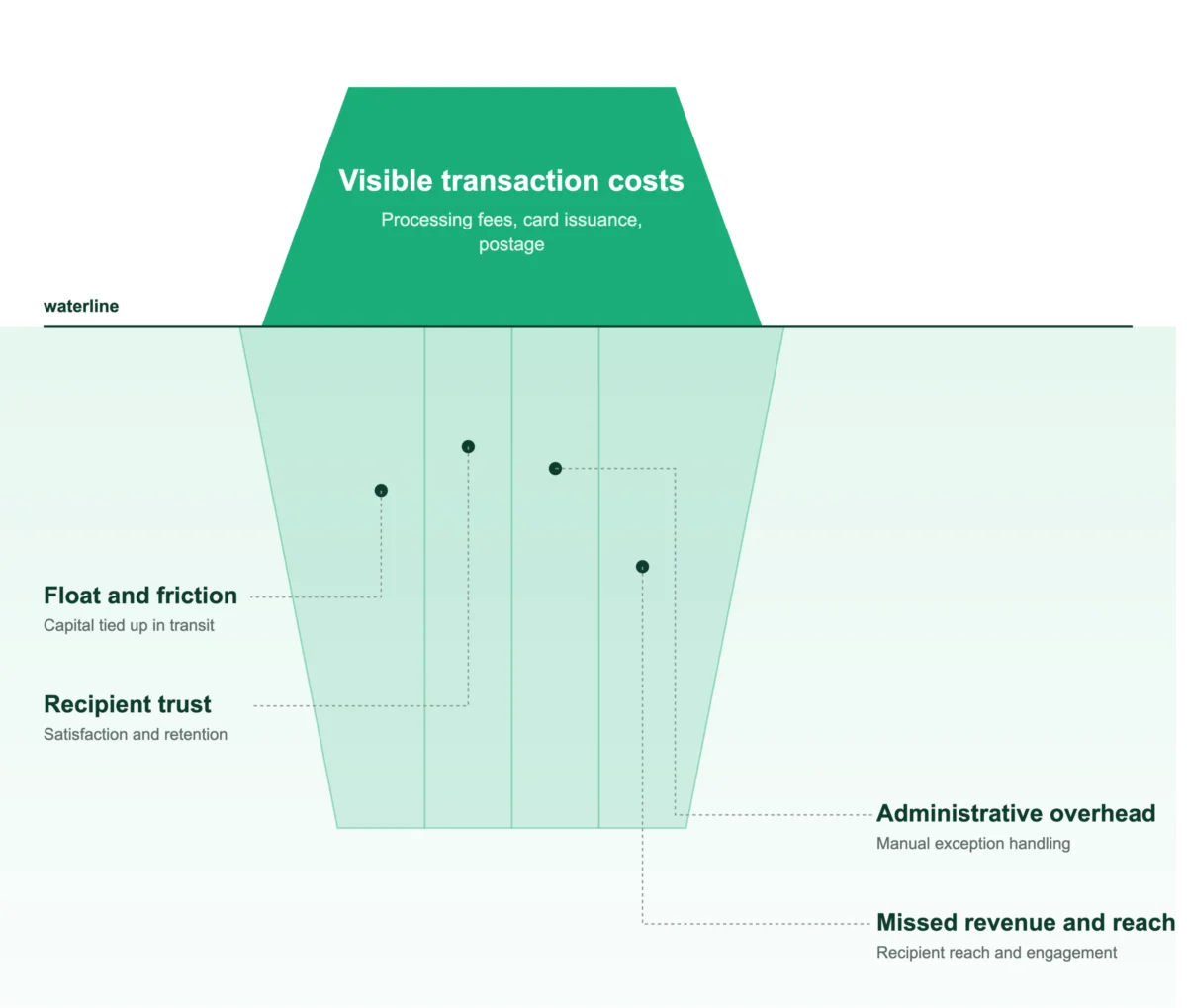
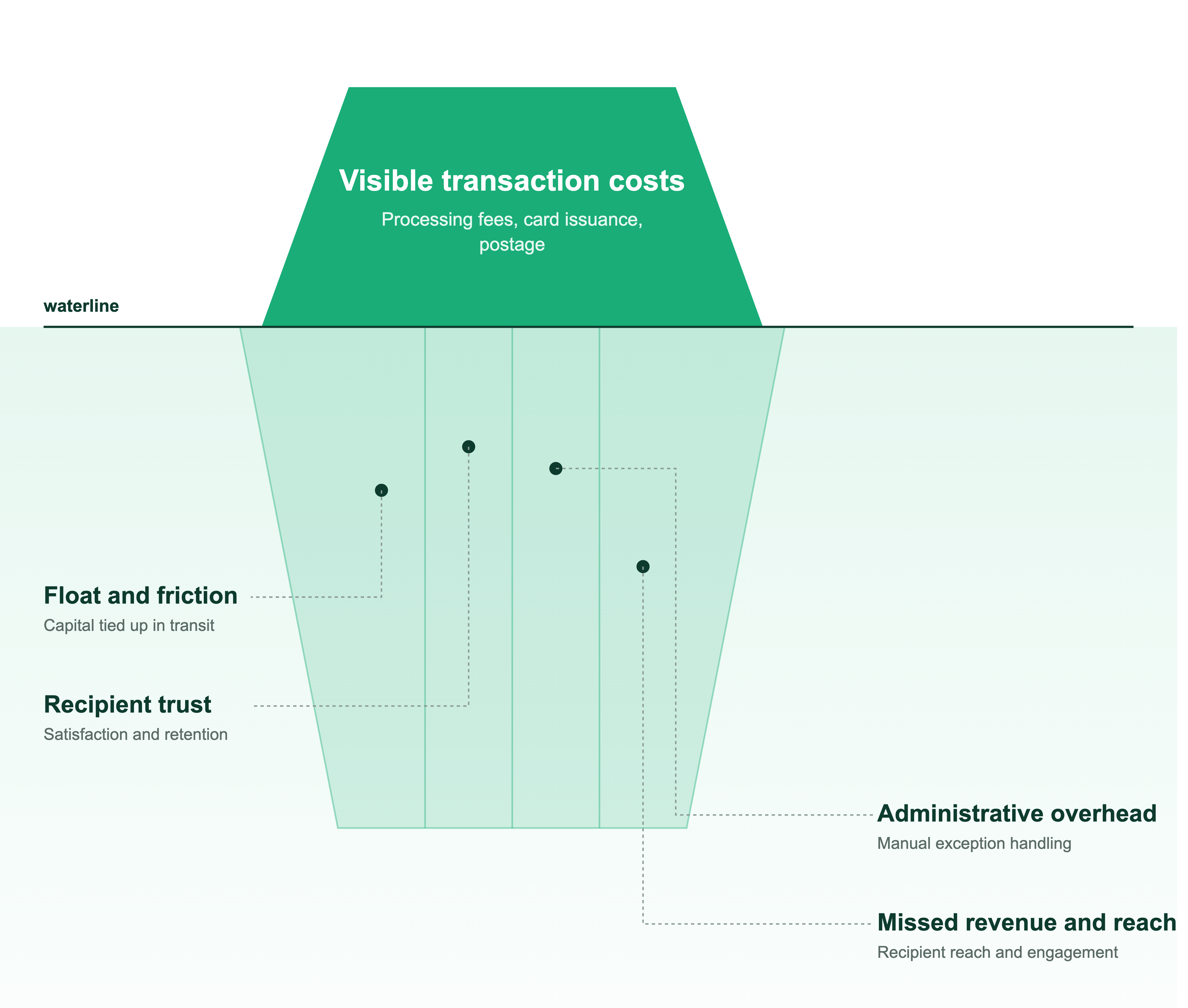
Most CFOs and operations leaders can recite their processing fees with precision. Yet, when asked about the total cost of ownership for their disbursement program, the conversation often hits a wall. This is because the most significant costs associated with legacy rails—checks and manual wires—exist in the "submerged" portion of the iceberg.
The Float Trap
Capital tied up in transit is perhaps the most quantifiable, yet often ignored, cost. When a payout is approved, the funds are effectively locked. They are no longer available for corporate growth, debt reduction, or operational agility. In a high-velocity business, this "float" acts as a drag on liquidity.
For an organization disbursing $10 million monthly, a five-day delay—standard for many paper-based cycles—means that roughly $1.6 million in capital is constantly trapped in the pipeline. In a modern, card-based ecosystem, that capital remains liquid until the exact moment of disbursement, allowing the enterprise to maximize its cash position.
The Friction of Failure
Beyond float, there is the compounding cost of operational failure. A mailed check is susceptible to loss, theft, and address errors. Each failed delivery triggers a predictable, costly sequence: a customer inquiry, a manual investigation, a voiding of the original payment, and a re-issuance.
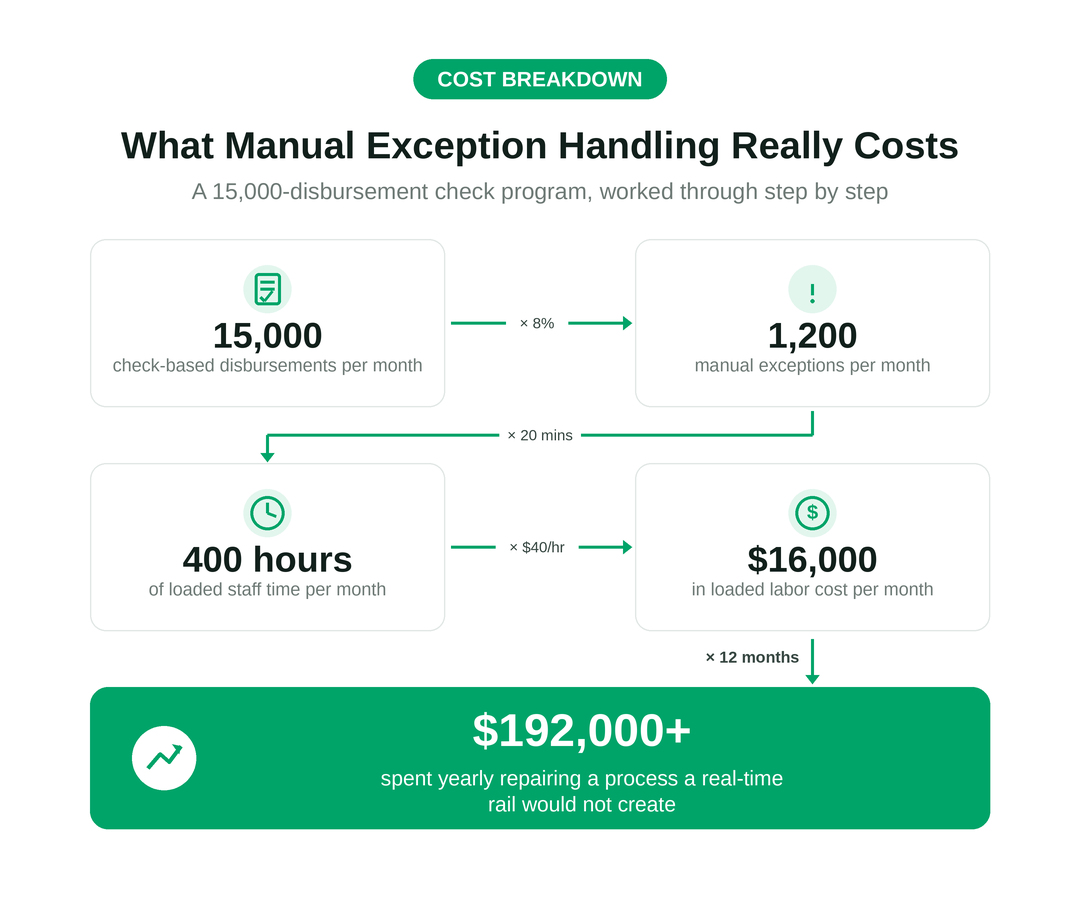
When you account for the loaded hourly rate of the staff managing these exceptions, the cost of a "simple" check escalates rapidly. Organizations processing 15,000 payments a month can easily see thousands of staff hours diverted to remediation, transforming a back-office function into a persistent, unscalable labor sink.
Chronology of a Payment: From Legacy to Instant
To understand the shift toward modernization, one must compare the "Chain of Events" between legacy systems and modern, API-first disbursement platforms.
The Legacy Chain (The "Check" Era)
- Approval: Internal systems clear the payout.
- Issuance: A print-and-mail cycle begins.
- Transit: Physical mail travels through the postal system (1–3 days).
- Delivery/Interception: Risk of loss or address-related return.
- Deposit: Recipient takes the check to a bank.
- Clearing: The bank verifies funds (1–3 days).
- Reconciliation: Manual entry into ERP/accounting software.
The Modern Chain (The "Instant" Era)
- Approval: Automated, policy-driven verification.
- API Trigger: Payment instruction sent via secure API.
- Instant Settlement: Funds are pushed to a virtual or physical card or digital wallet.
- Real-time Confirmation: The recipient gains immediate, 24/7 access to capital.
- Automated Reconciliation: Data flows directly into the ledger with zero manual intervention.
Supporting Data: The Case for Speed
The shift away from checks is not merely a preference for convenience; it is a data-backed necessity. According to Federal Reserve Financial Services research, the demand for instant payment rails is overwhelming. 61% of consumers state that the availability of instant payments is a deciding factor in their loyalty to a financial institution.
Furthermore, the risk profile of traditional methods is deteriorating. The 2026 AFP Payments Fraud and Control Survey highlights that checks remain the primary target for bad actors, implicated in 58% of all reported payment fraud incidents. By moving to tokenized, card-based, or digital wallet disbursements, organizations not only increase speed but also implement modern security protocols that effectively neutralize the risks associated with paper mail.
Official Perspectives: Navigating the Shift
Industry experts and technology partners emphasize that the move to modern disbursements must be treated as a strategic business initiative rather than an IT project.
"The modernization case starts when these costs become visible," note architects of modern payment stacks. "It gets funded when they become measurable. It succeeds when the new platform does more than move money—when it serves as a bridge for customer engagement."
For insurance companies, fintechs, and lending institutions, the transition represents a shift in governance. By using centralized management consoles, administrators can maintain rigorous compliance and control over funds—such as workers’ compensation or benefits disbursements—while simultaneously delivering the instant experience recipients expect.
Implications for the Future of Enterprise
The decision to modernize disbursement infrastructure carries profound implications for the future of the enterprise. It is a decision that impacts three critical pillars of business:
1. The Trust System
In moments of financial stress—such as an insurance payout after an accident or the disbursement of loan proceeds—the speed of payment is a proxy for the organization’s reliability. A slow, legacy-bound process sends a message of indifference, whereas an instant, transparent payout reinforces the brand promise.
2. The Growth System
Modern platforms offer more than just speed; they offer engagement. Unlike a check, which is a "dead-end" transaction, a digital card or wallet represents an open line of communication. It can be paired with loyalty incentives, personalized offers, and ongoing digital touchpoints that transform a one-time payment into a long-term customer relationship.
3. The Compliance System
Regulatory requirements are often cited as a barrier to modernization. However, modern platforms are built with "configurable controls" that allow for granular, real-time oversight. Organizations can define exactly how, where, and when funds are spent, satisfying state-level mandates and internal audit requirements with a level of precision that a physical check could never achieve.
The Revenue-Recovery Scorecard
To determine the urgency of modernization, CFOs should audit their existing infrastructure using a simple, four-pillar scorecard:
- Visibility: Can we track the exact status of every payout in real-time?
- Exception Rates: What percentage of our disbursements require manual intervention or re-issuance?
- Float Duration: How long does it take for a recipient to access funds after the payout is approved?
- Fraud Exposure: What is the cost of our current manual fraud detection processes compared to the potential for automated, tokenized security?
A low score across these metrics is not a sign of failure; it is an identification of "trapped value." By treating the disbursement process as a dynamic component of the balance sheet rather than a static cost center, organizations can unlock millions in hidden liquidity.
Conclusion: The Path Forward
The transition to modern disbursement infrastructure is an inevitable evolution. The technology is already here, the regulatory frameworks are maturing, and the recipient demand is at an all-time high. The only remaining barrier is the inertia of legacy thinking.
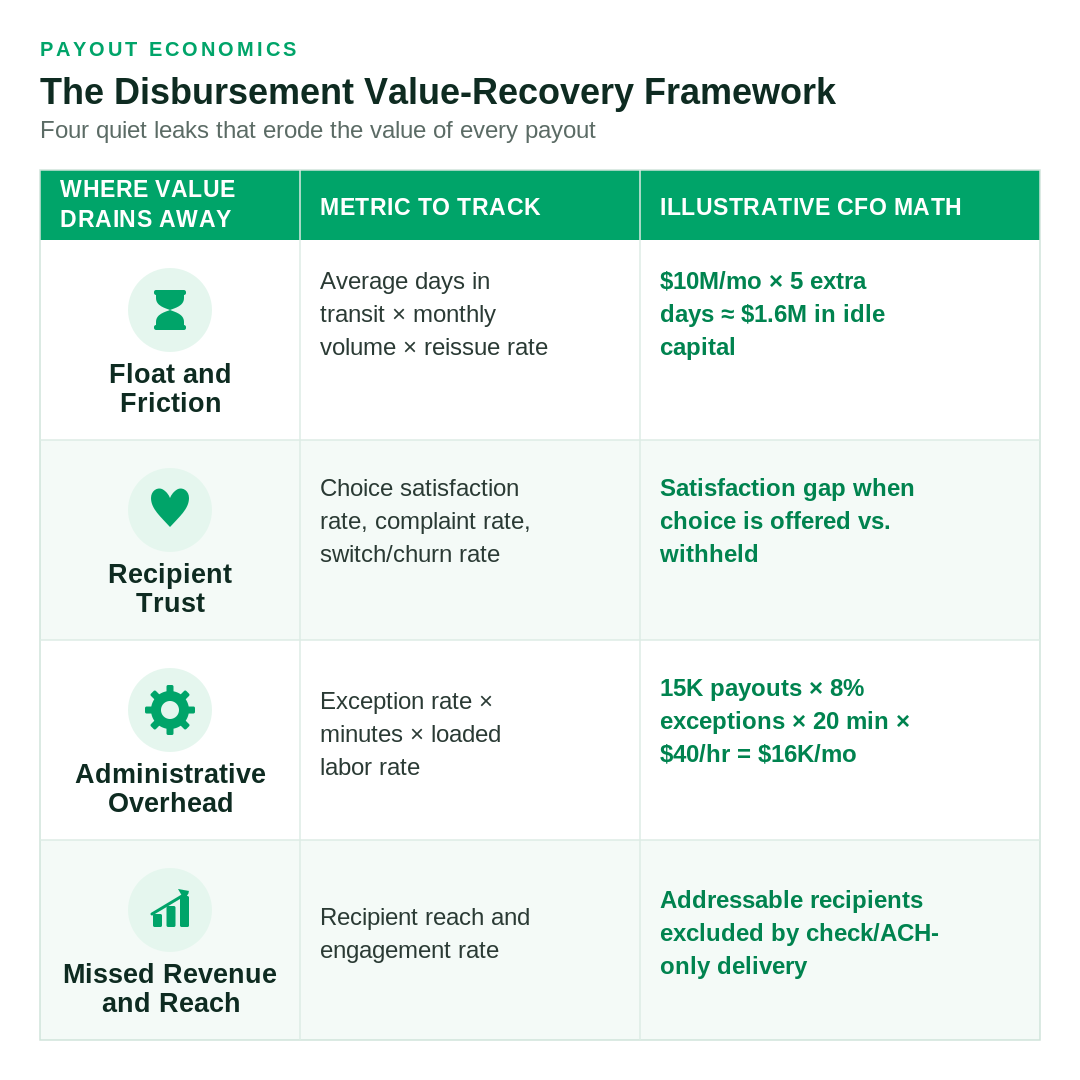
By building a business case grounded in CFO-level metrics—measuring capital efficiency, labor costs, and fraud risk—leaders can move beyond the "tip of the iceberg." The future of finance belongs to those who realize that every payment is an opportunity to reduce cost, mitigate risk, and strengthen the bond between the institution and the people it serves. The paper check has had its run; it is time to turn the page.