








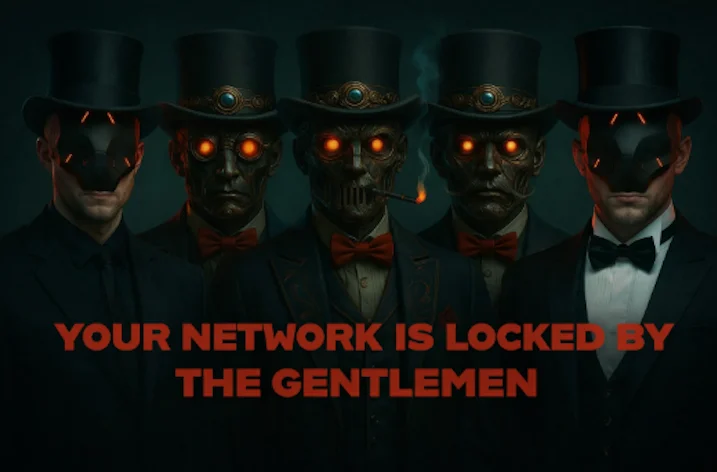
In the shadowy ecosystem of global cybercrime, few entities have ascended as rapidly—or as ruthlessly—as the ransomware collective known as "The Gentlemen." Emerging in mid-2025, the group has quickly solidified its position as the second most active ransomware-as-a-service (RaaS) operation globally. By abandoning the industry-standard profit-sharing models and employing aggressive recruitment tactics, they have turned the cyber-underworld on its head.
However, beneath the veneer of sophisticated malware and high-stakes extortion lies a trail of breadcrumbs leading back to a seemingly mundane life in the Russian city of Izhevsk. Investigative work by top security firms, including Check Point Software, Intel 471, and PRODAFT, has effectively pierced the veil of anonymity, pointing toward a primary administrator who balances a career in B2B marketing with the orchestration of massive international cyberattacks.
The Gentlemen: A Disruptive RaaS Model
The Gentlemen operate on a "ransomware-as-a-service" (RaaS) model, a business structure where the group develops the malicious software and provides the infrastructure, while "affiliates" perform the actual hacking.
Traditionally, the RaaS industry adheres to an 80/20 revenue split, where the affiliate keeps 80 percent of the ransom, and the core developers take 20 percent. The Gentlemen, however, have disrupted this status quo by offering a 90/10 split. This ten-percent increase may seem marginal to an outsider, but in the hyper-competitive market of cybercrime, it serves as a powerful magnet, luring experienced operators away from established cartels.
Since their inception, the group has proven to be an engine of destruction. According to Check Point Research, The Gentlemen claimed at least 332 published victims by mid-2026, with over 240 of those attacks occurring in the first half of 2026 alone. Their modus operandi is characterized by speed: by targeting vulnerable internet-facing devices—specifically VPNs and firewalls—they secure an initial foothold and often move to encrypt entire corporate networks within a matter of hours.
The Man Behind the Mask: A Chronology of "Hastalamuerte"
The investigation into the identity of the group’s administrator, known by the handles "Zeta88" and "Hastalamuerte," reveals a digital trail spanning nearly a decade.
The Early Years (2019–2021)
The persona "Hastalamuerte" first appeared on various Russian and English-language cybercrime forums, including Exploit, Breachforums, and Nulled, between 2019 and 2020. At this stage, the individual was far from the sophisticated kingpin seen today. Archives of their activity on hacker training platforms, such as the Telegram channel @pntst, show a novice struggling to master basic penetration testing tools.
During this period, the user registered under the email [email protected]. The inclusion of the "1488" numeric code—a known white supremacist dog whistle—provided early insight into the operator’s ideological leanings.
The Maturation (2022–2024)
By 2022, the user "Zeta88" emerged on English-language forums, showing a higher level of technical proficiency. Forensic analysis of forum registrations shows that both "Hastalamuerte" and "Zeta88" frequently signed up from IP addresses located in Izhevsk, the capital of the Udmurt Republic in Russia.
The Rise of The Gentlemen (2025–2026)
Following a backend infrastructure breach of The Gentlemen’s operations, researchers obtained internal logs confirming that the administrator of the RaaS panel—the person responsible for managing payments and maintaining the locker software—was the same individual operating under these monikers. This administrator keeps the remaining 10 percent of all ransoms, effectively acting as the CEO of the criminal enterprise.
Connecting the Dots: From Telegram to LinkedIn
The identification of the administrator as Alexander Andreevich Yapaev, a 36-year-old marketing executive, relies on a convergence of open-source intelligence (OSINT).
The breakthrough came via the analysis of the Telegram ID 30907522, associated with the handle @hastalamuerte18. This ID linked directly to the Russian phone number +79127650004. When cross-referenced with leaked Russian government databases, the number was explicitly tied to Alexander Yapaev.
Further corroboration was found through:
- Social Media: The same phone number was used to register an account on the Russian social media platform Pikabu under the handle "4apai18," a phonetic play on "Chapaev."
- Digital Footprints: The email
[email protected]was used by the hacker persona on multiple forums and is also the email linked to a professional LinkedIn profile for an Alexander Yapaev. - Professional Identity: The LinkedIn profile identifies Yapaev as the head of B2B marketing at Uralenergo Udmurtia, a significant supplier of electrotechnical and lighting products.
Despite multiple requests for comment sent to his professional and personal contact channels, Mr. Yapaev has remained silent.
Technical Innovation: AI and Brute Force
Recent intelligence from the threat research group PRODAFT provides a chilling update on the group’s operations. The investigation suggests that the administrator is not only managing a workforce of affiliates but is also actively integrating Artificial Intelligence to streamline the development of ransomware and the creation of custom post-exploitation scripts.
By utilizing AI to automate the maintenance of their tooling, the group has successfully reduced the time between initial access and total network encryption. PRODAFT confirmed that the administrator provides affiliates with pre-harvested credentials for Fortinet SSL-VPNs, often sourced from the group’s own internal database of leaked credentials, ensuring that every affiliate has a "plug-and-play" entry point into victim networks.
Implications: The "Double Life" of Modern Cybercriminals
The case of Alexander Yapaev raises a broader, uncomfortable question: Why do so many high-level cybercriminals operate with such visible connections to their real-world identities?
The answer lies in a combination of hubris, early-career negligence, and the geopolitical reality of the region. Many hackers, including the person behind "The Gentlemen," began their journey as low-level script kiddies. In those early years, they did not anticipate that their aliases would one day be associated with multi-million-dollar criminal empires, and thus, they failed to practice proper operational security (OPSEC).
Furthermore, the Russian government’s stance toward cybercrime acts as a shield. As long as these individuals do not target domestic Russian infrastructure, they are largely left unmolested by local authorities. This "dark covenant" allows criminals to live comfortably, hold traditional jobs, and remain insulated from international extradition, provided they avoid travel to Western jurisdictions.
Conclusion: The Path Ahead
The Gentlemen have proven that innovation in the cybercrime space is not just about writing better code, but about optimizing the business model. By incentivizing affiliates with higher payouts and utilizing AI-driven tools, they have created a self-sustaining ecosystem that is difficult to disrupt.
However, their reliance on a single administrator—who has left a clear, traceable path across the internet—makes them vulnerable. While they may currently be shielded by the borders of the Russian Federation, the "Breadcrumb" approach to threat intelligence ensures that their identities are no longer secret. As firms like Check Point and PRODAFT continue to document the inner workings of the group, the risk to individuals like Alexander Yapaev grows. For now, the "Gentlemen" remain at large, but the anonymity that once protected them is rapidly eroding, one data breach at a time.