







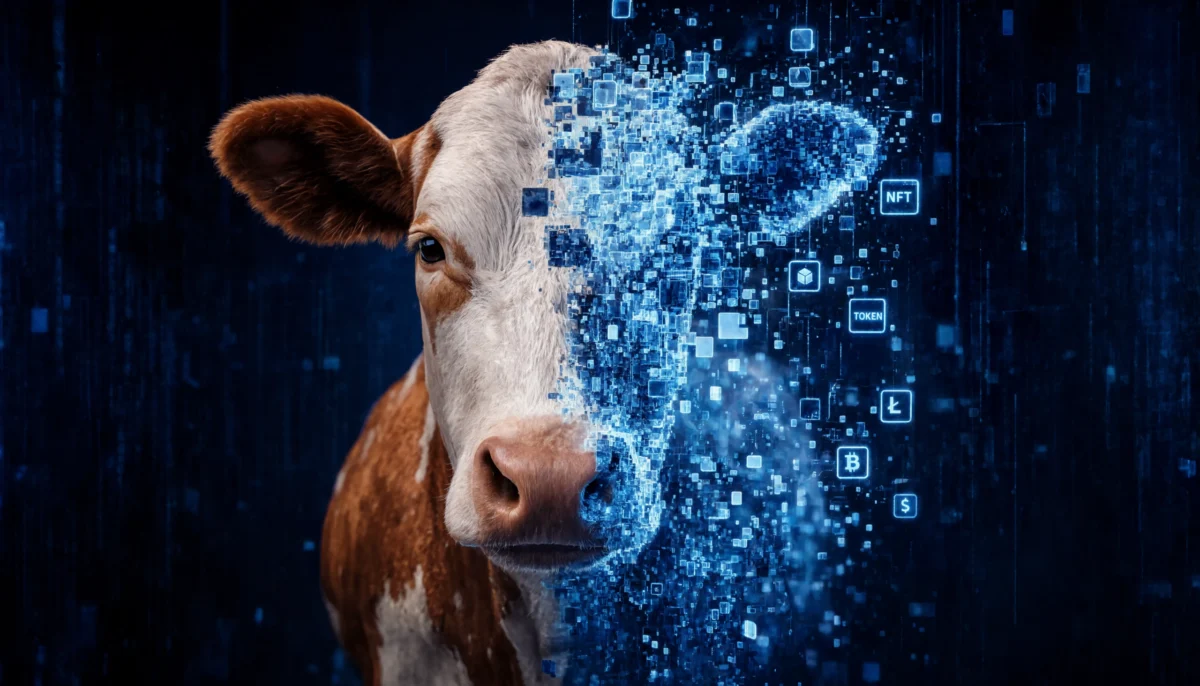
In an unprecedented fusion of high-frequency finance and traditional husbandry, the Brazilian agricultural sector has achieved a milestone that could redefine global rural lending. Ten dairy cows at the Fazenda Engenho Velho farm in Imbituva, Paraná, have officially become the first livestock in history to serve as formally registered collateral on a national stock exchange.
This transaction, which leveraged blockchain technology and artificial intelligence-powered biometrics, represents a watershed moment for the "Real-World Asset" (RWA) tokenization movement. By transforming biological, living assets into verifiable digital financial instruments, stakeholders are attempting to solve a chronic liquidity crisis facing farmers who, despite owning valuable herds, have historically struggled to access affordable credit.
The Mechanics of the Transaction: From Hooves to Hash-codes
The deal involved the pledge of ten high-value dairy cows, appraised at R$120,000 (approximately $23,310), to secure a R$100,000 ($19,420) loan via a Cédula de Produto Rural Financeira (CPR-F). The CPR-F is a specialized Brazilian financial instrument designed to allow agricultural producers to borrow capital against their future harvests or existing livestock.
The credit was extended by BMP, a direct credit company authorized by the Central Bank of Brazil. Crucially, BMP then sold the credit rights to Target FIDC, an investment fund specializing in the purchase and monetization of receivables. The final, pivotal step in the process was the formal registration of this collateralized debt on B3, Brazil’s primary stock exchange.
The innovation lies in the "tokenization" process. Each cow was fitted with a smart collar developed by Cowmed, an ag-tech startup. These collars capture granular data points regarding the animal’s health, behavioral patterns, and geolocation. Using this data, Cowmed generates a unique, encrypted digital ID for each cow. This identifier is cryptographically hashed, creating a tamper-resistant record that is permanently tethered to the credit contract. Because the technology monitors the cow in real-time, the lender is effectively relieved of the need for expensive, time-consuming physical farm inspections.
A Chronology of Innovation
The path to this breakthrough began long before the actual signing of the loan documents, rooted in years of developments in agricultural monitoring and the broader RWA movement.
- 2020–2023: The Rise of IoT in Agriculture: Cowmed begins expanding its footprint, deploying AI-driven monitoring systems across thousands of farms in Brazil and eventually entering international markets including the U.S., Canada, and across South America. The company builds a data reservoir of over 100,000 monitored animals.
- 2024: The Credit Crunch: Brazilian agribusiness faces a "perfect storm." Rising interest rates, volatile commodity prices, and climate-induced yield failures force a record number of farmers to file for recuperação judicial (the Brazilian equivalent of Chapter 11 bankruptcy). Total filings reach nearly 2,000 in 2025, a four-fold increase from 2023.
- Early 2026: The Pilot Formulation: Recognizing that banks are increasingly hesitant to lend without ironclad, high-transparency collateral, Cowmed and Target FIDC begin drafting a framework to link digital herd health records with formal financial securities on the B3 exchange.
- July 2026: The Milestone Transaction: The Fazenda Engenho Velho farm successfully completes the first-ever issuance of a CPR-F backed by tokenized cows. The deal is registered on the B3, signaling the official entry of "digital livestock" into the formal financial markets.
- Post-July 2026: Four additional Brazilian farms enter the evaluation phase with Target FIDC, with a stated goal of facilitating R$5 million (approx. $971,000) in credit through this model by the end of the year.
Supporting Data: The Efficiency Gap
The primary driver of this initiative is the systematic devaluation of livestock as collateral. Historically, traditional financial institutions have discounted livestock assets by as much as 60%. A cow with a market value of R$20,000 ($2,380) is often valued at only R$8,000 ($1,600) for loan purposes because lenders carry the risk of the animal’s death, theft, or health deterioration—risks they cannot easily verify from a desk in São Paulo.
The Cowmed data model eliminates this "information asymmetry." By providing a transparent, 24/7 data feed on the animal’s wellbeing, the lender can effectively audit the collateral in real time.
The scope of this potential is immense. Cowmed currently monitors 100,000 cows across 1,200 farms, with a total estimated herd value of R$2 billion ($395.4 million). Thiago Martins, CEO of Cowmed, projects that within two years, 20% of that herd—representing R$400 million ($77.6 million)—could be pledged as tokenized collateral, providing a massive influx of liquidity to producers who are currently constrained by rigid banking requirements.
Official Responses and Industry Perspectives
The stakeholders involved in this deal emphasize that this is not merely a technological experiment, but a necessary evolution of agricultural banking.
"We took the cow, a real and tangible asset, and transformed it into a digital asset backed by a unique code monitored in real time," said Thiago Martins in an interview with CNN Brazil. Martins argues that this digitalization is the only way to bypass the "strong credit restrictions" currently suffocating the agribusiness sector. By creating a verifiable digital twin of the animal, the farmer gains an "advantageous opportunity" to secure financing that was previously inaccessible or too expensive.
Humberto Brenner, director of Target FIDC, echoed these sentiments during his comments to Globo Rural. "With monitoring, that uncertainty is eliminated," Brenner noted. He highlighted that the banking industry is undergoing a paradigm shift: "Banks will increasingly demand real collateral and new information." The tokenized model provides exactly that—a higher standard of collateral that lowers the risk profile of the loan, allowing lenders to offer more competitive rates.
Broader Implications: The RWA Revolution
The successful tokenization of Fazenda Engenho Velho’s herd is a significant victory for the burgeoning Real-World Asset (RWA) sector. Across the globe, the practice of converting physical assets—such as U.S. Treasuries, commercial real estate, and now livestock—into digital tokens is gaining momentum.
Currently, the total value locked (TVL) in RWA tokenization across Decentralized Finance (DeFi) platforms has surged past the $10 billion mark. While much of that value has historically been tied to static assets like government bonds, the inclusion of "living" assets like cattle represents a significant leap forward in complexity and utility.
Potential Benefits to the Global Ag-Sector:
- Lower Interest Rates: Because the collateral is "real-time verified," the risk premium charged by banks can be significantly reduced.
- Increased Liquidity: Farmers who previously struggled to prove the value of their assets can now access capital markets directly through the exchange.
- Enhanced Transparency: Blockchain-based registries reduce the risk of fraud, as the "identity" of the animal cannot be duplicated or falsified.
- Resilience to Crisis: By diversifying the types of collateral available, the agricultural sector becomes less dependent on volatile commodity pricing alone to secure financing.
However, the model is not without its challenges. The reliance on IoT hardware (the smart collars) creates a potential point of failure. If a collar is damaged or loses battery, the digital "link" to the collateral could be broken. Furthermore, the regulatory landscape for tokenized assets remains fluid. While the B3 registration of this specific deal is a major legal precedent, the broader integration of crypto-assets with agricultural law will require ongoing cooperation between central banks, securities commissions, and rural regulators.
As the industry looks toward 2027, the success of the Paraná pilot suggests that the future of rural finance may lie not just in the land, but in the digital data harvested from the very animals that graze upon it. If the projected R$400 million in tokenized credit is realized, Brazil will have successfully pioneered a model that could provide a lifeline to farmers across the globe, bridging the gap between the physical barn and the digital stock exchange.