








Main Facts: The Evolution and Mechanics of Property Taxation
Property taxation is one of the oldest forms of public finance known to modern civilization. Tracing its roots back to feudal times, early iterations of the property tax were levied primarily on agrarian land and borne almost exclusively by farmers. Over the centuries, this concept evolved significantly. In the modern global economy, property taxes encompass a broad spectrum of assets—predominantly real estate, including both land and the physical structures built upon it. These levies are typically assessed on a recurrent basis, paid by individuals, corporations, and other legal entities to fund essential government operations.
At its core, a well-structured property tax serves a dual purpose. Ideally, it provides local governments with a reliable, predictable fiscal incentive to permit and encourage new real estate development. Furthermore, it acts as a mechanism to fund local public services—such as public safety, infrastructure, and education—whose value is directly capitalized into local property prices.
However, the economic architecture of property taxes introduces delicate trade-offs. While taxing land alone is widely considered by economists to be highly efficient because it does not discourage the creation of new land, levying high property taxes on buildings and physical structures introduces a significant deterrent. When businesses must pay additional taxes on the factories, offices, and warehouses they build, the tax acts as a penalty on capital investment. Consequently, high property taxes on structures can heavily influence corporate location decisions, often driving businesses away from heavily taxed municipalities and regions toward more business-friendly jurisdictions.
Across the globe, and particularly within Europe and North America, countries approach property taxation through vastly different lenses. These varying methodologies create a complex patchwork of tax burdens, exemptions, and economic incentives that directly shape housing markets, business investments, and municipal development.
Chronology: From Feudal Farmlands to Modern 2025 Reforms
To understand how modern property tax systems operate, it is essential to look at how they have evolved over time and how recent policy shifts are reshaping the fiscal landscape.
- The Feudal Era: Property taxes begin as rudimentary agrarian levies, targeted primarily at agricultural land ownership and collected to support local lords or centralized monarchies.
- The Industrial Revolution and Real Estate Expansion: As economies transition from agrarian societies to industrial powerhouses, property tax bases expand to include urban real estate, factories, and commercial structures, laying the groundwork for municipal finance in growing cities.
- Late 20th Century Harmonization Efforts: Various nations begin standardizing property valuations, shifting from subjective assessments to data-driven market valuations to ensure fairness among residential and commercial property owners.
- Recent Decades: Economic analyses increasingly highlight the distinction between land value taxation (which is economically efficient) and structural property taxation (which can discourage capital investment). A handful of pioneering nations begin reforming their tax codes to favor land-only models.
- January 2025: Germany undertakes a massive structural shift by devolving its property tax base authority down to the state level. Seizing this opportunity, the state of Baden-Württemberg restructures its system to tax solely the value of land, mirroring economic best practices.
- 2025 Onward: Croatia introduces a brand-new recurrent property tax, calculated based on the physical square meters of land and floor area, expanding the reach of property-based public finance in Eastern Europe.
Supporting Data: A Comparative Analysis of European and American Property Taxes
An empirical examination of property taxes across 34 European nations, alongside a comparison with the United States, reveals stark contrasts in how governments extract revenue from private capital stock.
The Landscape of European Property Taxes
Out of the 34 European countries analyzed:
- Zero-Tax Jurisdictions: Liechtenstein and Malta do not levy any recurrent taxes on property whatsoever, offering a unique tax environment for real estate owners and investors.
- The Land-Only Pioneer: Estonia stands alone on the European map by taxing only land rather than structures. By exempting buildings and improvements from recurrent taxation, Estonia’s real property tax is widely regarded by tax policy experts as the most economically efficient in Europe.
- Double Taxation Hazards: Of the 32 European nations that do levy property taxes, 28 allow businesses to deduct property or land taxes from their corporate income. This deduction mitigates the overall tax burden and encourages continuous business investment. However, four countries—Austria, Iceland, Italy, and Slovenia—strictly prohibit the deduction of property taxes from business income. This policy results in the double taxation of business properties, as companies are taxed on the property itself and then taxed again on income without accounting for the property tax expense.
Revenue as a Share of Private Capital Stock
Measuring property tax revenue as a share of private capital stock provides a clear picture of the true tax burden across nations:
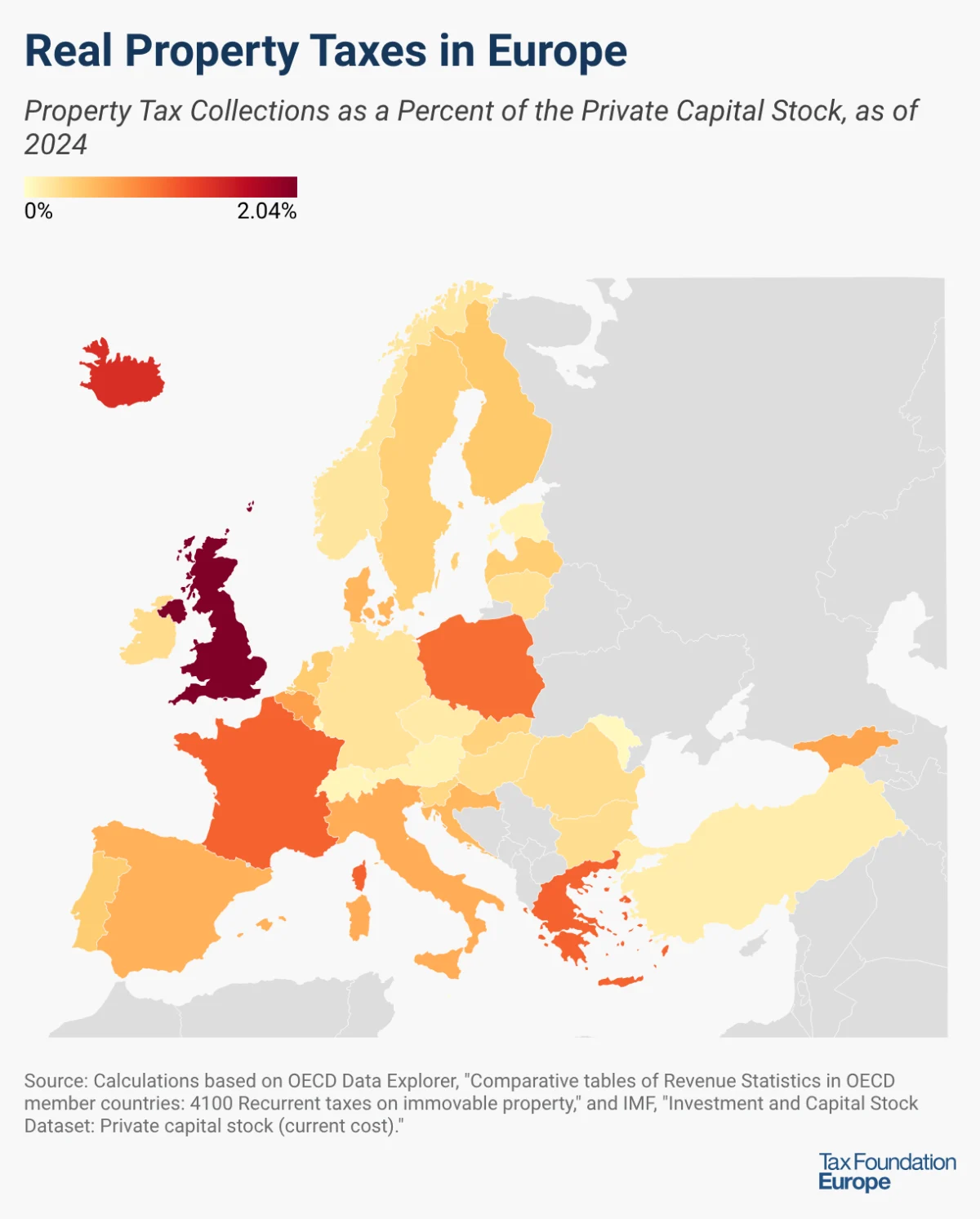
- Lowest Revenue Generators: Luxembourg and Moldova raise the lowest property tax revenues relative to their private capital stock, hovering at approximately 0.05 percent. They are closely followed by Switzerland (0.08 percent) and Estonia (0.09 percent).
- Highest Revenue Generators: At the other end of the spectrum, the United Kingdom imposes the highest property tax burden as a share of private capital stock at a staggering 2.04 percent. Iceland follows closely at 1.43 percent, with France recording 1.08 percent.
- The European Average: Across the 32 European countries that collect recurrent property taxes, the average revenue raised sits at 0.45 percent of their private capital stock.
The United States Outlier
When compared to Europe, the United States stands out as a high-property-tax economy. While the European average sits at 0.45 percent of private capital stock, the United States raises 1.88 percent of its private capital stock in property taxes—more than four times the European average. Property taxes serve as the single largest source of state and local revenue in the U.S., directly financing public education, local roads, police departments, and emergency services.
Who Bears the Burden? Households vs. Businesses
For the 16 European countries that systematically track how property tax revenues are split between residential households and commercial businesses, households shoulder the vast majority of the weight. On average, households remit around 60 percent of total property tax revenue.
However, the distribution varies dramatically by nation:
- In the Slovak Republic, households account for a mere 7.4 percent of property tax receipts, meaning businesses shoulder the overwhelming share of the burden.
- In France, households remit a staggering 71.4 percent of total property tax revenue, placing the primary tax obligation squarely on residential homeowners.
Official Responses and Policy Perspectives
Governments, economists, and international tax organizations hold sharply divergent views on how property taxes should be structured, highlighting the ongoing tension between generating municipal revenue and maintaining economic competitiveness.
Advocates of land-value taxation, championed by organizations like the Tax Foundation, argue that shifting the tax burden away from buildings and onto underlying land is the gold standard of fiscal policy. By not penalizing property owners for constructing new buildings, renovating homes, or expanding commercial spaces, governments can stimulate organic economic development without disincentivizing capital investment. Estonia’s model and Baden-Württemberg’s recent 2025 reform are frequently cited by policy analysts as modern blueprints for success.
Conversely, fiscal authorities in countries with high structural property taxes—such as the United Kingdom and France—defend their models as essential tools for wealth redistribution and stable local governance. Municipal leaders in these nations emphasize that taxing both land and buildings provides a steady, resilient revenue stream that is insulated from the volatile swings of corporate income taxes or consumption-based levies.
Furthermore, nations that maintain restrictive rules on corporate deductions—such as Italy and Austria—often view property taxes not merely as a service fee for local infrastructure, but as an appropriate mechanism to ensure that capital-heavy enterprises contribute a baseline share to public coffers, regardless of their annual net income fluctuations.
Implications: Economic Growth, Investment, and Future Reforms
The structural design of property taxes has profound, long-term implications for macroeconomic health, urban planning, and corporate strategy.
1. Corporate Location and Investment Decisions
Because businesses must factor operational costs into every expansion decision, high property taxes on physical structures act as a direct deterrent to capital investment. Regions that heavily tax commercial buildings risk losing competitive ground to jurisdictions with lower structural levies or land-only tax systems. Furthermore, countries that practice double taxation by disallowing property tax deductions on corporate income risk stifling domestic entrepreneurship and repelling foreign direct investment.
2. Housing Affordability and Urban Development
The way property is taxed directly influences real estate markets. When property taxes heavily penalize improvements, developers may be disincentivized from building high-density housing or upgrading aging urban infrastructure. Conversely, adopting models that prioritize land value over structural value encourages landowners to develop vacant or underutilized urban plots rather than leaving them idle for speculative purposes, thereby helping to combat housing shortages and urban sprawl.
3. The Trend Toward Decentralization and Modernization
Recent developments—such as Germany’s devolution of property tax powers to state level in 2025 and Croatia’s introduction of a modernized square-meter-based property tax—signal a growing global recognition that property tax systems must be continually updated to reflect modern economic realities. As municipalities face mounting infrastructure demands and shifting demographic patterns, policymakers are under increasing pressure to design tax regimes that balance revenue generation with economic dynamism.