







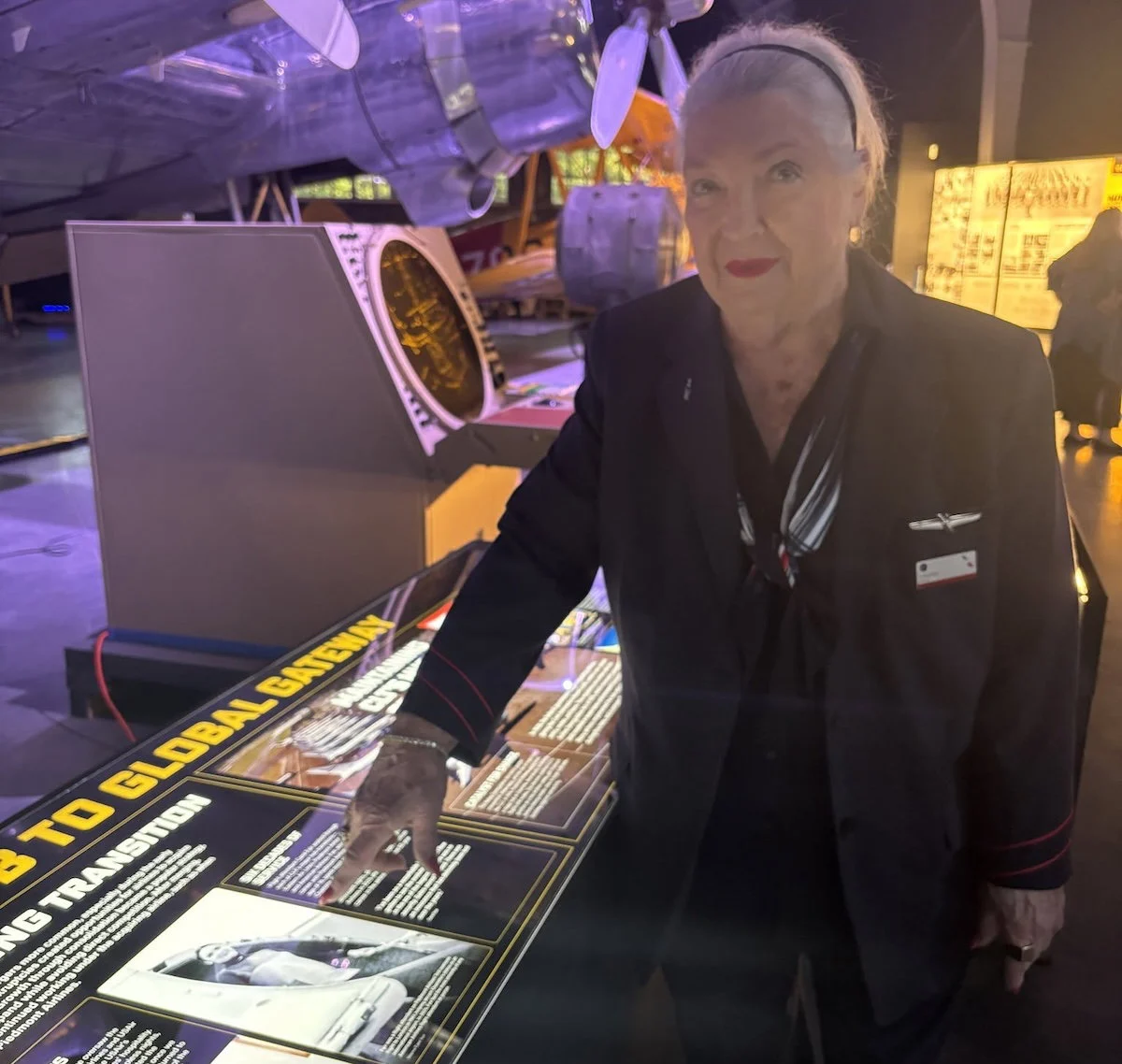
In the aviation industry, seniority is more than just a number; it is a currency. It dictates schedules, determines pay scales, and defines the lifestyle of those who call the cabin their office. On Monday, October 26, 2026, the American aviation landscape will witness the end of an era as Carol Fair, American Airlines’ most senior active flight attendant, hangs up her wings for the final time. At 83 years old, Fair will conclude a career that has spanned more than six decades, marking a transition from a pioneer of the "Golden Age" of flying to a symbol of enduring dedication in the modern era.
The Final Flight: A Career Capped by Excellence
Carol Fair’s final assignment will be a transatlantic journey from London Heathrow (LHR) to Charlotte Douglas International Airport (CLT). As she deplanes in Charlotte, the airline intends to perform a ceremonial water salute—a poignant gesture typically reserved for retiring pilots or the introduction of a new aircraft. By honoring a flight attendant with this tradition, American Airlines is acknowledging that Fair is not merely an employee, but a living institutional memory.
Fair’s journey began in 1963 with Piedmont Airlines. Through the complex web of industry consolidation—navigating the transitions from Piedmont to US Airways, and ultimately to the American Airlines of today—she remained a constant. Her longevity is a testament to the structure of the American labor system, which rewards flight attendants for their tenure. With no mandatory retirement age, those who maintain the physical and cognitive stamina to pass annual recurrent safety training can effectively work for as long as they choose, enjoying maximum pay and their pick of the most desirable international routes.
A Chronology of Six Decades in the Skies
To understand the scale of Carol Fair’s career, one must look at the timeline of her service:
- 1963: Fair begins her career at Piedmont Airlines, entering an industry that looked radically different from today’s high-frequency, low-margin model.
- The Merger Era: As the aviation industry consolidated, Fair transitioned through the US Airways acquisition, eventually becoming an integral part of the workforce at American Airlines.
- The Seniority Peak: Over 30,000 flight attendants currently serve at American. Fair rose to the very top of that list, becoming the number one active flight attendant in the company.
- 2026: After 63 years of service, Fair decides it is time to step back, remarking, "I made No. 1 out of 30,000. You can’t go any higher, so I might as well hang it up."
It is a poetic irony that her career began with a rejection. In her early years, she applied to American Airlines only to be told she "wasn’t American material." She spent the following decades refining her craft, only to eventually "join" the very airline that once turned her away through the force of corporate consolidation.
The Shadow of Bette Nash: A Industry Standard
While Carol Fair’s tenure is historic, she follows in the footsteps of the legendary Bette Nash. Nash, who passed away in 2024, held the Guinness World Record for the longest-serving flight attendant, having worked for 67 years. Nash’s career, which began in 1957, set the gold standard for longevity in the skies. The two women represent a generation of flight attendants who viewed the profession not as a transitory job, but as a lifelong vocation. The passing of this torch from Nash to Fair, and now to the next generation of senior staff, highlights the changing demographics of the workforce.
The Cultural Divide: Perspectives on "Super Senior" Staff
The presence of octogenarian flight attendants often creates a stark divide in global perceptions of service. In many Middle Eastern and Asian carriers, the cabin crew demographic is strictly curated, often favoring younger staff as a matter of brand image. Former Qatar Airways CEO Akbar Al Baker once famously disparaged "American carriers" by highlighting the presence of "grandmothers" in the aisles, contrasting them with the youthful average age of his own staff.
However, many frequent flyers argue that the "super senior" flight attendant brings a level of grace and service that is increasingly rare. These veterans are seen as a "throwback" to an era where the passenger experience was prioritized above all else. Fair herself has noted that she prefers international routes, citing that the passengers are "vented better"—a humorous nod to the fact that longer-haul travelers are often more seasoned and tempered than those on chaotic, short-haul domestic flights.
Safety and the Regulatory Balance
While the romanticism of a long career is undeniable, the aviation industry faces a delicate balancing act regarding safety. The fundamental role of a flight attendant is to act as a first responder in the event of an emergency. Critics of extended careers often point to the physical requirements of the job—maneuvering heavy carts, performing CPR, or executing high-pressure evacuations.
Federal regulations require all flight attendants, regardless of age, to pass annual recurrent training. This training includes rigorous safety drills and emergency scenarios. However, concerns have been raised in the past—most notably regarding high-seniority staff at other major carriers—about the number of attempts allowed to pass these tests. While the safety record of the industry remains impeccable, the conversation surrounding the physical requirements of the job vs. the value of institutional experience is one that airline unions and the FAA continue to navigate.
The Implications of a Long-Term Career
Why do flight attendants choose to stay for 60+ years? The answers are as diverse as the employees themselves. For some, like Fair, it is a genuine passion for the lifestyle, the travel, and the social interaction. It provides a structure and a sense of purpose that retirement might otherwise lack.
Conversely, there is an economic reality that cannot be ignored. For many in the workforce, the prospect of retirement is tempered by the rising cost of living and the decline of robust, legacy-style pension plans. As retirement security becomes more precarious for the aging population, the "option" to work becomes an economic necessity.
Conclusion: A Final Landing
As Carol Fair prepares to step off the plane in Charlotte for the final time, she leaves behind a legacy defined by consistency and dedication. Her 63-year journey is more than just a record of flight hours; it is a chronicle of the evolution of American aviation.
Whether one views the longevity of staff like Fair as a triumph of the human spirit or a quirk of a seniority-based labor system, there is no denying the impact she has had on thousands of passengers over the decades. As she moves into her retirement, she does so having reached the absolute zenith of her profession. For those who follow in her footsteps, she serves as a reminder that the skies have room for both the ambition of the youth and the wisdom of the seasoned professional.
American Airlines, and the industry at large, will certainly feel the absence of such a long-standing presence, but for Carol Fair, the time has come to stop navigating the routes and start navigating a well-earned, quiet life on the ground.