








BEIJING – A chilling scene unfolded in the heart of China’s capital on Friday evening, June 26, 2026, when a light aircraft collided with the CITIC Tower, the tallest skyscraper in Beijing. The incident, which occurred during the early evening commute, prompted immediate emergency responses and sparked significant concerns regarding urban airspace security and the potential for intentional acts within high-density metropolitan environments.
The Incident: A Collision at 528 Meters
At approximately 5:50 PM local time, a Sunward SA 60L Aurora, a two-seater light sport aircraft, struck the upper levels of the CITIC Tower (also known as China Zun). The skyscraper, an architectural centerpiece of the Beijing Central Business District, stands at 528 meters (1,732 feet) with 109 floors above ground.
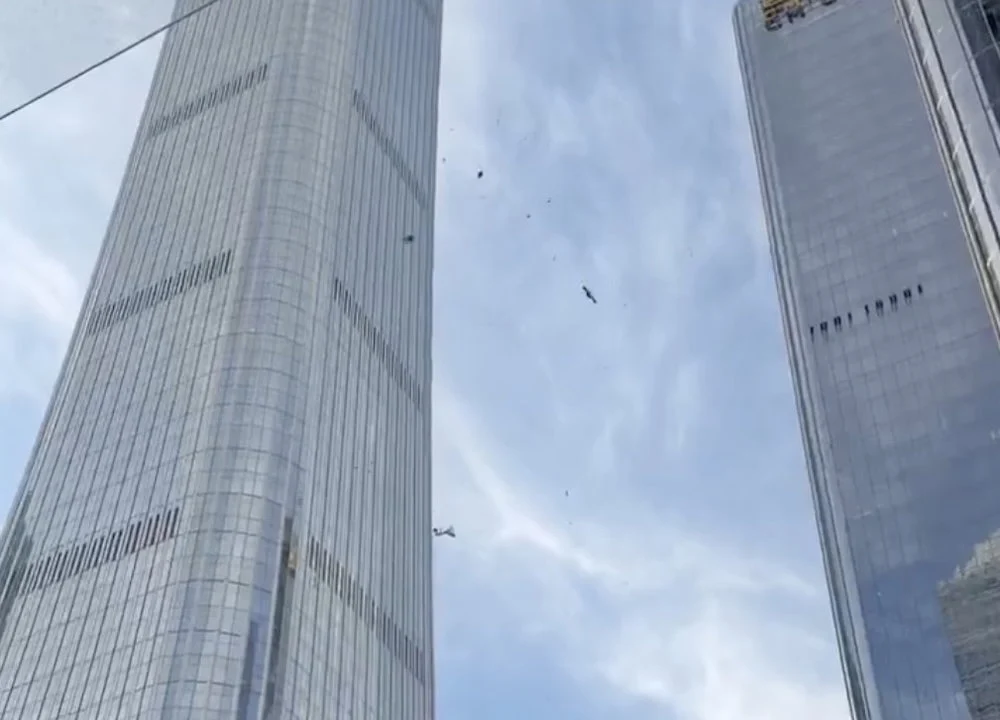
Witnesses in the surrounding area reported seeing the small aircraft maneuvering at a high altitude before it impacted the building’s facade. Unlike large-scale commercial aviation disasters, the physical impact of the light aircraft was contained primarily to the building’s glass curtain wall. Footage circulating on social media captured the grim moment of impact, showing the aircraft disintegrating upon contact, with debris—including the empennage (tail section)—cascading down the side of the skyscraper toward the street level.
While the structural integrity of the CITIC Tower remains reportedly sound, the visual impact of the crash, particularly in a city known for its stringent security measures, has left the public searching for answers.
Chronology of the Event
Based on preliminary reports and flight tracking data, the sequence of events began shortly before the collision:
- 17:30: The aircraft, registered under the code B-12PP and operated by Shuangyue General Aviation, departed from Beijing Shifosi Airport, a facility primarily utilized for general aviation, flight training, and aerial photography.
- 17:40: The pilot, identified by local reports as Liu Junhua, was reportedly performing a solo flight within the local airspace.
- 17:50: The aircraft veered toward the central urban core, deviating from standard training patterns. Shortly thereafter, it made direct contact with the CITIC Tower.
- 18:00 – 18:30: Emergency services cordoned off the area around the skyscraper. A localized fire erupted on the ground level where the wreckage landed; however, municipal fire crews brought the blaze under control within minutes.
Supporting Data and Aircraft Profile
The aircraft involved, the Sunward SA 60L Aurora, is a light sport aircraft (LSA) manufactured by the Hunan Sunward Technology Co., Ltd. It is designed for pilot training, recreational flying, and private transport. Weighing significantly less than a commercial airliner, the SA 60L is constructed largely of composite materials, which explains why the aircraft effectively shattered into fragments upon hitting the tempered glass panels of the skyscraper.
Shuangyue General Aviation, the entity associated with the registration B-12PP, has been under the spotlight since the incident. While the company provides services ranging from aerial photography to flight instruction, the circumstances surrounding this specific flight—including why a light aircraft was permitted to transit the dense, restricted airspace of Beijing’s CBD—remain the subject of intense speculation among aviation experts.
The Silence of Official Channels
In the hours following the crash, the Chinese government and state-run media outlets maintained a notably measured stance. While images and videos of the debris were shared widely on platforms like X (formerly Twitter) and other international forums, domestic discourse on Chinese social media platforms, including Weibo and WeChat, appeared to be heavily moderated.
The lack of official clarity is reminiscent of the state’s handling of the China Eastern Airlines flight MU5735 crash in March 2022. In that instance, international investigations led by the NTSB suggested human intervention (pilot suicide) as a primary cause, yet Chinese authorities refrained from confirming these findings, citing national security and the preservation of social stability.
Observers of the Chinese political landscape suggest that the government is unlikely to release a detailed investigative report regarding the pilot’s motives. The fear of "copycat" incidents and the potential for highlighting vulnerabilities in the nation’s low-altitude airspace management systems are perceived as major drivers for the current information blackout.
Security Implications and Urban Vulnerability
The collision has reignited global debates regarding the vulnerability of "super-tall" skyscrapers to aerial threats. While the CITIC Tower suffered only cosmetic damage, the incident serves as a stark reminder of the risks posed by light aircraft in urban centers.
- Airspace Management: Beijing maintains some of the most restricted airspace in the world. The fact that a private, light aircraft could penetrate the central business district—an area typically shielded by robust anti-aircraft and surveillance protocols—raises questions about the effectiveness of current regional aviation monitoring.
- Psychological Impact: The imagery of a plane impacting a signature skyscraper inevitably evokes memories of the September 11, 2001, attacks in the United States. Even if the intent and scale of the Beijing incident were vastly different, the psychological trauma on the local populace is significant.
- General Aviation Oversight: The incident may lead to a permanent tightening of regulations for general aviation across China. Expect increased pressure on private aviation firms to install mandatory GPS tracking and, potentially, remote-kill switches or geofencing technology that would prevent aircraft from entering restricted urban corridors.
Analytical Perspective: A Deliberate Act?
While official confirmation is absent, the trajectory of the flight and the lack of a distress signal before impact lead many aviation analysts to suspect a deliberate act. The Sunward SA 60L is a maneuverable aircraft; a collision with a 528-meter building requires specific intent.
The decision to fly toward the CITIC Tower—a building that represents China’s economic ambition and global standing—suggests that the pilot’s target was not accidental. Whether motivated by political grievance, personal crisis, or an attempt to make a high-profile statement, the act has placed the pilot’s background and the vetting processes of Shuangyue General Aviation at the center of a burgeoning internal inquiry.
Conclusion: The Path Forward
As of this writing, the debris has been cleared, and the CITIC Tower remains operational, though with the visible scars of the impact on its facade. The recovery of the black box—if the light aircraft was equipped with flight data recording capabilities—will be the only way to determine the final moments of flight B-12PP.
However, the international aviation community should temper its expectations for transparency. If the government’s past behavior is any indication, the investigation into the June 26 incident will likely remain internal. For the people of Beijing, the event serves as a harrowing reminder that even in the most controlled environments, the intersection of individual agency and technological access can lead to moments of profound instability.
The question remains: How will Beijing adjust its airspace security in the wake of this collision? With the proliferation of drones and light aircraft, the traditional "hard shell" of urban security may find that its most significant threats come not from above in the form of commercial jets, but from the quiet, small-scale machines that move unnoticed through the city’s lower altitudes.