









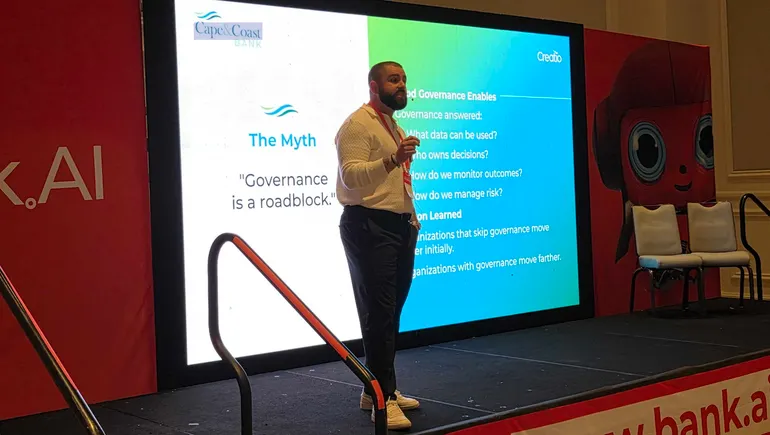
The conversation has moved beyond simple automation. Today, the focus is on "agentic AI"—autonomous or semi-autonomous tools capable of not just processing information, but executing complex tasks across the enterprise. From risk management to customer acquisition, the financial sector is proving that a well-orchestrated digital backbone can turn regulatory hurdles into competitive advantages.
Main Facts: The Rise of the AI-Native Bank
The transition from traditional banking to AI-driven finance is no longer a theoretical exercise. It is a strategic necessity driven by the need for operational efficiency and enhanced customer personalization. The primary catalyst for this shift has been the maturation of cloud computing within the sector. By migrating data to the cloud, banks have created the "liquidity" of information necessary to feed Large Language Models (LLMs) and agentic workflows.
Key takeaways from recent industry analysis and executive testimony include:
- The Shift to Agentic AI: Banks are moving away from passive chatbots toward active "AI agents" that can perform functions in risk, compliance, and audit with minimal human intervention.
- Cost Reduction: Strategic deployment of AI is projected to slash operational costs by as much as 20%, according to industry benchmarks.
- The No-Code Revolution: Platforms like Creatio are enabling mid-sized and regional banks to deploy AI solutions without the need for massive teams of specialized data scientists, democratizing access to high-level tech.
- The Data Quality Mandate: The success of any AI initiative is now recognized as being tethered directly to data hygiene. Financial institutions are implementing radical new programs—including employee incentives—to ensure data integrity.
Chronology: From Legacy Systems to Agentic Workflows
To understand the current state of AI in banking, one must look at the technological evolution of the last decade.
Phase 1: The Cloud Migration (2015–2020)
Initially, banks focused on moving core banking systems to the cloud to reduce hardware costs and improve scalability. This era was defined by "lifting and shifting" existing processes. While it improved efficiency, it did not fundamentally change the way banks operated.
Phase 2: The Data Democratization (2020–2022)
As data moved to the cloud, institutions began breaking down departmental silos. The "Data Lake" became a standard architecture, allowing for a holistic view of the customer. However, the industry still struggled with "actioning" this data in real-time.
Phase 3: The Generative AI Explosion (2023–Present)
The arrival of sophisticated LLMs provided the missing link. Banks began experimenting with internal assistants for document summarization and customer service.
Phase 4: The Agentic Era (Current)
We are now entering the phase of "Agentic AI." Unlike the previous phase, where AI merely suggested answers, agents are now being designed to trigger transactions, monitor fraud in real-time, and manage compliance audits autonomously. As highlighted in Orlando, this phase requires a "start small, scale fast" mentality.
Supporting Data: The Economic and Operational Impact
The move toward AI is backed by staggering projections from leading global consultancies. The financial incentive for banks to overcome their traditional conservatism is now too large to ignore.
The Cost-Efficiency Metric
According to a report by McKinsey, the deployment of AI technologies could trim banking industry costs by up to 20%. In an environment of fluctuating interest rates and tightening margins, a 20% reduction in overhead represents a transformative shift in profitability. These savings are expected to come from the automation of middle-office functions—areas traditionally heavy on manual labor, such as loan processing and KYC (Know Your Customer) verification.
Adoption Statistics
Data from Accenture underscores the depth of this integration. Their research indicates that more than 50% of banking IT executives expect AI agents to be fully embedded across critical functions by 2026. Specifically:
- Risk and Compliance: 54% of executives see agents handling primary monitoring.
- Fraud Detection: 58% expect AI to lead transaction monitoring.
- Audit Functions: 51% anticipate AI-driven continuous auditing.
These numbers suggest that the "human-in-the-loop" model is evolving into a "human-on-the-loop" model, where people oversee AI systems rather than performing the tasks themselves.
Official Responses: Insights from the Front Lines
At the Creatio No-Code Days Florida conference, technology leaders from regional and mid-sized banks shared their "boots-on-the-ground" experiences with AI deployment. Their insights highlight a move toward pragmatic, collaborative implementation.
Strategic Collaboration
Ken Tingle, First Vice President and Business Intelligence Manager at Cape & Coast Bank, emphasized that AI is not merely a "tech project" but a business transformation.
"There’s a strategic component, a collaboration component," Tingle noted. "You have to bring in not only technology but your sales leaders in order to deploy a solution that’s going to benefit the organization."
Tingle’s approach at the Massachusetts-based bank involved using a referral agent to track AI-recommended leads. His advice to the industry was clear: "Start small and focused… Start targeted with a very small audience, and then deploy slowly to the rest of your organization."
The "Assistant-First" Philosophy
Drew McMonigle, Chief Technology Officer at Lake City Bank, argued that the path to full automation must be paved with assisted tools.
"Ground zero is: have people use AI assistant-type use cases," McMonigle said. "You cannot fully automate something until you get people using the assisting capability."
By encouraging organic adoption, McMonigle believes banks can generate a "groundswell" of use cases that bubble up from the employees who actually do the work, rather than being forced down from the C-suite. This strategy also aids in governance, as successful, approved use cases become the blueprint for wider rollout.
The Data Hygiene Crisis
Meeta Autrey, Vice President and IT Manager at Mission Valley Bank, highlighted the industry’s "Achilles’ heel": data quality.
"If we don’t have clean data, any integration you make from any other system is not going to be satisfactory," Autrey warned.
To combat this, Cape & Coast Bank has taken the unusual step of gamifying data entry. They introduced an incentives program to reward employees for flagging and remediating errors in customer data. "It’s a big process," Tingle added. "You have to reward them for it."
Implications: The Future of the Financial Workforce
The aggressive move toward agentic AI in banking carries profound implications for the future of the industry, its workforce, and its customers.
1. The Redefinition of Roles
As AI agents take over routine monitoring and data-heavy tasks, the "banker" of the future will need to pivot toward high-value advisory roles. The "referral agent" model mentioned by Tingle suggests a future where AI handles the prospecting and initial qualification, while humans focus on relationship management and complex problem-solving.
2. The Democratization of Innovation
The use of "no-code" platforms is a game-changer for regional banks. Historically, only "Tier 1" banks like JPMorgan Chase or Goldman Sachs had the budget to build custom AI tools. Now, through platforms that allow for visual, modular development, smaller institutions can compete on the same technological footing, potentially leading to a more diverse and resilient banking ecosystem.
3. Regulatory and Ethical Challenges
As AI agents begin to "carry out actions," the question of liability becomes paramount. If an AI agent erroneously flags a transaction or denies a referral, the legal framework for accountability is still being written. Banks will need to invest as much in "Explainable AI" (XAI) as they do in the agents themselves to satisfy regulators that their autonomous systems are fair and unbiased.
4. The Human Element in Data
The realization that employees must be "rewarded" for data cleaning suggests that the "AI revolution" is still very much a human endeavor. Technology can process data at lightning speed, but the initial integrity of that data remains a human responsibility. The success of AI in banking may ultimately depend more on corporate culture and incentive structures than on the algorithms themselves.
Conclusion
The financial services sector is no longer the laggard of the digital world. By leveraging cloud maturity and embracing a collaborative, "start small" approach to AI agents, banks are positioning themselves at the forefront of the agentic revolution. As the industry moves toward 2026, the focus will remain squarely on the "Holy Trinity" of AI success: robust data governance, cross-departmental collaboration, and a relentless focus on user adoption. For the banks that get this right, the reward is a 20% reduction in costs and a quantum leap in operational agility. For those that don’t, the risk of obsolescence has never been higher.