








WASHINGTON D.C. — In a high-stakes session of the Senate Banking Committee on Tuesday, lawmakers from both sides of the aisle converged on a singular, pressing issue: the "Affordability Agenda." The hearing, aimed at addressing the rising cost of living and the financial burdens on American households, quickly transformed into a sharp interrogation of the banking industry’s fee structures and lending practices.
From the mechanics of transaction processing to the collapse of federal regulatory caps, the testimony highlighted a growing impatience in Washington with traditional banking revenue models. While Democrats focused on the predatory nature of "junk fees," a notable shift occurred as Republican lawmakers joined the fray, warning financial institutions that voluntary reform might be the only way to avoid heavy-handed legislation.
Main Facts: A Convergence of Criticism
The core of Tuesday’s hearing centered on two primary financial pain points for American consumers: overdraft fees and credit card interest rates.
According to testimony and data presented during the session, American consumers paid approximately $12 billion in overdraft fees over the past year. This figure, supported by the National Consumer Law Center (NCLC), underscores the scale of a revenue stream that critics argue disproportionately targets the most financially vulnerable.
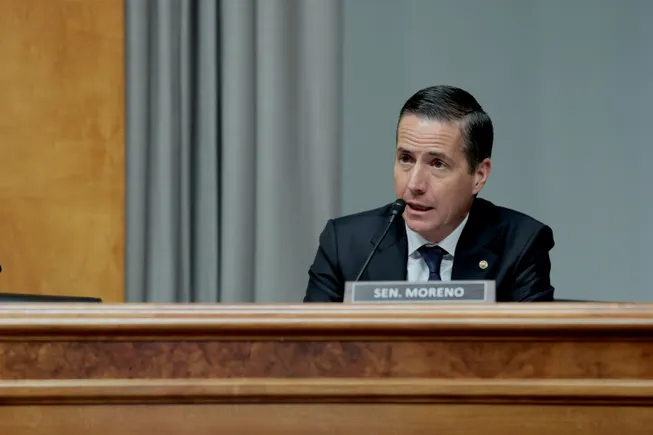
The hearing’s most striking moments involved Sen. Bernie Moreno (R-OH), who took a surprisingly hard line against the Consumer Bankers Association (CBA). Moreno focused on the practice of "transaction reordering," where banks process withdrawals before deposits to trigger multiple overdraft penalties. His rhetoric signaled that Republican patience with these practices is wearing thin, framing the issue not as a matter of free-market economics, but as one of fundamental fairness for "working Americans."
Simultaneously, Sen. Elizabeth Warren (D-MA) and Sen. Chris Van Hollen (D-MD) attacked the industry from a regulatory and consumer-protection standpoint. They highlighted the recent overturning of a Consumer Financial Protection Bureau (CFPB) rule that would have capped overdraft fees at $5, a move they claim has already cost the American public billions of dollars.
Chronology: The Rise and Fall of the $5 Overdraft Cap
To understand the tension in the room, one must look at the regulatory timeline of the past 18 months.
In early 2024, under the leadership of Director Rohit Chopra, the CFPB moved to aggressively rein in overdraft fees. The bureau proposed a rule that would have treated overdraft as a form of credit, effectively capping the fee at $5—a drastic reduction from the industry average of $35. The rule was intended to return overdraft services to their original purpose: a low-cost "courtesy" for occasional errors rather than a reliable profit center.
However, the political landscape shifted. In May 2025, President Donald Trump signed a resolution—utilizing the Congressional Review Act—that formally overturned the CFPB’s overdraft cap. This legislative maneuver not only killed the $5 cap but also prevented the CFPB from issuing a "substantially similar" rule in the future without new authorization from Congress.
Following the repeal of the rule, the NCLC reported that overdraft revenues at the nation’s top 20 banks jumped by 4.2% in 2025 compared to 2023. At some lenders, the increase was significantly higher, leading to the current environment of renewed legislative scrutiny. This timeline set the stage for Tuesday’s hearing, as lawmakers sought to determine if the industry would moderate its fees in the absence of federal mandates.
Supporting Data: The High Cost of Being Broke
The data presented during the hearing painted a grim picture of the financial "poverty trap."
The Overdraft Math:
Sen. Van Hollen provided a vivid example of the "cup of coffee" trap. A consumer purchasing a $3 coffee without realizing their balance is low can be hit with a $35 fee. When calculated as an interest rate for a small, short-term loan, this represents an effective annual percentage rate (APR) of over 16,000% in some cases, though Van Hollen noted that even conservative estimates place the effective annual interest at staggering levels.
The $57 Billion Gap:
Sen. Warren introduced data regarding credit card interest. Following a call by President Trump in January 2025 for a 10% cap on credit card interest rates, Warren claimed that no major bank has complied. She estimated that Americans have paid $57 billion more in interest since January 20th than they would have if the 10% cap had been implemented.
Transaction Reordering:
Sen. Moreno’s critique focused on the "ledger" system. If a customer has $100, deposits $500, and then spends $150 on the same day, many banks will process the $150 withdrawal first. This triggers an overdraft fee on the $150 transaction before the $500 deposit is "cleared" in the ledger, despite the funds being physically present. Moreno called this practice "fundamentally unfair."
Official Responses: Industry Defense vs. Legislative Threats
Lindsey Johnson, CEO of the Consumer Bankers Association (CBA), served as the primary witness for the industry, defending the current system as a necessary component of risk management.
The CBA Defense:
Johnson argued that overdraft fees are not "junk fees" but are charges for a service that consumers value—the ability to complete a transaction when funds are insufficient. She warned that government-imposed caps would have dire consequences for credit access. Specifically, she noted that a 10% cap on credit card interest would restrict access to credit for 75% to 80% of current cardholders.
"APRs are not a bank profit; APRs are how we extend credit," Johnson told the committee. She emphasized that risk-based pricing allows 4,000 different issuers to provide credit to a diverse range of consumers, including those with lower credit scores.
The Republican Divide:
While Moreno was critical, Sen. Thom Tillis (R-NC) offered a staunch defense of the banks. He characterized the issue as one of "financial literacy" rather than predatory behavior. "You’re helping people from themselves," Tillis said, arguing that banks already provide "passes" for occasional mistakes. He cited Illinois’ 36% rate cap implemented in 2021, which he claimed led to a 44% drop in loans to subprime borrowers, as a cautionary tale. "You know how this movie’s gonna end… it’s not going to end any differently," Tillis remarked, referencing the Toy Story franchise to suggest that price caps always lead to the same result: credit contraction.
The "Bad Practice" Warning:
The most pointed exchange occurred when Sen. Moreno cut off Johnson’s explanation of "back-end technology" regarding deposit timing. "Just do it the right way," Moreno said. "It’s just bad practice. Just don’t do bad things." He warned that if the industry does not voluntarily change the order of transactions to favor the consumer, Congress would be forced to pass a law.
Implications: The Future of Consumer Finance
The hearing signals a precarious moment for the American banking sector. The bipartisan nature of the criticism—specifically regarding the timing of deposits and withdrawals—suggests that even in a deregulatory environment, certain "ledger tricks" may no longer be politically defensible.
1. Potential for Narrow Legislation:
While a broad 10% interest rate cap remains unlikely due to fierce Republican opposition and industry warnings of a credit crunch, there is a growing appetite for narrow, bipartisan legislation targeting transaction reordering. If banks do not "voluntarily" adjust their software to credit deposits before debiting withdrawals, Moreno’s threat of a new law could gain traction.
2. The "Profit Center" Controversy:
Julie Margetta Morgan of The Century Foundation highlighted a critical shift in the industry’s identity. By transforming what was once a "courtesy" into a "profit center," banks have made themselves vulnerable to the argument that they are profiting from consumer misfortune. This narrative is increasingly difficult to counter in a period of high inflation where "affordability" is the top voter concern.
3. Credit Contraction vs. Consumer Protection:
The debate between Tillis and Warren encapsulates the fundamental tension in U.S. financial policy. If the government caps fees and rates, banks will undoubtedly tighten lending standards to mitigate risk. The question for policymakers is whether the benefit of lower fees for the majority outweighs the cost of total credit loss for the most "at-risk" borrowers.
4. The Trump Factor:
The hearing also highlighted the friction between President Trump’s populist rhetoric (the 10% cap) and the legislative actions of his party (overturning the CFPB rule). As Sen. Warren pointed out, the industry has ignored the President’s call for lower rates, creating a political vacuum that Democrats are eager to fill by painting the administration as siding with "Big Banks" over "Main Street."
As the Senate Banking Committee continues its "Affordability Agenda," the message to the financial sector is clear: the status quo is under siege. Whether through voluntary reform or mandated caps, the era of multibillion-dollar overdraft revenue is facing its most significant challenge in decades.