








The aviation community is currently grappling with a series of perplexing events that transpired at Cincinnati/Northern Kentucky International Airport (CVG) on the evening of Sunday, July 19, 2026. A Kalitta Air Boeing 777-300ER, operating as flight K4262 from Brussels (BRU), experienced a dramatic and highly unusual tail strike during a botched landing attempt. This initial incident, marked by a shower of sparks and significant structural contact with the runway, served as the catalyst for a chaotic sequence of events that saw the heavy cargo aircraft perform two consecutive go-arounds before finally touching down safely.
As regulatory bodies begin their deep dive into the incident, aviation experts and enthusiasts alike are questioning how a routine cargo operation under seemingly benign weather conditions devolved into such a hazardous sequence of flight maneuvers.
The Core Incident: A Sequence of Anomalies
The aircraft involved, a 21-year-old Boeing 777-300ER (registration N778CK), is a workhorse of the Kalitta Air fleet. On the night in question, the flight arrived from Brussels carrying international freight. At approximately 7:52 PM local time, the aircraft was established on final approach to Runway 36R at CVG.
Video footage captured from the airport perimeter provides a harrowing perspective of the event. As the aircraft neared the touchdown zone, the wheels appeared to make contact with the runway surface. However, rather than continuing the landing roll, the crew initiated a go-around maneuver. It was during this high-energy transition—where the pilots applied power and pitched the nose upward—that the tail of the massive aircraft struck the tarmac.
The impact was not a glancing blow; it was a substantial contact. The footage shows a sustained shower of sparks erupting from the aft section of the fuselage as the aircraft labored to gain altitude. In aviation terms, a tail strike during a go-around is a rare and dangerous occurrence, typically suggesting an over-rotation or a failure to maintain appropriate pitch geometry while transitioning from a landing configuration to a climb-out.
Chronology of a Chaotic Arrival
The sequence of events following the tail strike suggests a flight deck that may have been struggling with a significant loss of situational awareness or potential mechanical issues resulting from the impact.
Phase 1: The Initial Impact
At 7:52 PM, the decision to go around was made at an altitude where the wheels had already made contact with the runway. The resulting tail strike likely caused structural damage to the aft fuselage, the tail skid, and potentially critical sensors or control surfaces located in the empennage.
Phase 2: The Emergency Declaration
Upon climbing out, the air traffic control (ATC) tower alerted the crew to the visible sparks and the apparent tail strike. The pilots acknowledged the information and immediately declared an emergency. The priority shifted from a standard landing to a recovery operation.
Phase 3: The Failed Alignment
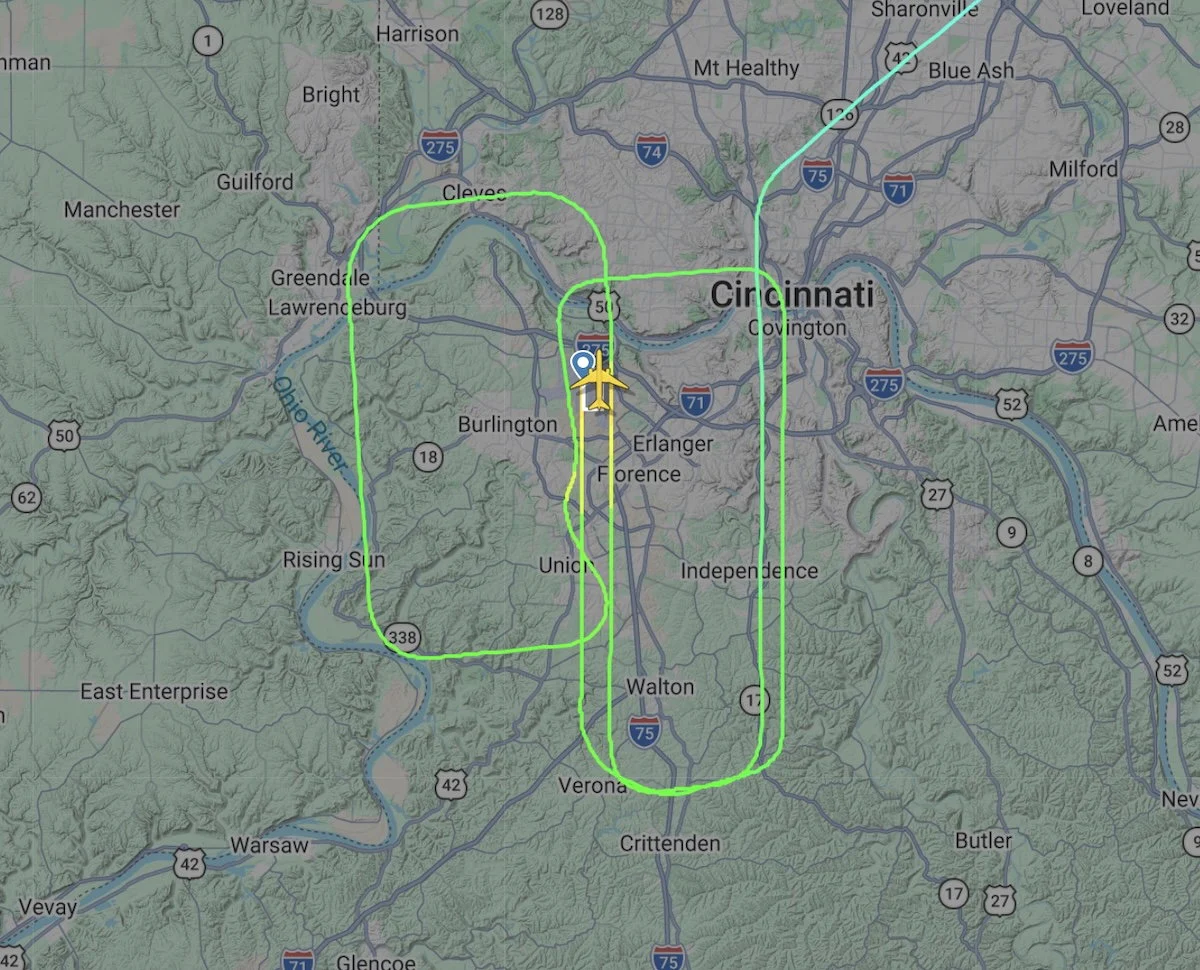
The crew requested an Instrument Landing System (ILS) approach to Runway 36C, a standard procedure for an aircraft dealing with a potential structural compromise. However, the flight path analysis revealed that the aircraft failed to intercept the localizer correctly. Despite clear ATC instructions, the aircraft drifted off course, leading to a second go-around as the controllers observed the misalignment.
Phase 4: The Final Touchdown
Following the second aborted landing, the crew was vectored for a final attempt. At 8:19 PM, roughly 27 minutes after the initial incident, the flight successfully landed on Runway 26C. The aircraft was then met by emergency vehicles as a precaution.

Analyzing the Environmental and Operational Context
One of the most striking aspects of this incident is the lack of adverse environmental factors. Meteorological reports for the Cincinnati area on July 19 indicated clear skies and light winds. There were no reports of wind shear, microbursts, or visibility issues that would typically explain a pilot’s inability to maintain a stable approach or execute a clean go-around.
Technical and Human Factors
In the absence of weather-related complications, investigators are looking at two primary pillars:
- Mechanical/Sensor Failure: Did the aircraft experience an instrument malfunction that gave the crew incorrect pitch or speed data, leading them to rotate too aggressively?
- Human Factors: Were there communication breakdowns, fatigue, or an over-correction in response to a perceived landing instability?
The fact that the aircraft struggled to intercept the localizer on the second attempt suggests that the crew may have been dealing with a degraded aircraft state, or perhaps a level of cognitive overload that impacted their ability to process navigational data accurately.
Official Responses and Regulatory Oversight
The Federal Aviation Administration (FAA) has confirmed its involvement in the investigation. In a concise statement, the agency noted: "Kalitta Air Flight 264 landed safely at Cincinnati/Northern Kentucky International Airport around 8:15 p.m. local time on Sunday, July 19, after the tail of the Boeing 777-300ER scraped the runway during a go-around. The flight departed from Brussels Airport in Belgium. The FAA will investigate."
Kalitta Air, a prominent player in the global air cargo market, has not yet released a detailed technical report. However, they are cooperating fully with federal authorities. The aircraft remains on the ground at CVG, where maintenance crews and NTSB investigators are conducting a detailed forensic inspection of the airframe, specifically focusing on the damage sustained at the tail skid area and the status of the flight control computers.
Implications for Safety Protocols
This incident serves as a sobering reminder of the complexities involved in heavy aircraft operations. A go-around is a standard safety maneuver, yet it carries inherent risks if the aircraft is already in the flare or touchdown phase. When a pilot initiates a go-around after the wheels have touched, the potential for a tail strike increases significantly due to the change in the aircraft’s center of gravity and the pitch required to get airborne again.
What the Investigation Must Resolve
To prevent future occurrences, the final report will likely need to address several key questions:
- The "Why": Why was a go-around initiated after the wheels were on the runway? Was the landing unstable, or was there an unexpected technical glitch during the flare?
- Structural Integrity: How much structural damage did the tail strike cause, and did that damage influence the flight control logic of the Boeing 777 during the subsequent missed approach?
- CRM (Crew Resource Management): Did the cockpit crew effectively manage the workload after the emergency was declared? The failure to intercept the localizer on the second attempt is a point of significant concern regarding the crew’s situational awareness during the recovery phase.
Conclusion: A Case Study in Recovery
While the events at CVG were undoubtedly alarming, the outcome—a safe landing—is a testament to the redundancy built into modern commercial aircraft and the standard operating procedures of air traffic control. The fact that the aircraft was able to remain airborne, navigate to a new approach, and eventually land safely suggests that, despite the severe tail strike, the primary flight controls remained functional.
However, the "head-scratching" nature of the two go-arounds indicates that the incident was far from routine. As the data from the Flight Data Recorder (FDR) and Cockpit Voice Recorder (CVR) are analyzed, the industry will be watching closely. For Kalitta Air, this event will likely result in a review of their landing and go-around protocols, particularly for their fleet of aging but capable Boeing 777-300ERs.
As we await the final NTSB findings, the incident remains a stark lesson in the unpredictable nature of flight. Even in perfect conditions, the margin between a routine cargo delivery and a potential catastrophe can be measured in seconds and inches. The aviation community waits with bated breath to understand how such a sequence could unfold, ensuring that such a "baffling" incident does not become a recurring feature in the skies.