








WASHINGTON — As wealth transfer policies face mounting economic pressure across the United States, a patchwork of state-level estate and inheritance taxes continues to shape financial planning for families, small business owners, and agricultural operations. While the federal government maintains a broad exemption threshold, 16 states and the District of Columbia still impose their own levies on the transfer of generational wealth, creating a complex and often contentious landscape for taxpayers and legislators alike.
Tax policy experts argue that these state-level levies act as a drag on local economies, driving high-net-worth individuals, family farms, and closely held businesses across state lines. With recent federal adjustments shifting the baseline for wealth transfers, state lawmakers find themselves under increasing pressure to reevaluate the structural integrity and economic competitiveness of their death taxes.
Main Facts: Understanding Estate Versus Inheritance Taxes
To understand the debate surrounding wealth transfer levies, it is essential to distinguish between the two primary mechanisms states use: estate taxes and inheritance taxes.
An estate tax is levied on the net, overall value of a decedent’s taxable estate before any assets are distributed to heirs. The estate itself is legally responsible for paying this obligation out of its accumulated assets. Typically, these taxes apply to residents who die while domiciled in the taxing state, as well as nonresident decedents who owned tangible property or real estate within state borders.
Conversely, an inheritance tax is assessed directly on the individual beneficiary who receives the bequest. Based on the specific amount distributed to each recipient, inheritance taxes are paid to the state where the decedent was domiciled or owned property, regardless of where the heir resides.
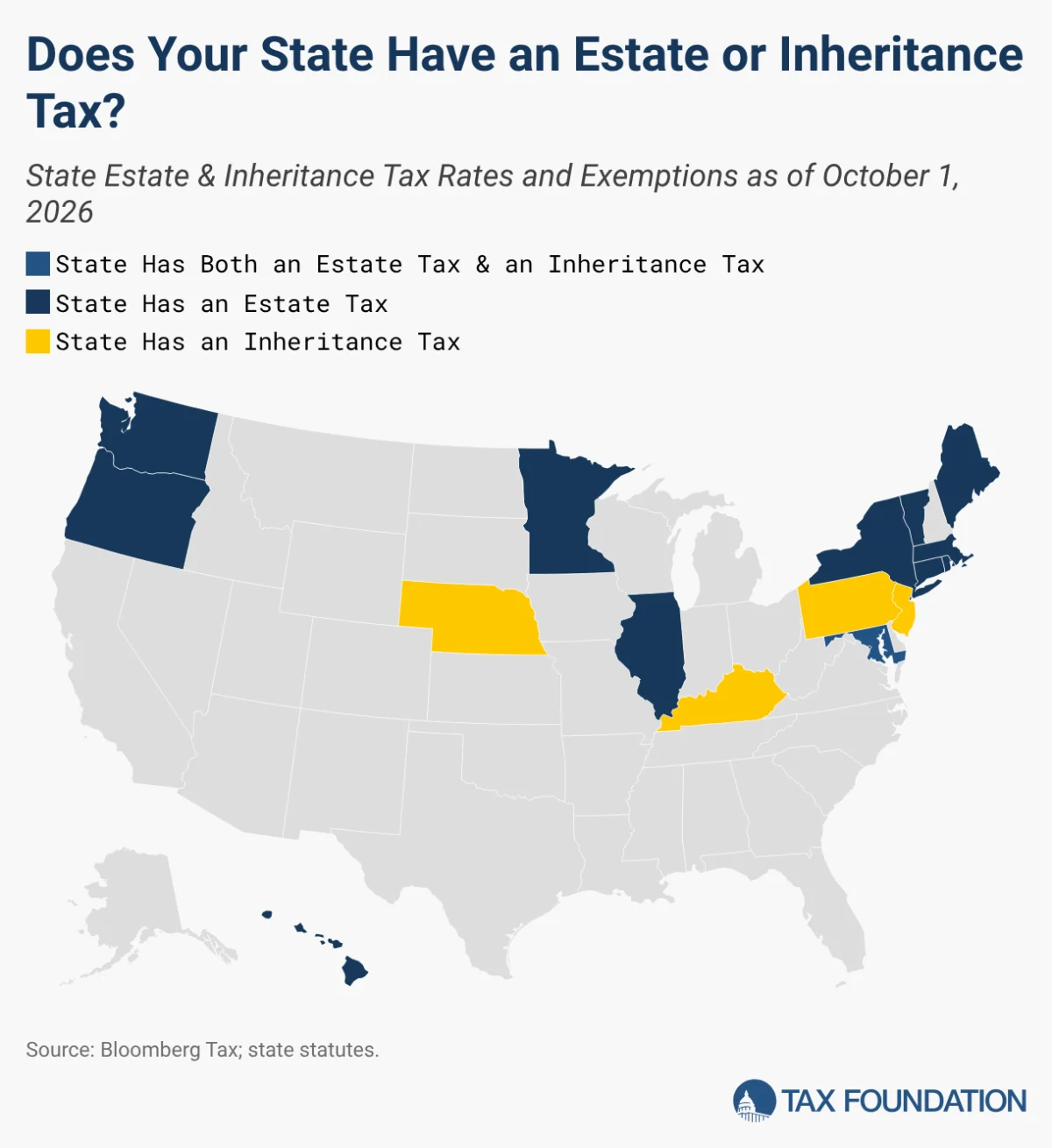
At the federal level, the top marginal estate tax rate sits at 40 percent. However, state-level implementation varies wildly. Currently, 12 states and the District of Columbia impose estate taxes, while five states levy inheritance taxes. Maryland remains the singular exception in the nation, simultaneously imposing both an estate tax and an inheritance tax.
Most estate taxes and certain inheritance taxes are progressive. The tax burden increases incrementally as the total value of the assets or the individual bequest scales upward.
When it comes to top marginal rates, Hawaii and Washington lead the nation with a 20 percent estate tax rate. Hawaii’s top rate kicks in for taxable estate values exceeding $10 million, while Washington applies its top rate to estates valued above $9 million. Despite Washington’s slightly higher threshold for its top bracket, its estate tax is generally considered more burdensome than Hawaii’s. Washington maintains a much lower basic exemption threshold—$3 million compared to Hawaii’s $5.49 million—meaning Washington exposes a significantly larger share of estates to taxation and scales its marginal rates faster.
Eight states and the District of Columbia assess a 16 percent top estate tax rate. The threshold at which this top rate applies ranges widely, from $5 million in Vermont to $10.1 million in Minnesota and New York. Meanwhile, states like Connecticut and Vermont utilize flat tax structures. Connecticut levies a flat 12 percent estate tax, and Vermont imposes a flat 16 percent rate. Connecticut’s structure is notably less burdensome due to its high exemption level, positioning the state favorably for potential future reforms or total elimination.
Inheritance taxes operate under a different set of rules. All five states that levy inheritance taxes—Kentucky, Maryland, Nebraska, New Jersey, and Pennsylvania—structure their rates based on the familial proximity of the recipient to the decedent. State tax codes routinely offer preferential treatment, such as lower tax rates and significantly higher exemption thresholds, to spouses, children, and lineal descendants. Distant relatives and unrelated beneficiaries face steeper rates and lower exemptions.
Kentucky and New Jersey tie for the highest top marginal inheritance tax rate at 16 percent. Maryland maintains the lowest top inheritance tax rate at a flat 10 percent for all non-lineal recipients, though those estates may also be subject to Maryland’s separate estate tax.
Chronology: The Evolution of Federal and State Death Taxes
The modern landscape of state-level death taxes cannot be understood without examining the historical relationship between federal and state tax codes.
- Pre-2005: For decades, the federal government strongly incentivized states to implement their own estate taxes by offering a federal tax credit for state-level estate taxes paid. Under this "pickup tax" system, taxpayers effectively paid the same aggregate amount whether their state levied an estate tax or not, making the state-level tax essentially a zero-sum transfer from the federal treasury to state coffers.
- 2005: The federal government formally phased out the state estate tax credit. This legislative shift changed the dynamic overnight. States that had directly tied their estate tax statutes to the federal credit automatically stopped collecting the tax, while other states chose to repeal their provisions legislatively to protect their economic competitiveness.
- 2017–2018: Recognizing the dampening effect of estate taxes on economic growth, several states took aggressive legislative action. Delaware completely repealed its estate tax in 2018. That same year, New Jersey completed the multi-year phaseout of its estate tax, though it chose to retain its inheritance tax.
- 2021: Vermont completed a phase-up of its estate tax exemption, nearly doubling the threshold to $5 million to keep pace with regional economic realities.
- 2023: Connecticut successfully phased in an ambitious, multi-year increase to its estate tax exemption, matching the federal exemption level by 2023 while concurrently transitioning to a streamlined flat tax rate. Simultaneously, Nebraska enacted legislation to substantially increase its inheritance tax exemptions and reduce its overall rates.
- 2025: Iowa officially completed the repeal of its long-standing inheritance tax, removing a notable barrier to generational wealth transfer in the state. On the federal front, the passage of the landmark One Big Beautiful Bill Act (OBBBA) reset the national conversation, boosting the federal estate tax exemption threshold to $15 million starting in 2026, with provisions to index it for inflation moving forward.
- 2026 and Beyond: Connecticut remains the single state in the nation that fully conforms its state-level estate tax exemption to the newly elevated federal threshold. New York follows with the second-highest state exemption at $7.35 million. At the opposite end of the spectrum, Oregon and Rhode Island maintain the least generous exemptions, sitting at $1 million and approximately $1.84 million, respectively. Only four states—Connecticut, Maine, New York, and Rhode Island—along with the District of Columbia, currently index their exemption amounts to combat inflation.
Supporting Data: Exemption Thresholds and Economic Realities
The structural disparity among state-level death taxes is starkly illustrated by comparing exemption levels and indexing mechanisms across jurisdictions. When exemptions fail to adjust for inflation, "bracket creep" and rising asset valuations pull ordinary middle-class estates and family-owned businesses into tax brackets intended for multi-millionaires.
| Jurisdiction | Tax Type | Top Marginal Rate | Exemption Threshold | Inflation Indexed? |
|---|---|---|---|---|
| Federal | Estate Tax | 40% | $15,000,000 (2026) | Yes |
| Connecticut | Estate Tax | 12% (Flat) | Matches Federal ($15M) | Yes |
| New York | Estate Tax | 16% | $7,350,000 | Yes |
| Hawaii | Estate Tax | 20% | $5,490,000 | No |
| Washington | Estate Tax | 20% | $3,000,000 | No |
| Vermont | Estate Tax | 16% (Flat) | $5,000,000 | No |
| Oregon | Estate Tax | 16% | $1,000,000 | No |
| Rhode Island | Estate Tax | 16% | ~$1,838,056 | Yes |
| New Jersey | Inheritance Tax | 16% | Varies by Class | No |
| Kentucky | Inheritance Tax | 16% | Varies by Class | No |
Data compiled by economic think tanks demonstrates that estate and inheritance taxes generate a relatively small fraction of total state tax revenue. Yet, the behavioral responses they trigger—such as capital flight, the restructuring of corporate assets, and expensive estate-planning compliance—impose disproportionately high deadweight economic losses.
Official Responses: Legislative Pushback and 2026 Policy Trends
The economic weight of estate and inheritance taxes has not gone unnoticed by state lawmakers. During the 2025–2026 legislative bienmiums, policymakers in states such as Maryland, Minnesota, Nebraska, New Jersey, Oregon, and Rhode Island introduced targeted structural reforms to curb the impact of their death taxes.
While comprehensive repeal bills or structural overhauls in these states frequently face fierce political headwinds from progressive lawmakers who view the levies as essential tools for wealth redistribution, the sheer volume of proposed legislation underscores a growing bipartisan acknowledgment that existing structures are punitive.
"When states maintain outdated or overly aggressive estate and inheritance taxes, they are effectively penalizing families for saving, investing, and building local enterprises," noted a prominent fiscal policy analyst. "Lawmakers are beginning to realize that chasing affluent retirees across state lines does more long-term damage to the tax base than the short-term revenue gains are worth."
Advocacy groups representing family farmers, independent auto dealers, and main street merchants have increasingly made death tax reform a legislative priority. Because small business owners and agricultural producers frequently tie up their capital in illiquid assets—such as working acreage, commercial real estate, and heavy machinery—they often find themselves classified as "asset rich but cash poor."
Implications: Protecting Family Enterprises and Economic Competitiveness
The continuation of state-level estate and inheritance taxes carries profound implications for the American economy, particularly regarding the continuity of family-owned enterprises and agricultural operations.
When a patriarch or matriarch passes away, heirs to a family farm or a regional manufacturing business are frequently hit with an immediate, massive tax liability based on the appraised market value of the business assets. Because these assets cannot be easily divided or instantly liquidated without destroying the enterprise itself, heirs are routinely forced to take on emergency debt, sell off critical business equipment, or liquidate the family business entirely just to pay the tax bill.
This friction fundamentally disrupts generational wealth transfer, breaking the chain of family stewardship that has historically stabilized local economies and provided steady blue-collar employment in rural and suburban communities. Furthermore, the administrative complexity of valuing complex estates leads to protracted legal battles with state tax authorities, imposing steep compliance costs on grieving families.
Economic literature consistently highlights that capital is mobile. High-net-worth individuals, retirees, and successful entrepreneurs frequently choose to establish legal residency in states with no estate or inheritance taxes—such as Florida, Texas, or Nevada—depriving high-tax states of valuable income and property tax revenue downstream.
As federal policy shifts toward a higher $15 million exemption threshold under the One Big Beautiful Bill Act, the remaining 16 states and the District of Columbia that cling to legacy death taxes find themselves increasingly out of step with national economic standards. To foster long-term fiscal stability, encourage entrepreneurial investment, and protect family businesses from unnecessary hardship, state policymakers should strongly consider systematically phasing out their estate and inheritance levies or, at a minimum, fully conforming their exemption thresholds to match federal standards.