








BRUSSELS / LONDON / WASHINGTON — As the calendar marches toward significant policy shifts slated for 2026, governments and fiscal authorities worldwide are grappling with a fundamental mismatch in how they tax alcoholic beverages. For centuries, excise taxes on beer, wine, and spirits have served a dual purpose: discouraging excessive consumption to protect public health and generating reliable streams of state revenue. Yet, the traditional architecture of these tax codes is rapidly crumbling.
Fueled by rapid industry innovation, the lines distinguishing beer from wine, and wine from ready-to-drink (RTD) spirits, have blurred beyond recognition. Craft breweries, non-traditional brewing methods, and an explosion of hybrid beverages have exposed the deep inefficiencies of legacy tax regimes. As policymakers look toward 2026 and beyond, experts argue that clinging to outdated, category-based tax systems is no longer economically viable. Instead, a modernized approach centered entirely on Alcohol By Volume (ABV)—similar to frameworks already emerging in parts of Europe and the United Kingdom—is gaining traction as the most equitable and efficient path forward.
Main Facts
The foundational mechanics of alcohol excise taxes are straightforward, yet their application is fraught with historical anomalies. Governments levy these taxes primarily as a blunt instrument for harm reduction, attempting to curb public health costs associated with alcohol abuse while capitalizing on a widely consumed commodity. However, the economic reality of how these taxes are applied across different beverage classes reveals profound inconsistencies.
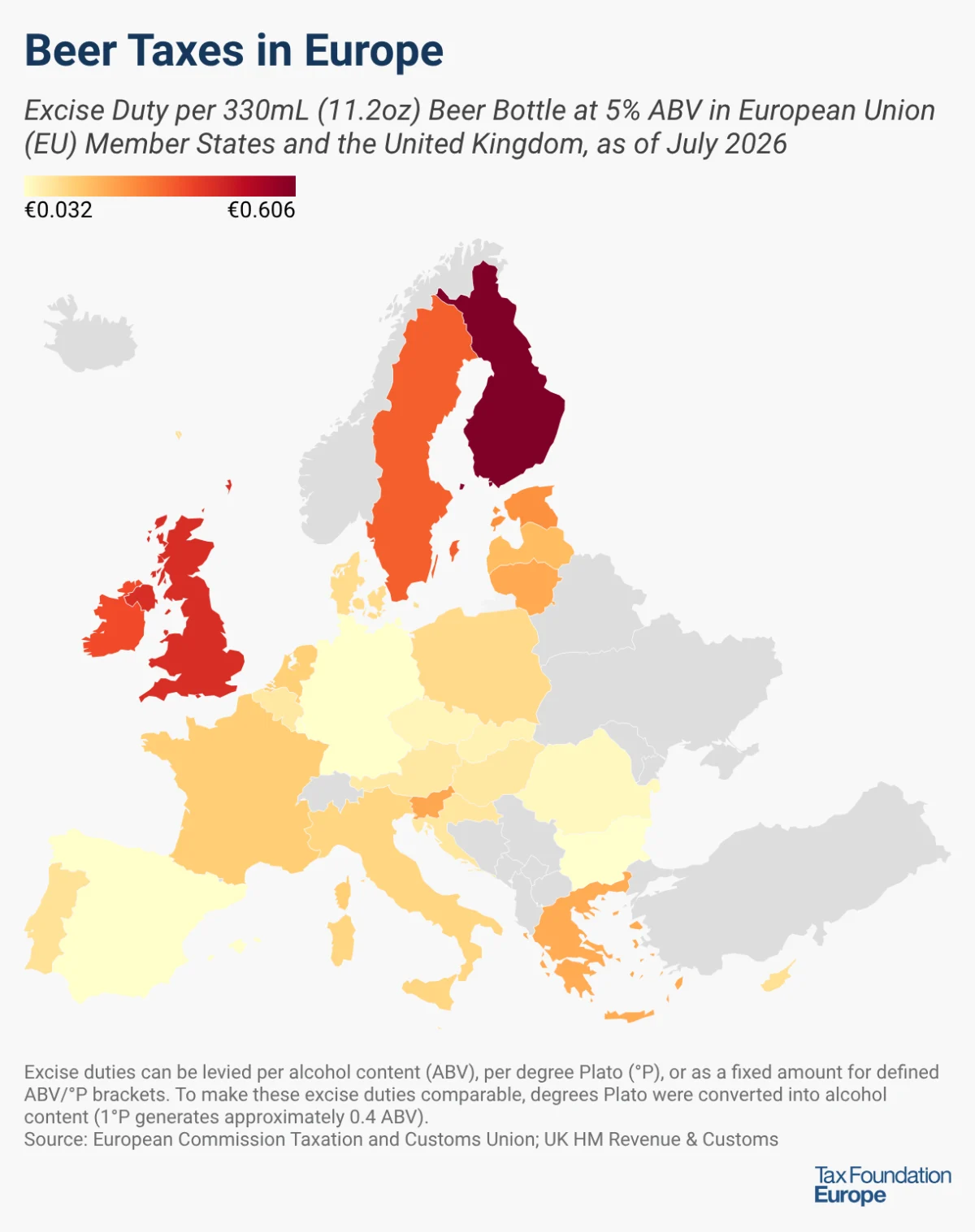
In Europe, the tax treatment of alcohol varies wildly. Generally speaking, beer faces heavier taxation than wine—with several European Union member states levying a zero-percent excise tax on wine entirely. Conversely, beer is taxed much lighter than distilled spirits. This hierarchy of taxation has little to do with public health outcomes and everything to do with historical agricultural lobbies, regional traditions, and archaic legislative definitions.
The core dilemma facing modern tax authorities is that the alcohol market has outgrown its legal definitions. The rise of craft brewing has revolutionized the global market, introducing an unprecedented diverse flavor profile and a much wider range of alcohol content. Furthermore, the explosion of ready-to-drink (RTD) cocktails has shattered traditional market boundaries. Many RTDs are technically crafted from distilled spirits, but once combined with heavy mixers, the final ABV of the canned beverage mirrors that of a standard beer or cider. Despite this similarity in alcohol content, the tax burden between an RTD cocktail and a beer can be vast and unjustifiable.
While beer within the EU is generally taxed based on its alcohol content—calculated either by percent alcohol or degree Plato—other categories remain trapped in rigid, volume-based or product-category tax frameworks. Meanwhile, jurisdictions like the United Kingdom have begun moving toward more uniform duty rates based strictly on alcohol content across various categories. As the product landscape continues to evolve, maintaining disparate tax brackets for chemically similar products will only amplify administrative friction, compliance costs, and market distortions.
Chronology
To understand how modern alcohol taxation reached this precarious crossroads, it is essential to examine the historical evolution of excise duties and the milestones leading up to the anticipated regulatory shifts of 2026.
- Pre-20th Century: The Era of Product-Specific Tariffs
Historically, alcohol taxes were levied based on the source material or the perceived luxury status of the drink. Beer, wine, and spirits were taxed as entirely distinct economic entities, reflecting the agrarian economies that produced them. Wine was often viewed as an agricultural staple in Southern Europe, while beer dominated the north, and spirits were frequently targeted as high-risk "sin" goods. - Late 20th Century: The Craft Beer Revolution
The craft brewing movement disrupted the consolidated industrial beer market. Breweries began producing high-gravity ales, imperial stouts, and session beers that spanned a massive ABV spectrum. Legacy tax systems, which assumed a standard beer strength of roughly 4% to 5% ABV, struggled to fairly assess these diverse products. - The 2010s: The Rise of Hybrid Beverages and RTDs
The beverage market witnessed a massive paradigm shift with the commercial explosion of flavored malt beverages, hard seltzers, and spirit-based ready-to-drink cocktails. Because tax codes relied on how a drink was made rather than what was inside the can, identical alcohol concentrations faced wildly different tax liabilities depending on whether their alcohol base originated from fermented malt or distilled spirits. - 2023–2025: Transition Periods and Structural Reforms
Countries began experimenting with sweeping systemic overhauls. The United Kingdom implemented radical reforms to its alcohol duty system, moving toward a unified system based on alcohol content. Simultaneously, pan-European bodies and economic think tanks began laying the groundwork for broader tax modernizations, setting the stage for significant legislative updates slated to take full effect by 2026. - 2026 and Beyond: The Anticipated Regulatory Horizon
As of 2026, multiple national and international tax jurisdictions are scheduled to review or implement structural changes to their excise regimes. The focus has pivoted toward eliminating administrative redundancies, closing tax loopholes exploited by hybrid beverages, and harmonizing rates through pure ABV-based taxation.
Supporting Data
A closer examination of global economic data underscores why structural reform is urgently needed. Excise taxes represent a volatile yet persistent stream of revenue for governments, but the administrative burden of collection often outweighs the efficiency of the tax itself.
| Beverage Category | Typical ABV Range | Traditional EU Tax Treatment | Proposed Modernized Treatment |
|---|---|---|---|
| Wine | 9% – 15% | Often lightly taxed; several EU nations levy a €0 excise duty. | Standardized per-gram of pure alcohol. |
| Beer | 3.5% – 10%+ | Generally taxed by volume combined with degree Plato or ABV. | Standardized per-gram of pure alcohol. |
| Spirits | 37.5% – 50%+ | Heavily taxed based on pure alcohol volume (the highest burden). | Standardized per-gram of pure alcohol. |
| RTD Cocktails | 4.5% – 9% | Varies wildly; often taxed at high spirit rates despite low ABV. | Aligned with beer/wine based strictly on ABV content. |
Economic modeling from public finance institutions demonstrates that category-based systems create severe economic distortions. When a high-ABV craft beer is taxed at the same volume rate as a low-alcohol session beer, consumers face distorted pricing signals that do not accurately reflect the social or health costs associated with alcohol consumption. Conversely, when spirit-based RTDs are penalized relative to malt-based beverages of the exact same strength, manufacturers are incentivized to reformulate products strictly for tax avoidance rather than consumer preference.
Furthermore, compliance costs for multinational beverage producers operating across European borders are exceptionally high. Navigating 27 distinct national tax codes, each with its own definitions of what constitutes "beer," "wine," or an "intermediate product," costs the industry millions annually in legal and administrative overhead.
Official Responses
Governments, public health advocates, and industry stakeholders are deeply divided on the best path forward, though a growing consensus is forming around the necessity of modernization.
Treasury and finance ministries across Europe face a delicate balancing act. On one hand, finance officials are hesitant to alter tax structures that guarantee stable revenue streams. On the other hand, tax administrators increasingly acknowledge that modernizing alcohol taxation by discarding clunky categorical systems—in favor of a tax levied strictly on alcohol content—would drastically simplify enforcement.
Public health organizations have offered nuanced perspectives. Many health advocates historically supported heavy, punitive taxes on spirits and high-ABV products under the assumption that price hikes directly reduce consumption and binge drinking. However, modern public health research suggests that a transparent, graduated tax based strictly on absolute alcohol content is actually a superior tool for harm reduction. When every gram of pure alcohol is taxed at an equal rate, consumers receive clear, consistent pricing signals regardless of whether they choose beer, wine, or spirits.
Industry leaders, particularly within the dynamic craft brewing and RTD sectors, have been vocal critics of legacy tax frameworks. Trade associations have repeatedly pointed out that outdated tax classifications penalize innovation. Craft brewers producing specialty beverages with higher ABVs often find themselves pushed into punitive tax brackets meant for industrial heavy spirits, stifling market growth.
In statements leading up to the 2026 policy adjustments, manufacturing representatives have urged lawmakers to harmonize duties. "The marketplace has evolved past nineteenth-century definitions," noted a representative from a prominent European beverage federation. "Tax policy must catch up to the reality of modern product innovation. A system based on absolute alcohol content is the only way to ensure fairness, reduce compliance burdens, and foster a competitive market."
Implications
The push toward modernized, ABV-based alcohol taxation carries profound implications for consumers, producers, and public finances alike.
Economic and Market Implications
If governments successfully transition to a uniform, content-based tax model by 2026, the economic playing field will radically level.
- For Craft Brewers: High-ABV craft beers will no longer face disproportionate tax penalties simply because they deviate from mass-market industrial lagers.
- For the RTD and Spirits Sectors: Spirit-based ready-to-drink beverages will compete fairly against malt-based hard seltzers of equivalent strength, ending a long-standing regulatory arbitrage.
- For Wine Producers: Nations that have long enjoyed zero-excise tax protections for wine may face pressure to integrate into a broader public health and revenue framework, though agricultural lobbies will undoubtedly fight vigorously to protect their historical exemptions.
Administrative Efficiency
Moving away from archaic product definitions will significantly reduce compliance costs. Manufacturers will no longer need to navigate convoluted legal definitions regarding fermentation processes just to determine their tax liability. For tax authorities, auditing a system based on verifiable laboratory-tested ABV is vastly simpler and less prone to legal challenges than interpreting whether a hybrid beverage legally qualifies as a beer, wine, or spirit.
Public Health Outcomes
Ultimately, a transparent tax system aligns fiscal policy with public health goals. By ensuring that taxation scales directly with the amount of alcohol consumed, governments create a rational economic environment where consumers are naturally discouraged from high-volume, high-strength consumption without the arbitrary market distortions caused by historical tax favoritism.
As 2026 approaches, the debate over alcohol taxation is no longer just a technical accounting dispute—it is a crucial modernization effort that will shape the global beverage industry for decades to come.