







BRUSSELS — As European policymakers look toward significant tax framework shifts slated for 2026, the continent’s complex, fragmented, and often contradictory system of alcohol taxation is facing renewed scrutiny. For decades, excise duties on beer, wine, and spirits have served as a dual-purpose fiscal instrument: a mechanism to generate reliable state revenue and a blunt behavioral deterrent aimed at curbing public health risks associated with excessive drinking.
Yet, as the alcohol industry undergoes its most radical transformation in a century—driven by the craft beer revolution, cross-category innovations, and the proliferation of ready-to-drink (RTD) cocktails—traditional tax classifications are breaking down. The impending adjustments in 2026 highlight a pressing structural dilemma: how can European governments effectively tax an industry whose boundaries are increasingly blurred by modern manufacturing and shifting consumer preferences?
Main Facts: The Anatomy of European Alcohol Taxation
At its core, the taxation of alcoholic beverages in Europe is governed by a patchwork of national laws, European Union directives, and historical precedents. Governments typically levy excise taxes on beer based on traditional policy justifications. However, the economic reality of how these taxes are applied reveals deep disparities across product categories and national borders.
Generally speaking, European tax treatment creates a three-tiered hierarchy:
- Spirits face the heaviest tax burdens, reflecting their high alcohol-by-volume (ABV) content and historical classification as luxury or high-harm goods.
- Beer occupies a middle tier, subjected to moderate-to-significant excise duties that vary wildly from one member state to another.
- Wine frequently enjoys the lightest tax burden, with several European Union member states levying a zero percent excise tax on wine entirely.
This uneven landscape means that a unit of alcohol consumed in the form of wine is often taxed at a significantly lower rate than the exact same unit of alcohol consumed via beer or spirits. While the motivations for these discrepancies are rooted in cultural traditions and agricultural protections—particularly in major wine-producing nations like France, Italy, and Spain—they lack a cohesive public health or economic rationale.
Furthermore, excise taxes remain inherently blunt instruments. Because they are typically levied flatly or through generalized brackets, they struggle to surgically target harmful drinking behaviors without penalizing moderate consumers or efficient producers. As European legislators prepare for significant policy adjustments heading into 2026, the fundamental question remains whether these antiquated systems can be adapted to a modern economy.
Chronology: The Path to the 2026 Tax Landscape
To understand how Europe arrived at the current crossroads of alcohol policy, it is necessary to examine the historical evolution of excise duties and the regulatory milestones leading up to 2026.
The 20th Century: Foundations of Categorical Taxation
For most of the 20th century, European tax codes treated beer, wine, and spirits as entirely separate economic entities. Taxes were levied based on physical volume (e.g., per hectolitre of liquid) rather than the actual amount of pure alcohol contained within the beverage. This approach favored high-volume, low-strength products and entrenched rigid market divisions.
The Late 1990s to 2010s: The Craft Beer Explosion
The modern complication of alcohol taxation began in earnest around the turn of the 21st century with the global craft brewing revolution. Small, independent brewers introduced diverse flavor profiles, non-traditional ingredients, and wide-ranging ABV levels—from low-alcohol session IPAs to barrel-aged imperial stouts boasting double-digit alcohol content.
Concurrently, beverage scientists and marketers developed hybrid products. Malt liquors, heavily hopped high-gravity lagers, and eventually ready-to-drink (RTD) spirit-based coolers began crossing traditional categorical boundaries. An RTD cocktail might be formulated using a distilled spirit base, but once diluted with commercial mixers, its final alcohol content mirrored that of a standard beer or cider, creating a regulatory nightmare for tax authorities.
2020–2024: Regulatory Divergence and the Push for Modernization
As the discrepancies multiplied, international economic watchdogs and tax policy organizations, such as the Tax Foundation, began publishing extensive research highlighting the administrative inefficiencies of traditional alcohol duties.
During this period, the United Kingdom took a notable divergent path by overhauling its alcohol duty system to align rates more closely with actual alcohol content across most categories. Meanwhile, several continental European countries began experimenting with localized reforms, though harmonization across the EU remained elusive.
2025–2026: The Impending Shift
As the European Union and individual member states approach 2026, policymakers are confronting the administrative reality that category-based tax systems are no longer tenable. With the market flooded by boundary-pushing beverages, the friction between legacy tax codes and modern consumer goods has reached a tipping point, setting the stage for significant legislative debates and potential structural overhauls.
Supporting Data: Disparities in Rates, Volume, and Administration
A granular analysis of European tax data reveals the extent of the discrepancies in how governments extract revenue from the brewing and alcohol sectors.
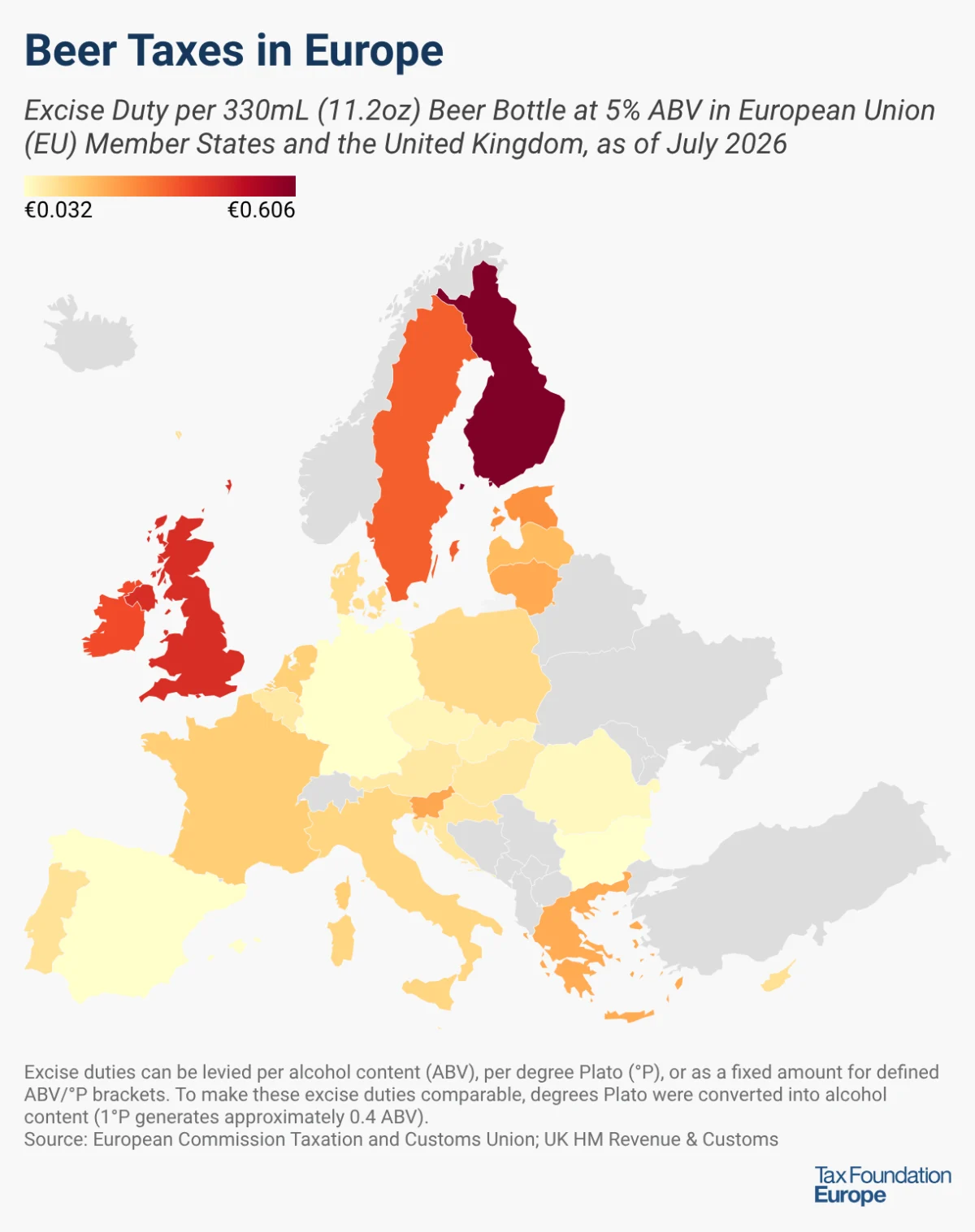
- The Beer-to-Wine Tax Gap: While countries like Ireland, Finland, and the Nordic nations maintain high, health-motivated excise duties on beer, several Southern and Central European nations maintain zero-rate excise policies for wine. This creates profound market distortions, shifting consumer demand based on tax-induced price differentials rather than pure market preference.
- The Degree Plato System: Unlike wine or spirits in many jurisdictions, beer in the EU is frequently taxed based on alcohol content—either by actual percentage of ABV or by degrees Plato (a measurement of the original gravity of the wort before fermentation). However, the rates applied per degree vary dramatically. For example, a degree Plato that incurs a nominal tax in Germany might face punitive rates in Scandinavian markets.
- Administrative Compliance Costs: As product lines expand, the burden of compliance falls heavily on small and medium-sized enterprises (SMEs). Craft brewers navigating multiple export markets must contend with varying definitions of what constitutes "beer," "malt beverage," or "low-alcohol specialty." The administrative overhead required to classify, report, and pay excise duties on hundreds of distinct stock-keeping units (SKUs) drains resources away from innovation and production.
Official Responses: Perspectives from Policymakers, Industry Leaders, and Economists
The debate over how to tax alcohol ahead of 2026 has drawn sharp commentary from various stakeholders across the European economic landscape.
Public Health Advocates
Public health organizations generally support high excise duties, arguing that taxation remains one of the most effective tools for reducing overall alcohol consumption and mitigating the societal costs associated with chronic disease, addiction, and healthcare burdens. However, health advocates have increasingly signaled support for movement toward a pure alcohol-content-based tax model. Their rationale is straightforward: if higher-strength products pose greater health risks, they should uniformly carry higher tax burdens, regardless of whether the alcohol is derived from fermented grapes, grain, or distilled spirits.
Industry Representatives and Craft Brewers
The brewing sector, particularly the craft segment, has voiced mounting frustration over administrative complexity and discriminatory rate structures. Major brewing conglomerates and independent craft associations alike argue that traditional excise structures penalize innovation.
An executive from a pan-European brewing federation noted: "When a small brewer creates an experimental brew with a unique malt bill or a slightly elevated ABV, they shouldn’t have to hire a legal team just to figure out which tax bracket the government is going to force them into. The system punishes creativity."
Economic Analysts and Tax Experts
Tax policy researchers emphasize the inefficiency of the status quo. According to analyses by fiscal think tanks, maintaining separate, siloed tax regimes for beer, wine, and spirits creates economic distortions that misallocate capital and resources. Economists argue that a modernized system based strictly on alcohol content would eliminate competitive distortions, streamline compliance, and enhance transparency for both consumers and tax administrators.
Implications: The Future of European Alcohol Markets Beyond 2026
The structural changes anticipated in 2026 and beyond carry profound implications for the European beverage industry, national treasuries, and consumers.
1. The Rise of Content-Based Neutrality
The most logical trajectory for European alcohol taxation is the gradual abandonment of clunky categorical boundaries in favor of a unified, ABV-based taxation model. By levying taxes strictly per unit of pure alcohol—similar to the framework adopted in the UK—governments can neutralize the artificial distinctions between beer, wine, spirits, and RTDs. Under such a system, a standard unit of alcohol would face the same base tax rate whether it is found in a pint of lager, a glass of table wine, or a spirit-based mixer.
2. Market Adaptation and Product Formulation
If tax systems shift toward uniform per-unit alcohol pricing, beverage manufacturers will adapt their product formulations accordingly. Brewers and producers may lean further into the burgeoning "no-and-low" alcohol sector, capitalizing on significantly lower tax rates to market sessionable, low-ABV beverages to health-conscious consumers. Conversely, high-strength specialty beers and craft ales could see further price inflation, forcing producers to compete more fiercely on quality and brand loyalty rather than sheer alcohol potency.
3. Administrative Simplification vs. Political Resistance
While the economic and administrative arguments for modernizing alcohol taxation are robust, the path to implementation is fraught with political hurdles. In wine-producing powerhouses like France, Italy, and Spain, any move to touch the traditional tax treatment of wine—let alone introduce comprehensive per-unit alcohol taxes that could raise wine prices—faces fierce domestic political opposition. Agricultural lobbies and cultural preservationists view traditional wine exemptions as non-negotiable.
Conclusion
As Europe navigates the complexities of the 2026 fiscal landscape, the archaic walls separating beer, wine, and spirits are crumbling under the weight of modern industrial innovation. Whether European governments possess the political will to dismantle these categorical barriers and replace them with a transparent, efficient, alcohol-content-based tax system remains to be seen. What is certain, however, is that maintaining the status quo will only render the continent’s tax administration increasingly costly, complex, and detached from economic reality.